Is Nuclear Energy Renewable? The Science, Fuel Cycle and Policy Definitions Explained
Is nuclear energy renewable? Learn why nuclear power is classified as low-carbon but non-renewable, exploring uranium reserves, fuel cycles, and policies.
By M. Khalif | Published 2026-11-18 | Updated 2026-11-18
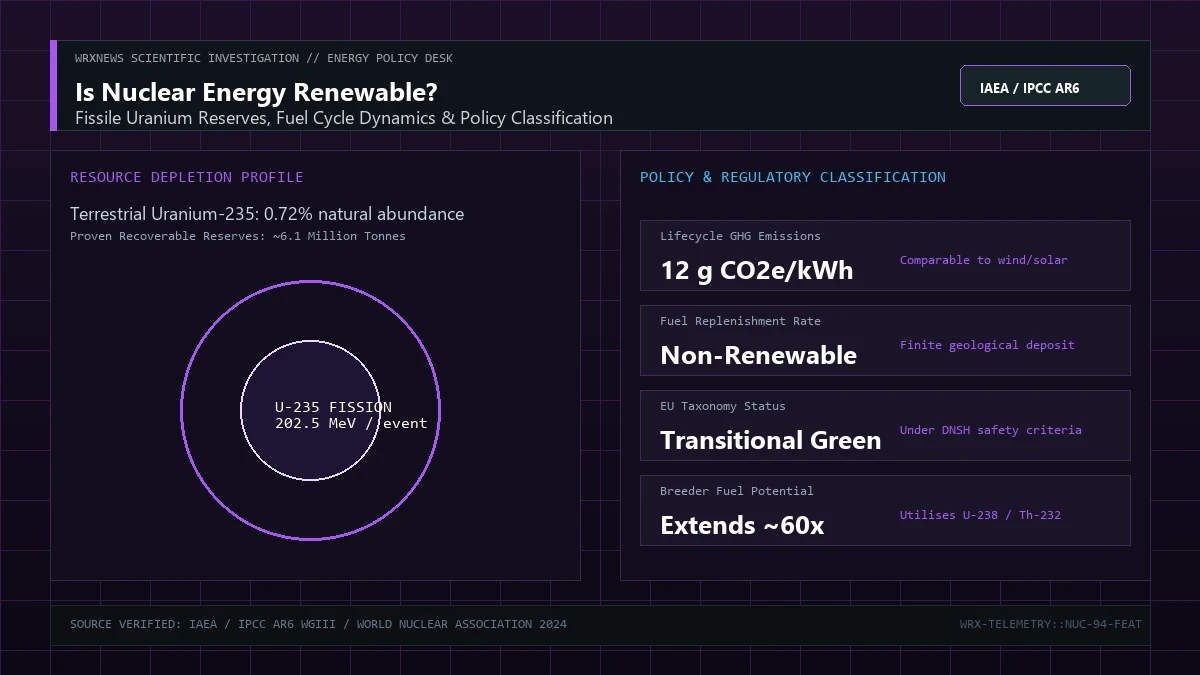
The short, scientific answer to whether nuclear energy is renewable is no: conventional nuclear fission is not a renewable energy source under standardized scientific, statutory, and thermodynamic definitions. A renewable energy resource is defined by natural replenishment at a rate equal to or faster than its human consumption—such as sunlight radiating perpetually from thermonuclear fusion in the core of the Sun, atmospheric wind currents created by planetary thermal gradients, or hydraulic flows sustained by the hydrological cycle. In contrast, commercial nuclear power relies on extracting, enriching, and consuming mined isotopes of uranium (principally Uranium-235), which is a finite terrestrial mineral formed in ancient supernovae and trapped within Earth's crust billions of years ago.
However, the debate persists because nuclear energy occupies a unique operational profile: it is a firm, dispatchable, and exceptionally low-carbon source of baseload electricity. In terms of lifecycle greenhouse gas emissions, nuclear generation produces approximately 12 grams of carbon dioxide equivalent per kilowatt-hour (g CO2e/kWh)—a figure on par with offshore wind and lower than rooftop solar photovoltaics. Because it produces negligible operational greenhouse gas emissions during generation, policymakers and financial frameworks frequently classify nuclear power alongside renewables under broader umbrellas like 'clean energy', 'zero-emission energy', or 'low-carbon transition energy', while maintaining distinct statutory definitions for the underlying fuel sources.
Why Nuclear Energy Is Classified as Low-Carbon but Not Renewable
To understand why nuclear energy is classified as low-carbon rather than renewable, one must examine the physical laws of resource replenishment. A renewable energy flow is self-renewing within human generational timescales. The Sun will radiate energy for approximately another five billion years; wind currents will circulate as long as atmospheric pressure differentials exist; and rivers will flow so long as ocean evaporation and rainfall continue.
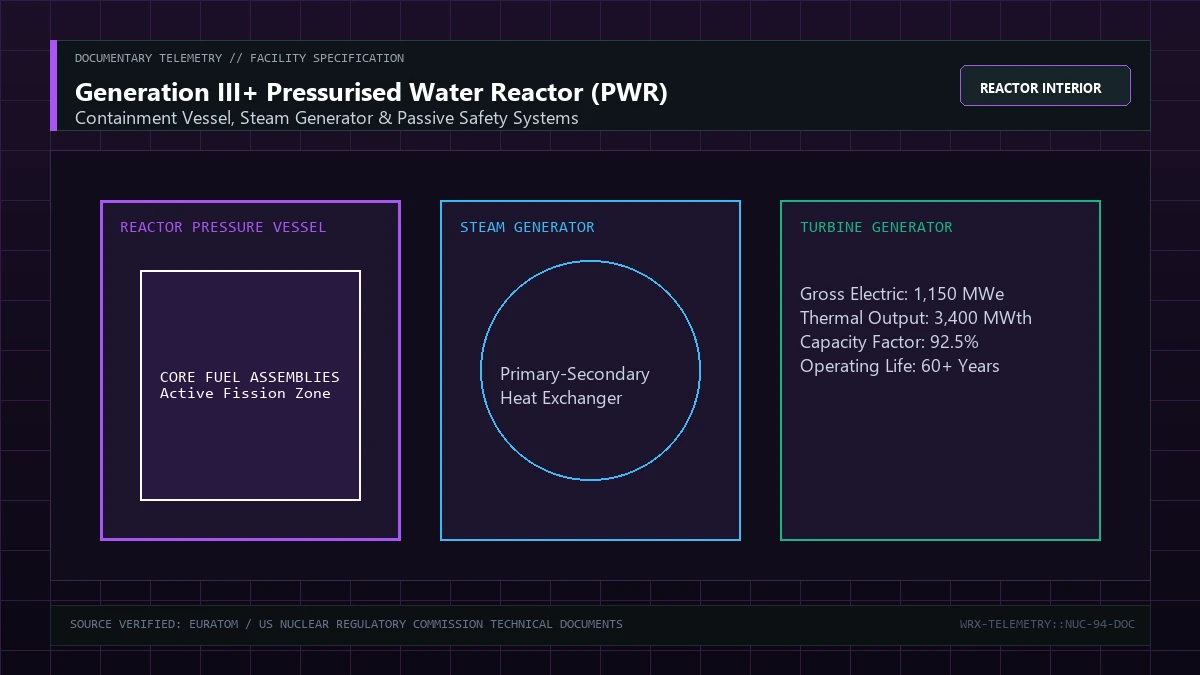
Commercial nuclear power, by contrast, operates by splitting fissile atomic nuclei—primarily Uranium-235 (U-235)—in a controlled chain reaction inside a reactor pressure vessel. When a thermal neutron strikes a U-235 nucleus, it splits into lighter fission fragments, releasing high-energy neutrons and approximately 202.5 million electron volts (MeV) of binding energy as thermal heat. That heat boils water into high-pressure steam to spin a synchronous turbine generator. Once a U-235 atom undergoes fission, it is permanently transformed into fission products; it does not regenerate through natural atmospheric or geological processes on any humanly relevant timescale.
Consequently, the International Energy Agency (IEA), the Intergovernmental Panel on Climate Change (IPCC), the U.S. Energy Information Administration (EIA), and the European Commission all classify nuclear fission as a non-renewable, low-carbon energy source. It shares the non-renewable classification with coal, petroleum, and natural gas because it depends on extracted geological minerals, but it shares the low-carbon operational profile of solar, wind, and geothermal energy.
The Science of Fissile Resources: Terrestrial Reserves and Consumption Rates
Natural uranium consists of two primary isotopes: Uranium-238 (which makes up roughly 99.27% of natural uranium ore) and Uranium-235 (which accounts for just 0.72%). Most commercial light-water reactors (LWRs)—which represent over 80% of operating reactors globally—can only sustain a fission chain reaction using the scarce U-235 isotope, requiring raw uranium ore to undergo complex isotopic enrichment up to concentrations between 3% and 5%.
According to the Joint Report by the OECD Nuclear Energy Agency (NEA) and the International Atomic Energy Agency (IAEA) ('The Red Book'), identified global conventional resources of uranium recoverable at costs below $130 per kilogram total approximately 6.1 million metric tonnes. At current global consumption rates of approximately 67,000 metric tonnes annually across roughly 440 commercial reactors, proven recoverable reserves represent an operational horizon of approximately 90 to 130 years using once-through fuel cycles.
While ongoing mineral exploration and improved extraction techniques consistently expand known reserves, the geological reality remains: uranium deposits in sandstone, unconformity-related formations, and quartz-pebble conglomerates are localized and finite. Extracting deeper or lower-grade deposits involves escalating financial and energy expenditures, reinforcing why the physical resource base cannot be termed infinite or naturally self-replenishing.
The Complete Nuclear Fuel Cycle: Front-End Mining to Geological Repositories
Evaluating the sustainability profile of nuclear energy requires auditing its complete cradle-to-grave fuel cycle. The cycle divides into front-end processing, reactor operation, and back-end waste stewardship:
1. Mining and Milling: Uranium ore is extracted through underground mining, open-pit operations, or in-situ recovery (ISR). In ISR, an oxygenated, alkaline or acidic leaching solution is pumped through permeable ore bodies to dissolve uranium into a liquid brine, which is processed into 'yellowcake' (U3O8 concentrate). 2. Conversion and Enrichment: Yellowcake is chemically converted into uranium hexafluoride gas (UF6). Because U-235 is only slightly lighter than U-238, thousands of high-speed gas centrifuges spin the UF6 at supersonic speeds to concentrate U-235 to 3–5% for commercial power generation. 3. Fuel Fabrication: The enriched UF6 is converted into ceramic uranium dioxide (UO2) powder, pressed into cylindrical pellets, baked at over 1,700°C, and stacked inside sealed zirconium-alloy fuel rods arranged into square fuel assemblies. 4. Reactor In-Core Residence: Fuel assemblies operate within the reactor core for 3 to 6 years, undergoing fission until the accumulation of neutron-absorbing fission products ('poisons') dampens reactivity. 5. Back-End Management and Deep Storage: Discharged spent fuel assemblies are intensely radioactive and thermally hot. They reside in wet cooling pools for 5 to 10 years before transfer to passively cooled dry storage casks fabricated of heavy steel and reinforced concrete. Long-term stewardship culminates in deep geological repositories—such as Finland's Onkalo repository—excavated into stable granite bedrock 400 to 500 meters underground.
This extensive industrial supply chain contrasts fundamentally with solar or wind installations, where the fuel (photons and kinetic air masses) requires zero mining, refining, or long-term radiation containment during operational life.
Lifecycle Greenhouse Gas Emissions: Nuclear vs Solar, Wind and Fossil Fuels
While nuclear energy is non-renewable, its climate mitigation value is undeniable. During reactor operation, nuclear fission emits zero direct carbon dioxide or criteria air pollutants (such as sulfur dioxide, nitrogen oxides, or particulate matter). Lifecycle greenhouse gas assessments conduct a comprehensive analysis encompassing mining, construction, concrete production, enrichment electricity, maintenance, decommissioning, and spent fuel management.
In its comprehensive Sixth Assessment Report (AR6), Working Group III of the IPCC evaluated hundreds of peer-reviewed lifecycle analyses and published median lifecycle emission factors:
• Coal (Pulverized): ~820 g CO2e/kWh • Natural Gas (Combined Cycle): ~490 g CO2e/kWh • Solar Photovoltaics (Utility-Scale): ~48 g CO2e/kWh • Solar Photovoltaics (Rooftop): ~41 g CO2e/kWh • Geothermal Energy: ~38 g CO2e/kWh • Nuclear Fission: ~12 g CO2e/kWh • Hydropower (Run-of-River): ~11 g CO2e/kWh • Offshore Wind: ~12 g CO2e/kWh • Onshore Wind: ~11 g CO2e/kWh
Nuclear power's lifecycle emissions are essentially identical to onshore and offshore wind, and significantly lower than crystalline silicon solar photovoltaics, which require energy-intensive quartz reduction in electric arc furnaces. For grid operators seeking continuous, high-capacity-factor generation to stabilize variable renewable inputs, nuclear power delivers deep decarbonization without atmospheric carbon pollution.
Advanced Fuel Cycles: Breeder Reactors, Thorium and Seawater Uranium
Proponents of reclassifying nuclear energy as quasi-renewable frequently cite advanced reactor concepts and alternative fuel sources that radically alter the resource depletion timeline:
Fast Breeder Reactors and Fuel Recycling: Conventional light-water reactors consume less than 1% of the potential energy stored in natural uranium. Fast-spectrum breeder reactors (FBRs) use high-energy, unmoderated neutrons to transmute fertile Uranium-238 into fissile Plutonium-239 at a rate faster than they consume fuel. By recycling spent fuel through PUREX or pyroprocessing into Mixed Oxide (MOX) fuel, fast breeder systems can extract up to 60 times more energy from the same quantity of mined uranium, extending the operational horizon of terrestrial reserves from decades to thousands of years.
Thorium-232 Fuel Cycles: Thorium is three to four times more abundant in Earth's crust than uranium. While thorium is fertile rather than fissile, placing Thorium-232 in a neutron flux converts it into Uranium-233, an outstanding nuclear fuel. Molten Salt Reactors (MSRs) operating on the thorium cycle produce substantially less long-lived transuranic waste.
Seawater Uranium Extraction: The world's oceans contain an estimated 4.5 billion metric tonnes of dissolved uranium in trace concentrations of approximately 3.3 parts per billion. Researchers at Oak Ridge National Laboratory and institutions in Japan and China have developed amidoxime-functionalized polymeric adsorbent braids capable of selectively capturing uranyl ions from ocean currents. Because marine uranium exists in dynamic chemical equilibrium with continental river runoff and ocean floor erosion, oceanic uranium extraction could theoretically supply nuclear fuel for millions of years, leading some physicists (notably Bernard Cohen) to argue that nuclear could be practically considered sustainable on astronomical timescales. However, commercial seawater extraction remains economically uncompetitive compared to terrestrial mining by a factor of 4 to 8 at current spot prices.
Policy and Legal Divergence: EU Taxonomy, US Standards and National Frameworks
Because the physics definition of 'renewable' differs from policy objectives for 'clean energy', national legal codes treat nuclear energy very differently across global jurisdictions:
European Union Taxonomy for Sustainable Finance: After intensive scientific debate and an expert assessment by the Joint Research Centre (JRC), the European Commission included nuclear energy within the EU Taxonomy Complementary Delegated Act in 2022. However, it classified nuclear under 'transitional' economic activities rather than purely renewable activities, mandating strict compliance with the 'Do No Significant Harm' (DNSH) principle, including proven operational plans for deep geological repositories by 2050, accident-tolerant fuels, and stringent safety criteria.
United States Renewable Portfolio Standards (RPS) vs Clean Energy Standards (CES): In the United States, individual state statutes govern clean energy requirements. Most state Renewable Portfolio Standards explicitly exclude nuclear power, reserving credits strictly for wind, solar, geothermal, and eligible biomass. Conversely, modern federal initiatives—such as the Inflation Reduction Act (IRA) Section 45U zero-emission nuclear power production credit—and states adopting broader Clean Energy Standards (CES) treat nuclear as an eligible zero-emission asset, subsidizing its operational preservation alongside wind and solar.
India and the Developing World: Under India's Ministry of Power and Central Electricity Authority frameworks, nuclear power is treated as a strategic national clean baseload asset, separate from the 500 GW non-fossil renewable capacity targets, which primarily track solar, wind, and hydro assets. In international climate negotiations (UNFCCC COP summits), nuclear generation is recognized under non-fossil pathways, but distinct from native renewable energy investments.
Frequently Asked Questions
Is nuclear energy considered green or clean energy?
Yes, nuclear energy is broadly recognized as 'clean' or 'zero-emission' because operating reactors emit zero direct greenhouse gases, sulfur dioxide, or particulate pollution. However, whether it is termed 'green' depends on regulatory frameworks, as some environmental standards exclude nuclear due to radioactive waste generation and mining impacts.
Why isn't nuclear energy renewable if it doesn't emit carbon?
Renewability is determined by resource replenishment rate, not greenhouse gas emissions. Cleanliness refers to environmental output (low emissions), while renewability refers to input sustainability. Because nuclear fission consumes finite, non-replenishing uranium ore, it cannot be classified as renewable.
Could nuclear energy ever become renewable in the future?
True nuclear fission will never be renewable in the strict geological sense because it destroys heavy atomic nuclei. However, if fast breeder reactors or economically viable seawater uranium extraction are deployed at scale, nuclear fuel availability could span thousands to millions of years, achieving functional sustainability.
What is the difference between nuclear fission and nuclear fusion?
Nuclear fission splits heavy atomic nuclei (such as Uranium-235) and produces long-lived radioactive fission products. Nuclear fusion fuses light atomic nuclei (such as Deuterium and Tritium isotopes of hydrogen) to release energy, producing non-toxic helium. While fusion fuels are virtually inexhaustible in ocean water, commercial fusion power is still under active scientific development.