Renewable Energy and Environmental Compliance in India: The MPCB Sawarghar Notice and the Green Infrastructure Dilemma
Examine the MPCB stop-work notice on the Sawarghar transmission corridor. Understand regulatory notices vs final findings and green infrastructure compliance.
By WRXNEWS Energy & Clean Tech Desk | Published | Updated
Executive Summary & Direct Answer
When the [Maharashtra Pollution Control Board](https://mpcb.gov.in/) (MPCB) issued an administrative stop-work notice regarding transmission and substation activities linked to Adani Renewable Energy One’s project at Sawarghar, it brought into sharp focus the complex tension at the heart of India's clean energy boom: the race to build high-voltage evacuation corridors versus the strict procedural enforcement of environmental clearances. This investigative analysis examines the statutory mechanisms governing India's green infrastructure, clarifying the vital legal distinction between an interim administrative notice and a final judicial finding of violation, while exploring how regulators are navigating the delicate balance between transition velocity and ecological due process.
The Intersection of Transition Velocity and Environmental Due Process
India's drive to install 500 gigawatts of non-fossil electricity capacity by 2030 has unleashed the largest electrical grid expansion in the nation's history. Thousands of circuit kilometers of high-voltage transmission lines, substations, and evacuation towers are being constructed across diverse terrains to carry clean electricity from rural generation parks to urban load centers.
However, as infrastructure buildouts accelerate, projects inevitably intersect with localized ecosystems, forested tracts, and community lands. In late 2026, this dynamic was highlighted when the Maharashtra Pollution Control Board (MPCB)—the statutory environmental regulator for the state of Maharashtra—issued an administrative stop-work notice concerning preliminary transmission and substation development activities associated with Adani Renewable Energy One at the Sawarghar site, located within the industrial and forest fringes of the Konkan-Western Ghats interface.
The incident triggered widespread debate across corporate boardrooms, regulatory bodies, and civil society. More importantly, it illuminated the critical regulatory mechanics that govern India’s energy transition—and the necessity of maintaining rigorous precision when reporting on environmental enforcement.
======================================================================================== THE STATUTORY ENVIRONMENTAL LIFECYCLE ======================================================================================== [STAGE 1: PLANNING] -> Topographical Survey & Right-of-Way (RoW) Alignment [STAGE 2: CLEARANCES] -> Forest Clearance (Stage I/II) & Wildlife Clearance (NBWL) [STAGE 3: CONSENTS] -> Consent to Establish (CTE) under Water/Air Acts [STAGE 4: MONITORING] -> Administrative Inspections & Interim Notices (Show-Cause) [STAGE 5: ADJUDICATION] -> Formal Hearing, Rectification or Judicial Tribunal (NGT) ========================================================================================
The Legal Crux: Regulatory Notice vs. Final Judicial Determination
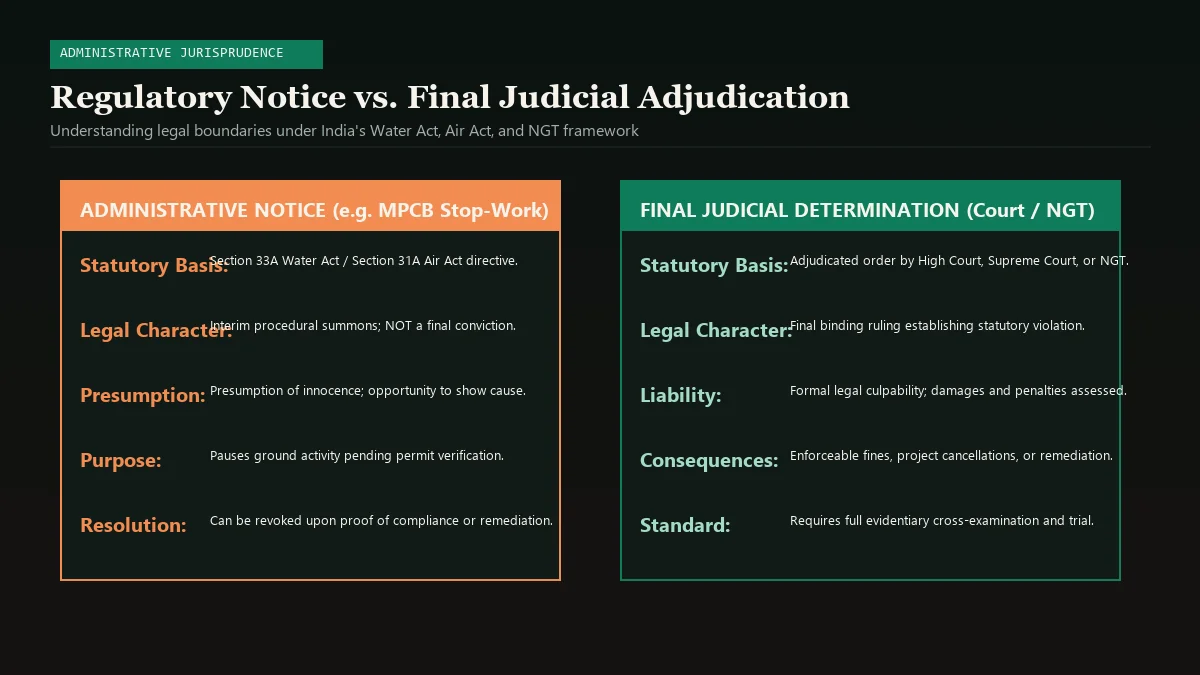
In financial and environmental journalism, administrative enforcement actions are frequently sensationalized. Headline reporting often conflates an interim regulatory directive with a final, legally binding finding of wrongdoing. In Indian jurisprudence and administrative law, this distinction is fundamental:
Under Section 33A of the Water (Prevention and Control of Pollution) Act, 1974, and Section 31A of the Air (Prevention and Control of Pollution) Act, 1981, state pollution control boards possess the statutory authority to issue administrative directions—including stop-work directives and show-cause notices. These are interim preventive measures, typically enacted when site inspections or citizen representations suggest that ground-disturbing work has begun prior to the finalization of specific documentation, or when boundary demarcation warrants formal review. An administrative notice is a procedural summons requiring the entity to halt specific activities, appear for a formal hearing, submit verified documentation, and provide compliance evidence.
An administrative notice is not a final conviction, a judicial verdict, or an irreversible determination of environmental criminality. It does not establish that irreversible ecological damage has been legally adjudicated, nor does it preclude the project proponent from demonstrating that full statutory approvals are in place, clarifying boundary coordinates, or completing required mitigating protocols.
- What an Administrative Regulatory Notice Is:
- What an Administrative Regulatory Notice Is Not:
In the case of the Sawarghar transmission corridor, the MPCB's action represented a classic invocation of administrative oversight: an interim directive to pause site clearing pending verification of local Consent to Establish (CTE) filings, muck-disposal plans, and alignment with demarcated forest buffer zones. The corporate developer is afforded full statutory due process to present its permissions, resolve administrative queries, or implement prescribed mitigation measures before any permanent legal order or penalty can be determined.
The Transmission Dilemma: Why Grid Corridors Face Friction
To understand why linear infrastructure projects like transmission corridors encounter regulatory hurdles, one must examine the physical realities of grid engineering.
Unlike centralized solar parks or wind farms, which are confined to a single, contiguous parcel of land, high-voltage transmission corridors are linear infrastructure that stretch across hundreds of kilometers. A single 400 kV or 765 kV transmission line must traverse an intricate mosaic of land tenures: privately owned agricultural plots, municipal right-of-ways, revenue wastelands, reserve forests, and ecologically sensitive catchment zones.
This creates compounding regulatory complexities:
- Forest Clearances and the Van Sanrakshan Act: Under the Van (Sanrakshan Evam Samvardhan) Adhiniyam (formerly the Forest Conservation Act, 1980), any diversion of recorded forest land for non-forest purposes—including stringing high-voltage conductors or laying concrete foundations for transmission towers—requires two-stage Central Government clearance. Stage-I approval requires compliance with dozens of in-principle conditions, including compensatory afforestation and net present value (NPV) payments, before Stage-II operational diversion is granted.
- Tree Felling and Canopy Loping Approvals: Even when a transmission corridor avoids core reserve forests, laying conductors often necessitates clearing a statutory Right-of-Way (RoW) width (up to 46 meters for a 400 kV line) to maintain safe electrical flashover clearances. Tree cutting within these RoW corridors requires separate municipal and district-level tree authority permissions. If tree clearing commences before local municipal tree officers issue formal felling tokens, local authorities can halt work immediately.
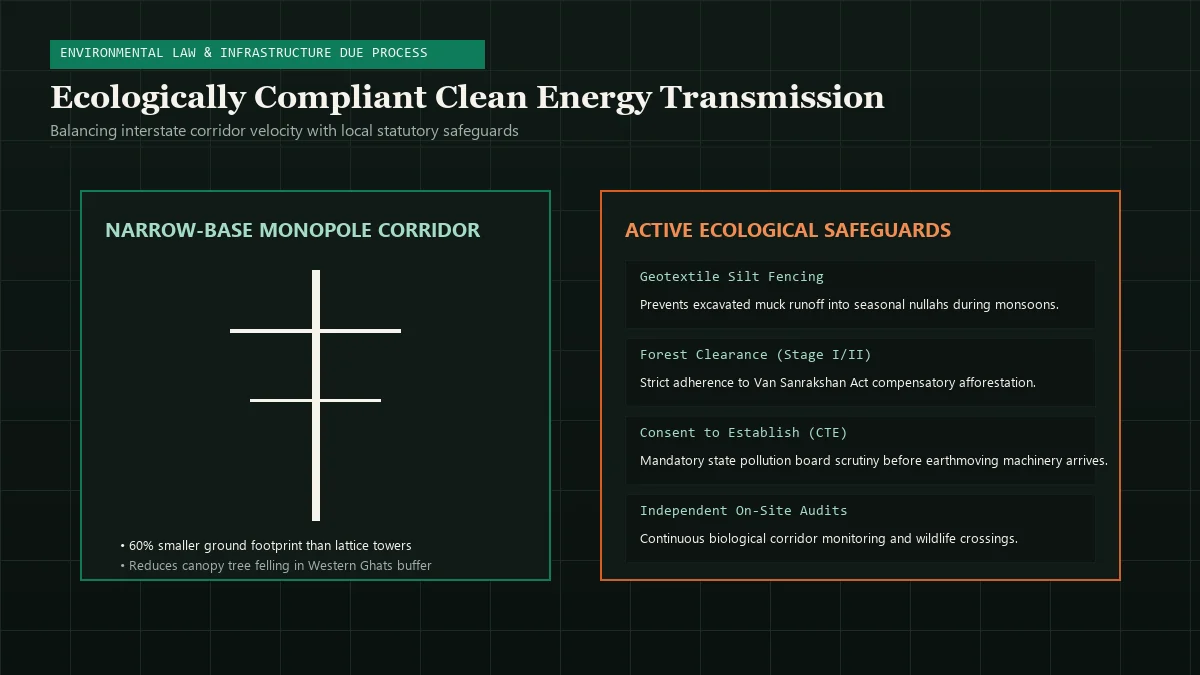
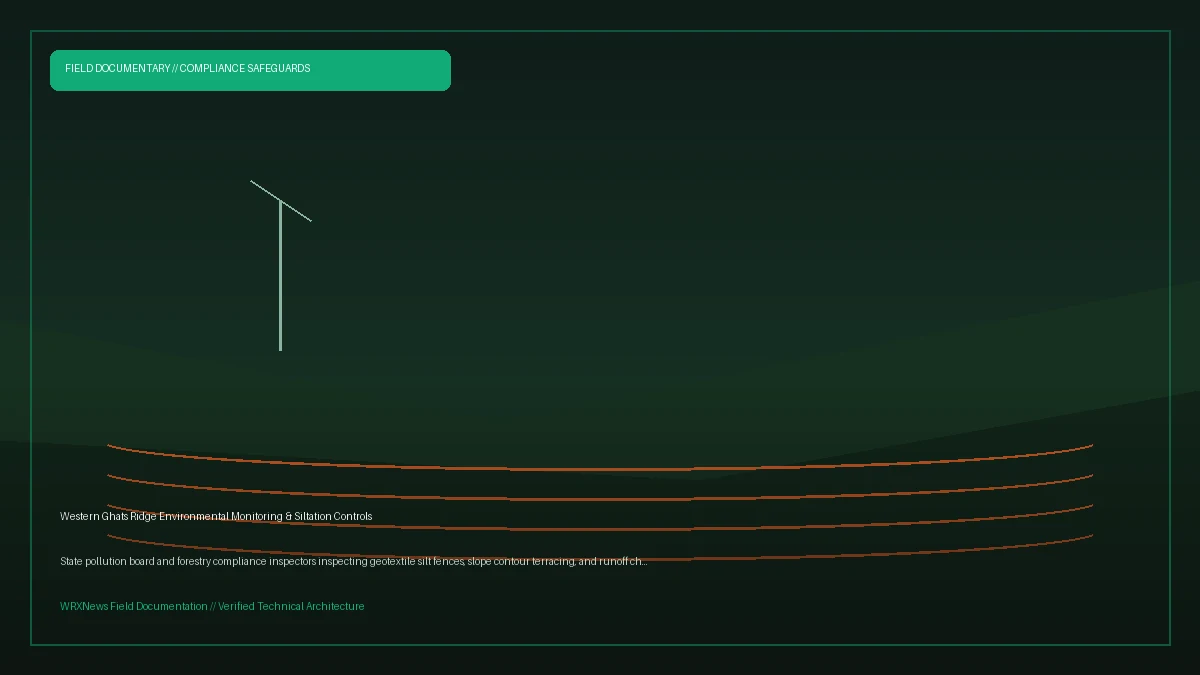
- Topographical Grading and Muck Disposal: In rugged, hilly terrain like Maharashtra's Konkan belt, leveling earth for substation switchyards involves extensive earth-cutting and filling. If excavated muck and debris are deposited near seasonal nullahs or drainage channels without retaining walls and siltation traps, local pollution control boards can cite the project for potential water pollution under the Water Act.
The Institutional Balancing Act: Speed vs. Compliance
The Sawarghar situation exemplifies a macro-level institutional challenge confronting the Ministry of Power, the Ministry of Environment, Forest and Climate Change (MoEFCC), and state administrations nationwide.
On one hand, India faces an existential climate mandate to evacuate dozens of gigawatts of stranded clean electricity from renewable generation zones to major urban hubs like Mumbai, Pune, and surrounding industrial belts. When transmission corridors suffer administrative delays of eighteen to thirty-six months, commissioned solar and wind parks are forced to curtail power, clean energy investors bleed capital, and urban utilities are forced to burn thermal coal to prevent blackouts.
On the other hand, the ecological integrity of regions like the Western Ghats—one of the world's eight "hottest hotspots" of biological diversity—cannot be subordinated to infrastructure speed. The Western Ghats regulate the monsoon patterns of the entire Indian peninsula, harbor thousands of endemic flora and fauna species, and support millions of downstream rural livelihoods. Bypassing forest clearance procedures or failing to control soil runoff during construction risks destabilizing fragile hill slopes, inducing landslides during extreme monsoonal downpours, and fragmenting sensitive wildlife migration corridors.
``` ======================================================================================== THE GREEN INFRASTRUCTURE EQUILIBRIUM ======================================================================================== [TRANSITION URGENCY] [ECOLOGICAL INTEGRITY]
\ / \ / [THE BALANCED SOLUTION] -> Pre-Tender Digital RoW Clearance -> Monopole Towers & Elevated Conductors -> Transparent Show-Cause Adjudication ======================================================================================== ```
- 500 GW Non-Fossil Mandate - Western Ghats Biodiversity Hotspot
- Preventing Renewable Curtailment - Monsoonal Landslide Risk Prevention
- Powering Heavy Urban Industries - Strict Compliance with Water/Air Acts
The Path Forward: Engineering Solutions and Regulatory Streamlining
Resolving the tension highlighted by the MPCB Sawarghar notice does not require weakening environmental regulations, nor does it require abandoning clean energy targets. Leading energy and environmental experts point to concrete administrative and engineering solutions:
- Pre-Construction Regulatory Readiness: Developers must ensure that all statutory approvals—including district tree authority tokens, Consent to Establish (CTE) certifications, and muck-disposal site approvals—are fully finalized and publicly uploaded before earthmoving machinery is mobilized to the site. Relying on "post-facto" regularization or concurrent processing invites stop-work orders that prove far more costly than upfront procedural diligence.
- Advanced Engineering to Minimize Footprints: Instead of traditional wide-base lattice towers that require extensive ground clearing, utilities are increasingly deploying narrow-base steel monopole towers in ecologically sensitive corridors. Monopoles reduce the required ground footprint by up to 60 percent. Furthermore, the use of insulated Cross-Linked Polyethylene (XLPE) underground cables or Gas-Insulated Substations (GIS) dramatically shrinks the land area required, preserving surface forest cover.
- Transparent Adjudication Platforms: State pollution control boards and regulatory tribunals must conduct show-cause hearings with speed and transparency. When a notice is issued, technical compliance teams should be dispatched within days to inspect remediation measures, enabling compliant projects to resume swiftly while penalizing genuine violations.
India’s green transition cannot afford to sacrifice environmental governance on the altar of rapid execution. The true strength of a democracy's sustainability framework lies in its ability to build clean infrastructure while honoring statutory checks, balances, and ecological accountability.
---
Frequently Asked Questions
What is the statutory role of the Maharashtra Pollution Control Board (MPCB)?
The MPCB is the statutory regulatory body responsible for implementing and enforcing environmental legislation in the state of Maharashtra, primarily the Water (Prevention and Control of Pollution) Act, 1974, the Air (Prevention and Control of Pollution) Act, 1981, and the Environment (Protection) Act, 1986. It monitors industrial emissions, issues Consents to Establish and Operate, and investigates compliance violations.
What is a "Consent to Establish" (CTE) and why is it required for power substations?
A Consent to Establish (CTE) is an initial statutory permit issued by a state pollution control board under the Air and Water Acts before any construction or physical development activity can begin on an industrial or infrastructure site. It ensures that the proposed facility has adequate pollution-control systems, effluent treatment, and waste-disposal plans built into its engineering designs.
Does a stop-work notice permanently cancel an infrastructure project?
No. An administrative stop-work notice is an interim preventive measure. It directs the project proponent to suspend on-site construction activities immediately while a specific compliance query, permit verification, or remediation measure is reviewed. If the developer presents valid statutory documentation, corrects non-compliant practices, or satisfies the board's conditions during a show-cause hearing, the board can revoke the notice and allow work to resume.
Are renewable energy projects exempt from environmental laws in India?
While solar photovoltaic and wind power generation plants are often classified in the "White Category" (non-polluting) by pollution control boards and are generally exempt from formal Environmental Impact Assessments (EIAs), associated infrastructure—such as massive electrical substations, access roads, and transmission lines traversing forest lands—remains strictly subject to the Forest Conservation Act, municipal tree laws, and applicable provisions of the Water and Air Acts.