Renewable Energy Solutions: Choosing Practical Clean Energy Approaches for Homes, Businesses and Grids
Compare renewable energy solutions across residential, commercial, municipal, and remote applications with decision matrices on cost, land, tariffs, and reliability.
By WRXNEWS Energy & Clean Tech Desk | Published 2026-11-18 | Updated 2026-11-18
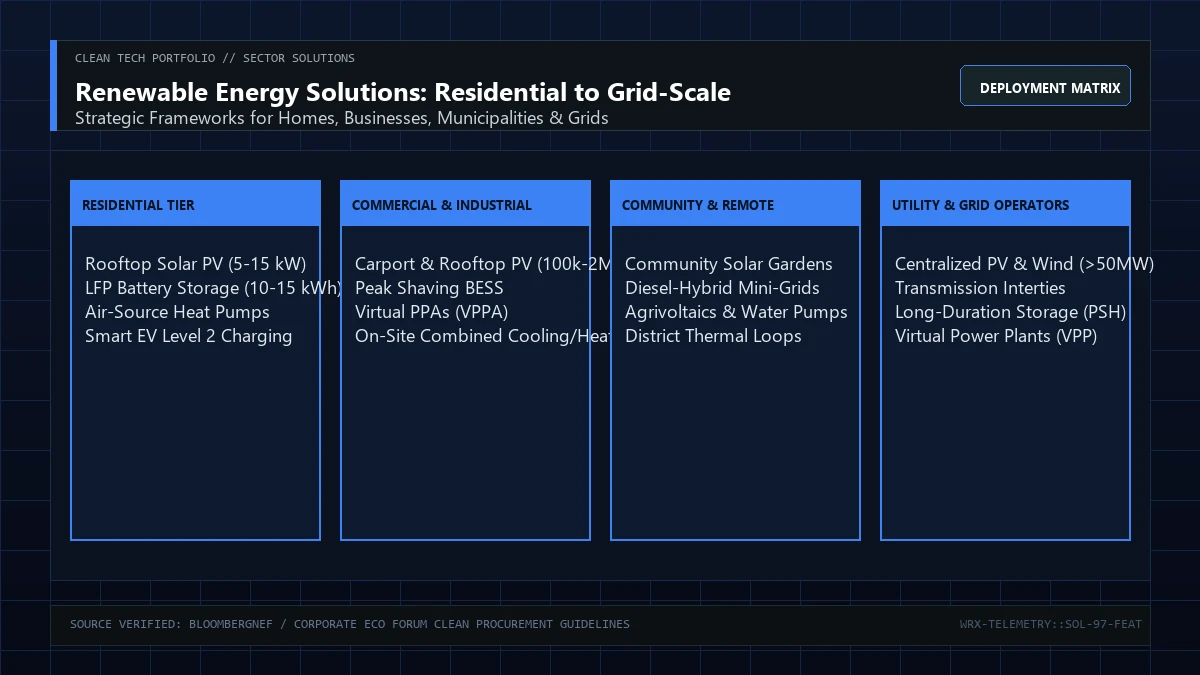
The phrase 'renewable energy solutions' is often treated as a marketing buzzword, but in practice, it represents a concrete decision-making challenge: selecting the precise combination of generation, storage, electrification, and contractual models that best matches a specific organization's load profile, geographic resource quality, financial constraints, and regulatory environment. A solution that yields a 4-year payback for a commercial refrigerated warehouse in California could prove economically unviable for an apartment renter in London or a rural agro-processing cooperative in Gujarat.
Successful clean energy transitions avoid universal, dogmatic prescriptions. Instead, they evaluate options systematically across operational scales—residential homeowners, commercial and industrial enterprises, municipal communities, remote off-grid operators, and electric utilities. By analyzing structural space, tariff designs, capital models, and resilience requirements, decision-makers can select renewable energy solutions that deliver measurable financial returns while eliminating fossil carbon dependency.
Sector-by-Sector Evaluation: Matching Solutions to Operational Needs
Renewable energy solutions divide into four distinct implementation tiers:
1. Residential Homeowners: The core residential package integrates rooftop solar photovoltaics (5 kW to 12 kW), an air-source heat pump replacing fossil gas heating, a smart Level 2 electric vehicle charger, and an optional 10–15 kWh battery. For homeowners with shaded or older roofs, community solar subscriptions offer an alternative pathway without on-site construction.
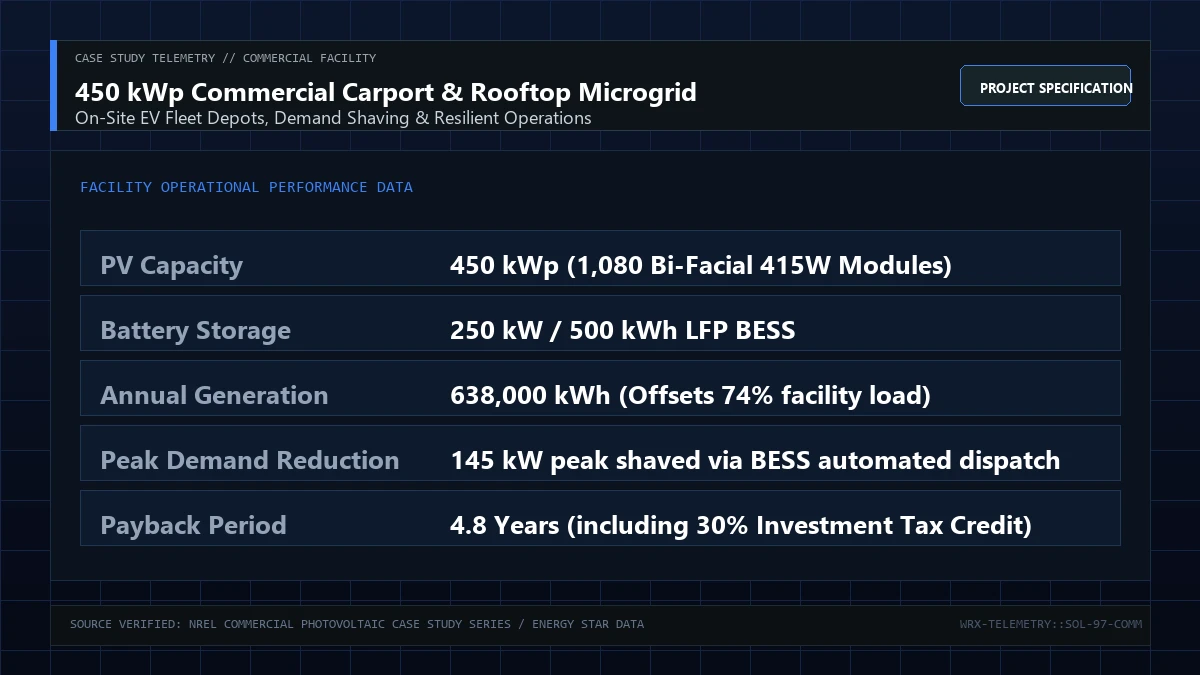
2. Commercial & Industrial (C&I): Factories, logistics hubs, data centers, and corporate office parks face high electrical demand and punitive 'demand charges' based on peak 15-minute usage. C&I solutions include behind-the-meter rooftop and parking carport solar (100 kW to 2 MW), paired with peak-shaving batteries that discharge automatically during facility demand spikes. Off-site options include Power Purchase Agreements (PPAs) or Virtual PPAs (VPPAs) with utility-scale clean developers.
3. Municipalities & Communities: Cities and local governments deploy district heating loops powered by municipal waste heat or geothermal aquifers, install rooftop arrays across public schools and administrative buildings, transition municipal transit fleets to electric buses paired with solar-powered charging depots, and establish local microgrids to preserve power at water treatment plants and emergency shelters during disasters.
4. Remote, Rural & Island Microgrids: Communities isolated from high-voltage transmission grids historically relied on expensive diesel generators (electricity costs often exceeding $0.40 to $0.80 per kWh due to fuel transport). Modern microgrid solutions deploy solar PV paired with battery storage and smart microgrid controllers, with existing diesel units relegated strictly to emergency backup, reducing fuel consumption by 60% to 90%.
The 5-Step Project Feasibility Checklist Before Procurement
Before signing Engineering, Procurement, and Construction (EPC) contracts or entering long-term leases, decision-makers must evaluate five technical feasibility filters:
1. Space and Structural Integrity Audit: For rooftop solar, inspect remaining roof membrane life (>15 years required; re-roofing prior to solar avoids double labor costs) and structural load-bearing capacity (residential roofs typically support 15–20 kg/m² for ballasted or mechanically attached racking). For ground arrays, verify zoning, topography, and soil geotechnical stability.
2. Hourly Consumption and Load-Match Analysis: Obtain interval meter data (8,760 hours of annual electricity use). Compare peak consumption hours against local solar generation profiles. High daytime consumption (such as air conditioning or commercial manufacturing) allows high direct self-consumption without needing battery storage.
3. Tariff Structure and Net Metering Policy: The financial viability of on-site renewables depends heavily on local utility compensation rules. Full 1:1 net energy metering provides rapid payback; time-of-use (TOU) rates with low wholesale export compensation mandate installing battery storage to store power for high-rate evening hours.
4. Financing and Capital Model: Evaluate Cash Purchase (highest 20-year ROI and tax equity retention) vs Low-Interest Clean Energy Loans vs Third-Party Power Purchase Agreements (PPAs) or Solar Leases (zero upfront capital; operational maintenance assumed by third party).
5. Resilience and Islanding Requirements: If emergency backup power is required, ensure the inverter architecture includes an automated transfer switch (ATS) and microgrid controller capable of disconnecting from the utility grid during blackouts.
Commercial Procurement: On-Site Assets vs Off-Site PPAs vs RECs
Corporate and institutional energy buyers must navigate three distinct procurement pathways:
• On-Site Capital Assets: Solar carports and rooftop installations provide physical energy hedge and visible sustainability leadership on corporate properties, offsetting retail electricity rates directly. • Corporate Power Purchase Agreements (PPAs): An off-site contract where a corporate buyer contracts directly with an independent power producer (IPP) to purchase renewable electricity and bundled Renewable Energy Certificates (RECs) from a designated new-build solar or wind farm, typically for a 10- to 15-year fixed term. Physical PPAs deliver power into the corporate buyer's local balancing authority; Virtual PPAs (VPPAs) operate as a financial contract-for-differences, enabling buyers with fragmented, multi-state footprints to offset global energy consumption. • Unbundled Renewable Energy Certificates (RECs): Purchasing environmental attribute certificates separate from physical electricity. While low in cost and administrative friction, unbundled RECs face increasing scrutiny for failing to prove 'additionality'—meaning they do not necessarily drive the construction of new clean energy assets.
Common Pitfalls and How to Avoid Them
Clean energy project failures typically stem from predictable planning oversights:
• Over-Sizing Without Storage: Sizing a solar array to offset 100% of annual electricity demand under non-favorable net billing rules leads to massive midday power export at wholesale rates, dragging down project ROI. • Ignoring Utility Interconnection Queue Times: In many utility jurisdictions, engineering interconnection studies and transformer upgrades take 6 to 24 months, stalling fully constructed facilities. • Omitting Operation and Maintenance (O&M) Budgets: Modules accumulate dust and soiling in arid regions, reducing annual output by 8% to 25% without regular cleaning. Inverters typically require component replacement or refurbishment at years 10 to 15, which must be accounted for in 25-year financial models.
Frequently Asked Questions
What is the best renewable energy solution for a small business?
For businesses that own their building, rooftop or carport solar PV paired with a smart peak-shaving battery is typically the best solution, as it directly offsets expensive commercial electricity rates and reduces demand charges. For businesses leasing premises, green power utility tariffs or community solar subscriptions provide clean power without on-site capital expenditure.
What is the difference between a PPA and buying solar panels directly?
Buying solar panels directly requires upfront capital (or a loan) and makes you responsible for maintenance, but yields the highest long-term financial returns and federal tax incentives. Under a Power Purchase Agreement (PPA), a third-party developer finances, owns, and maintains the system, and you simply purchase the generated electricity at a predetermined, lower per-kWh rate.
How do remote island microgrids operate with renewable solutions?
Remote microgrids combine solar PV arrays, wind turbines, and large battery energy storage systems (BESS) orchestrated by an automated microgrid controller. Existing diesel generators are kept in reserve, running only during extended cloud cover or emergencies, cutting expensive diesel fuel consumption by 60% to 90%.
What is additionality in renewable energy procurement?
Additionality means that your financial investment directly caused a new renewable energy project to be built that would not have existed otherwise. Long-term corporate PPAs demonstrate strong additionality, whereas purchasing unbundled legacy RECs often does not.