Renewable Energy Storage: Batteries, Pumped Hydro, Thermal and Grid-Balancing Systems
Compare renewable energy storage technologies by duration, efficiency, and cost: lithium-ion batteries, pumped hydro, flow batteries, and thermal systems.
By WRXNEWS Energy & Clean Tech Desk | Published 2026-11-18 | Updated 2026-11-18
Renewable energy storage is the linchpin of modern clean power grids. Wind and solar photovoltaics generate electricity according to meteorological conditions rather than consumer demand schedules. When the sun sets or wind speeds drop, electricity demand must be met without interruption; conversely, during peak afternoon sunlight or nocturnal wind gusts, generation can exceed transmission capacity, leading to costly renewable curtailment. Energy storage decouples the moment of electricity generation from the moment of consumption, shifting zero-carbon kilowatt-hours across minutes, hours, days, or seasons.
However, there is no single universal storage technology suited for every operational challenge. Matching the appropriate storage solution requires distinguishing between power capacity (measured in megawatts, MW) and energy capacity (measured in megawatt-hours, MWh), alongside evaluating round-trip efficiency, degradation rates, capital cost, and safety. From millisecond-response frequency regulation to multi-day seasonal balancing, modern power engineers deploy a portfolio of mechanical, electrochemical, thermal, and chemical storage systems to build a reliable 24/7 clean energy grid.
Understanding Core Storage Metrics: Power, Energy Capacity and Efficiency
Evaluating any energy storage system requires mastering four fundamental engineering parameters:
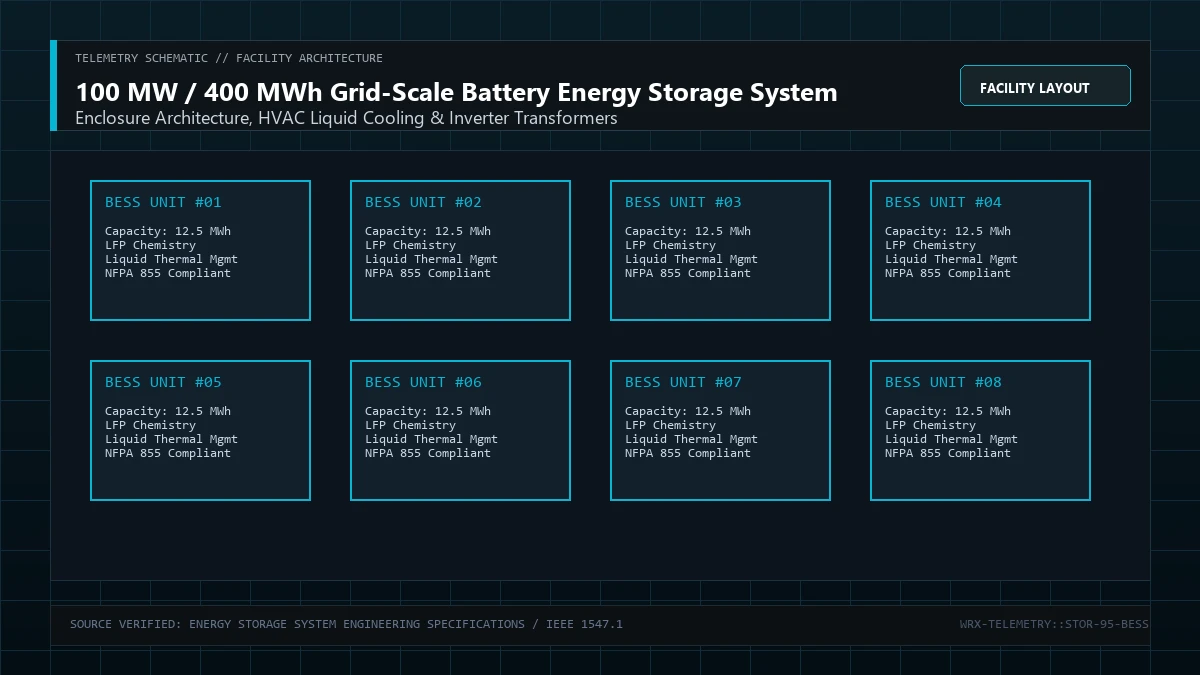
1. Rated Power (MW or kW): The maximum instantaneous rate at which the system can charge or discharge electricity. Power rating determines how much load the system can support at any given moment. 2. Energy Capacity (MWh or kWh): The total quantity of stored electricity the system can deliver before becoming fully discharged. Sizing energy capacity determines how long the system can sustain its discharge. 3. Discharge Duration (Hours): The ratio of energy capacity to rated power (Duration = MWh / MW). A 100 MW battery with 400 MWh of storage capacity has a 4-hour duration. 4. Round-Trip Efficiency (RTE, %): The percentage of electricity retrieved from the storage system divided by the electricity injected during charging. If a system consumes 100 MWh to charge and delivers 85 MWh back to the grid, its round-trip efficiency is 85%, with the remaining 15% dissipated as thermal losses in transformers, chemical resistance, and auxiliary cooling.
Additional criteria include cycle life (number of full charge-discharge cycles before capacity drops below 80% of nominal rating), calendar degradation, and the Levelized Cost of Storage (LCOS), which calculates the net present cost of discharging one megawatt-hour over the facility's economic life.
The Storage Duration Spectrum: Sub-Second to Multi-Day Grid Balancing
Power grids require flexibility across vastly different time domains:
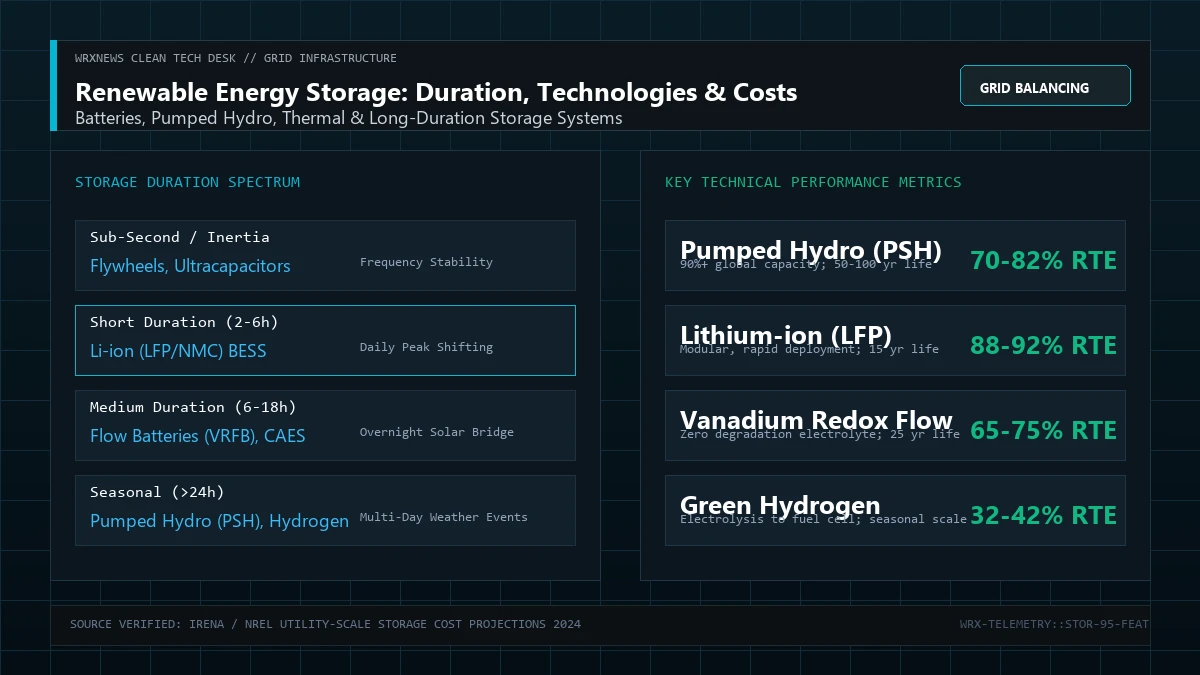
• Sub-Second to Minutes (Frequency Regulation & Synthetic Inertia): When heavy industrial motors turn on or power plants trip offline, grid frequency deviates from nominal 50 Hz or 60 Hz. Flywheels, supercapacitors, and high-rate battery inverters inject instantaneous active power within 20 to 100 milliseconds to arrest frequency drop before traditional generators can ramp. • Short-Duration (2 to 6 Hours): The classic daily solar cycle creates an evening 'duck curve' demand peak when residential lighting, cooking, and electronics surge just as solar output disappears. Four-hour lithium-ion batteries dominate this segment, soaking up midday solar clipping and discharging during peak revenue hours between 17:00 and 21:00. • Medium-Duration (6 to 18 Hours): To bridge continuous overnight demand or periods of daytime cloud cover, grid operators deploy long-duration battery systems, including Vanadium Redox Flow Batteries (VRFB), sodium-ion, and Compressed Air Energy Storage (CAES). • Long-Duration and Seasonal (>24 Hours to Weeks): Seasonal weather variations—such as winter wind lulls ('Dunkelflaute') across Northern Europe or monsoonal reductions in solar irradiance across Asia—require massive volumetric storage. Pumped Storage Hydropower (PSH) and green hydrogen underground cavern storage are the primary options capable of storing terawatt-hours of energy economically over weeks and months.
Comparing the Four Major Storage Pathways
Modern storage technologies divide into four physical domains:
1. Electrochemical Batteries (Lithium Iron Phosphate & Flow Systems): Lithium Iron Phosphate (LFP) chemistry has superseded NMC (Nickel Manganese Cobalt) in stationary utility storage due to superior thermal stability, zero cobalt dependency, lower cost ($180–$250/kWh at system level), and cycle lives exceeding 6,000 cycles. For durations exceeding 8 hours, Vanadium Redox Flow Batteries (VRFB) offer distinct advantages: they store energy in aqueous liquid electrolyte tanks that experience zero degradation over 25+ years, and energy capacity can be expanded simply by building larger fluid tanks. 2. Mechanical Storage (Pumped Hydro & CAES): Pumped Storage Hydropower (PSH) remains the titan of grid storage, accounting for over 90% of global operational energy storage capacity. Water is pumped from a lower reservoir to an upper reservoir during low-cost surplus hours, then released through reversible Francis pump-turbines during peak demand, achieving 70–82% round-trip efficiency over 50- to 100-year operational lifetimes. Compressed Air Energy Storage (CAES) compresses ambient air into underground salt caverns up to 70 bar, expanding the air through turbines when dispatched. 3. Thermal Energy Storage (Molten Salt & Sand Batteries): Concentrated Solar Power (CSP) facilities use binary molten nitrate salts (60% NaNO3 / 40% KNO3) heated to 565°C to store thermal energy for 10 to 15 hours, driving steam turbines after dark. Industrial sand batteries and rock-bed thermal storage store excess renewable power as heat up to 600°C for district heating networks. 4. Chemical Storage (Green Hydrogen & Synthetic Fuels): Electrolysers split water into hydrogen using excess renewable power. The hydrogen is stored in salt caverns or pressurized vessels, and later combusted in modified combined-cycle gas turbines or converted via fuel cells. While round-trip efficiency is relatively low (32–42% power-to-gas-to-power), hydrogen is practically unmatched for seasonal, gigawatt-scale storage.
Economic Realities: Levelized Cost of Storage (LCOS) and Safety Standards
A frequent mistake is comparing storage technologies solely on upfront capital expenditure ($/kWh of capacity). Levelized Cost of Storage (LCOS) provides the true economic benchmark by accounting for Capex, ongoing Opex, parasitic cooling loads, round-trip efficiency losses, replacement cycles, and salvage value:
$\text{LCOS} = \frac{\text{Initial Capital} + \sum_{t=1}^{N} \frac{\text{Opex}_t + \text{Charging Electricity}_t}{(1+r)^t}}{\sum_{t=1}^{N} \frac{\text{Electricity Delivered}_t}{(1+r)^t}}$
Because round-trip efficiency dictates charging power losses, a battery with 90% RTE requires purchasing only 1.11 kWh of wholesale power to deliver 1.0 kWh, whereas a 40% efficient hydrogen cycle requires purchasing 2.50 kWh of power to deliver that same 1.0 kWh. Consequently, battery systems hold a decisive economic advantage for daily cycling.
Safety engineering is equally paramount. The energy storage sector adheres strictly to NFPA 855 (Standard for the Installation of Stationary Energy Storage Systems) and UL 9540A thermal runaway testing. Modern utility BESS installations utilize multi-tier safety architectures: cell-level ceramic separators, module-level aerosol fire suppression, and liquid-glycol cooling plates that maintain cell temperature uniformity within ±2°C, preventing thermal runaway propagation.
Does Every Renewable Installation Require Dedicated Storage?
A common misconception is that every wind farm or rooftop solar system must have an accompanying battery to function. In reality, modern power systems employ multiple non-storage flexibility mechanisms that are often more cost-effective:
• Geographical Grid Diversity: Interconnecting geographically diverse solar and wind regions via high-voltage AC and HVDC transmission lines smooths local weather variations. When clouds cover one region, adjacent sunny regions feed the grid. • Demand-Side Flexibility: Shifting flexible electrical loads—such as municipal water pumping, electric vehicle smart charging, industrial cold storage, and heat pump water preheating—to midday hours absorbs surplus solar generation directly without round-trip storage losses. • Thermal Inertia and Flexible Peakers: Existing hydroelectric reservoirs, dispatchable biomass plants, and fast-start open-cycle turbines provide ramping capacity without requiring new battery capex during early stages of renewable grid penetration (below 30–40% annual energy share).
Dedicated storage becomes mandatory primarily when variable renewable generation regularly exceeds transmission capacity or when local grid codes mandate capacity firming and evening peak delivery.
Frequently Asked Questions
What is the most widely used form of renewable energy storage today?
Pumped Storage Hydropower (PSH) is by far the most widely used form of energy storage, accounting for over 90% of all operational utility storage capacity worldwide. It stores energy by pumping water uphill between two reservoirs and releasing it through hydro turbines during peak demand.
How efficient are lithium-ion grid batteries compared to hydrogen storage?
Lithium-ion battery energy storage systems (BESS) achieve 88% to 92% round-trip efficiency, meaning only 8–12% of electricity is lost during charging and discharging. In contrast, complete green hydrogen cycles (power-to-gas-to-power via electrolysis and fuel cells) achieve approximately 32% to 42% round-trip efficiency.
How long do commercial grid-scale batteries last before replacement?
Modern Lithium Iron Phosphate (LFP) grid-scale batteries typically last between 12 and 18 years, delivering 4,000 to 8,000 full daily charge-discharge cycles before capacity degrades to 80% of original nameplate rating.
Can renewable energy grids operate reliably without fossil fuel backup?
Yes. By combining geographically diverse wind and solar, smart demand response, interregional high-voltage transmission, and a balanced portfolio of short-duration (batteries) and long-duration (pumped hydro, clean fuels) storage, modern grids can achieve 24/7 reliability without fossil generation.