Renewable Energy Systems: Types, Core Components and How They Work Together
An engineering-grade guide to renewable energy systems: generation assets, power conversion, grid synchronisation, SCADA controls, and system integration.
By WRXNEWS Energy & Clean Tech Desk | Published 2026-11-18 | Updated 2026-11-18
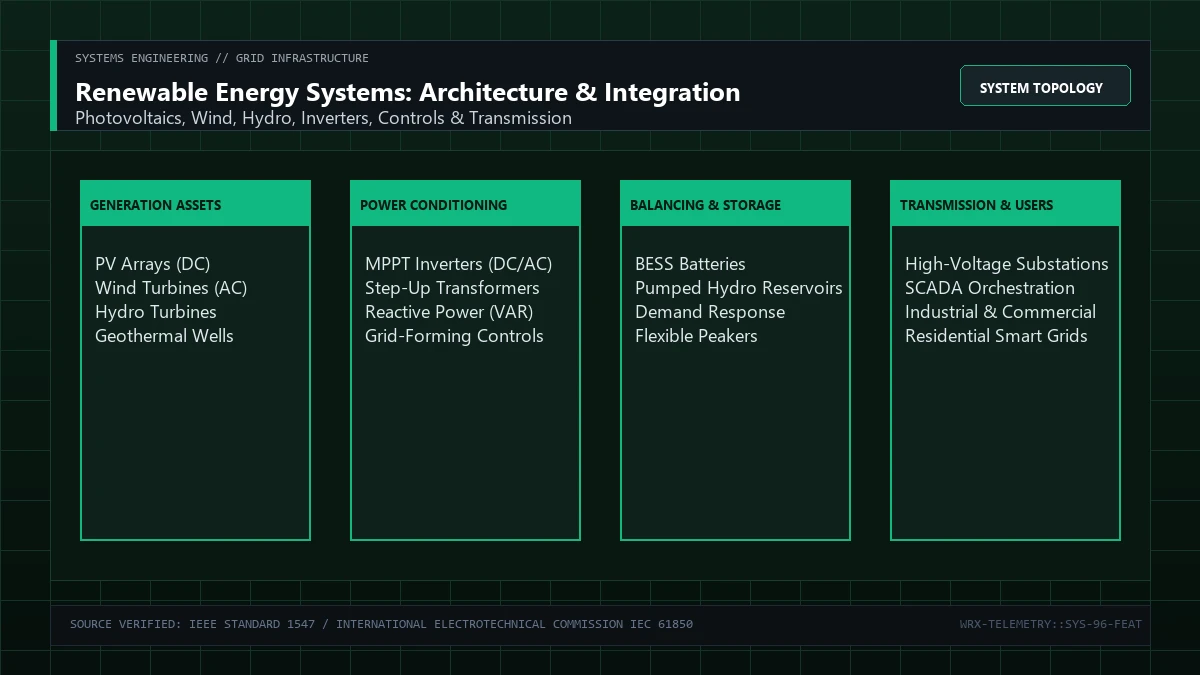
A renewable energy system is not merely an isolated piece of generation equipment like a solar panel or a wind turbine. In rigorous electrical engineering terms, a renewable energy system is an integrated technical infrastructure that captures naturally replenishing kinetic, photonic, hydraulic, or thermodynamic energy flows, conditions that power into synchronized electrical alternating current, balances energy flows across variable weather patterns, and safely delivers regulated electricity to end-users or the high-voltage transmission grid.
Building an effective renewable energy system requires harmonizing five distinct subsystems: primary energy conversion assets, power electronic converters and conditioning equipment, balance-of-plant electrical safety systems, digital supervisory control and data acquisition (SCADA) networks, and the grid interconnection interface. Understanding how these components interact is critical for engineers, facility managers, and policymakers transitioning from centralized fossil fuel thermal plants to distributed, inverter-based clean power architectures.
The Five Essential Subsystems of Modern Renewable Architecture
Every commercial renewable energy system comprises five core technical layers:
1. Primary Generation Assets: The physical transducers that capture environmental energy flows: • Photovoltaic modules: Convert photons into direct current (DC) electricity via solid-state semiconductor junctions. • Wind turbine nacelles and rotors: Transform aerodynamic lift into rotational torque, spinning asynchronous or permanent-magnet synchronous generators to produce variable-frequency AC. • Hydroelectric turbines: Use Francis, Pelton, or Kaplan turbines to convert the potential energy of elevated water into rotational mechanical power. • Geothermal enthalpy exchangers: Extract high-pressure geothermal brine or dry steam to spin thermal turbines before re-injecting the cooled fluid into deep subsurface aquifers.
2. Power Electronics and Conditioning: Raw electricity from renewable sources is rarely grid-compatible. Solar arrays generate variable DC; wind turbines produce fluctuating variable-frequency AC. Solid-state power electronics—including DC-DC boost converters, Maximum Power Point Trackers (MPPT), and four-quadrant Inverters utilizing Insulated Gate Bipolar Transistors (IGBTs) or Silicon Carbide (SiC) MOSFETs—synthesize pure sinusoidal AC at precise grid frequencies (50 Hz or 60 Hz).
3. Balance of Plant (BOP): The structural and electrical framework supporting the generation assets. This includes galvanized steel mounting racks, single-axis solar trackers, underground medium-voltage (33 kV) collector cabling, switchgear, vacuum circuit breakers, and comprehensive grounding networks.
4. Digital Control, SCADA and Energy Management Systems (EMS): Distributed energy systems rely on high-speed industrial Ethernet and fiber-optic communication protocols (such as IEC 61850). The Energy Management System monitors meteorological telemetry, optimizes dispatch along wholesale price curves, and executes automated curtailment or battery charging commands.
5. Grid Interconnection and Substation Tier: The Point of Common Coupling (PCC) where the renewable system interfaces with the utility distribution or transmission network. Step-up transformers elevate voltage (e.g., from 33 kV collector voltage to 132 kV, 220 kV, or 400 kV transmission levels), equipped with protective relaying to isolate faults within milliseconds.
Grid Integration: Grid-Following vs Grid-Forming Power Electronics
As renewable energy penetration approaches 70% to 100% on regional grids, the fundamental nature of grid stability changes. Traditional power plants used multi-ton spinning steel rotors in synchronous generators, which inherently provided 'physical rotational inertia' that resisted sudden changes in grid frequency.
Early renewable installations used Grid-Following (GFL) inverters. A GFL inverter relies on a Phase-Locked Loop (PLL) to track the external voltage sine wave established by conventional power plants, acting essentially as a current source that injects active power into that existing voltage waveform. However, on grids with very few rotating synchronous generators—known as 'low system strength' or low short-circuit ratio (SCR < 2.0) conditions—GFL inverters can become unstable and disconnect during voltage disturbances.
The industry has transitioned to Grid-Forming (GFM) inverters. A GFM inverter acts as an independent voltage source behind a virtual impedance, establishing its own voltage magnitude and phase angle. By implementing virtual synchronous machine (VSM) or droop control algorithms, GFM inverters provide 'synthetic inertia', instantly delivering active power during frequency drops without waiting for a control loop. GFM inverters can black-start an islanded grid without any fossil generation present, unlocking true 100% renewable grid operation.
Hybrid Renewable Systems: Co-Locating Solar, Wind and Storage
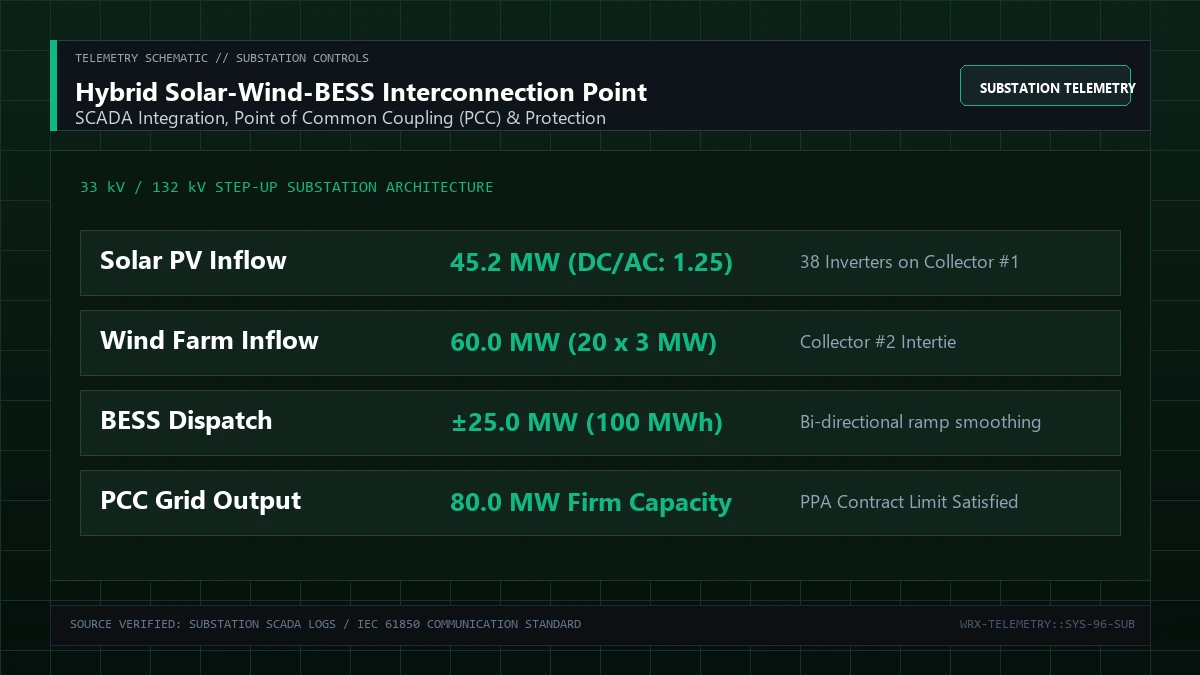
One of the most cost-effective developments in utility engineering is the hybrid renewable energy system. Rather than developing standalone wind or solar parks, developers co-locate solar photovoltaic arrays, wind turbines, and Battery Energy Storage Systems (BESS) at a single substation intertie:
• Anti-Correlated Generation Profiles: In many geographical regions, solar generation peaks between 10:00 and 15:00 on calm, hot days, while wind resources peak during late evenings, overnight hours, and winter storms. Co-locating them provides complementary generation that smooths seasonal and diurnal variability. • Maximizing Interconnection Utilization: Grid interconnection capacity is expensive and subject to multi-year queue delays. A standalone 100 MW solar farm might only utilize its interconnection line at a 24% capacity factor over the year. By co-locating 100 MW of wind and a 50 MW / 200 MWh BESS behind the same 100 MW grid connection point, the facility operates at a 60–75% capacity factor, drastically reducing balance-of-system and transmission tariffs per delivered megawatt-hour. • Dynamic Curtailment Absorption: When simultaneous solar and wind production exceeds the substation transmission limit, the excess generation is directed into the on-site battery rather than curtailed, stored for release during high-priced evening peak hours.
Operational Scale: Residential, Commercial and Utility Engineering
Renewable energy system engineering scales across three distinct operational tiers:
1. Residential Behind-the-Meter (5 kW to 15 kW): Systems prioritize self-consumption and household resilience. Equipment consists of rooftop PV, string inverters with DC optimizers or microinverters, residential 10–15 kWh LFP batteries, and an automated transfer switch (ATS) that isolates the home from the grid during blackouts to enable safe off-grid operation. 2. Commercial & Industrial (C&I, 50 kW to 2 MW): Deployed on factory roofs, logistics warehouses, or corporate campuses. The primary engineering goal is peak-demand shaving—reducing 15-minute demand spike charges imposed by utility commercial tariffs—using smart battery dispatch synchronized with facility building automation systems. 3. Utility-Scale Centralized Generation (50 MW to 2,000+ MW): Engineered for wholesale grid injection. Arrays feature single-axis astronomical trackers, medium-voltage underground collector loops, high-voltage substations, and automated robotic dry-cleaning fleets in arid regions.
Frequently Asked Questions
What is the difference between a renewable energy source and a renewable energy system?
A renewable energy source is the natural phenomenon itself (such as solar radiation, kinetic wind, or geothermal heat). A renewable energy system is the engineered hardware, power electronics, controls, and grid infrastructure built to capture, convert, regulate, and deliver that energy as usable electricity or heat.
What is a hybrid renewable energy system?
A hybrid renewable energy system combines two or more generation or storage technologies—most commonly solar photovoltaics, wind turbines, and battery storage—sharing a common electrical balance of plant and grid interconnection point to optimize reliability and reduce costs.
What does a grid-forming inverter do?
A grid-forming (GFM) inverter establishes its own independent voltage magnitude and frequency rather than following an external grid signal. It provides synthetic inertia and black-start capability, allowing power grids to operate reliably without traditional spinning fossil fuel generators.
How do renewable energy systems handle grid power outages?
Standard grid-tied systems shut down immediately during an outage for safety (anti-islanding protection). Systems equipped with hybrid inverters, battery storage, and an automated transfer switch (ATS) disconnect from the utility grid in milliseconds and continue powering critical local circuits safely.