Sustainable Fashion and Textile Decarbonization: Chemical Effluents, Microplastics, and the Supply-Chain Financing Chasm
UNEP and Geneva Environment Network expose fashion's true footprint: toxic chemical effluents, microplastics, and the $1 trillion supply-chain finance gap.
By WRXNEWS Editorial Team | Published | Updated
Executive Summary & Direct Answer
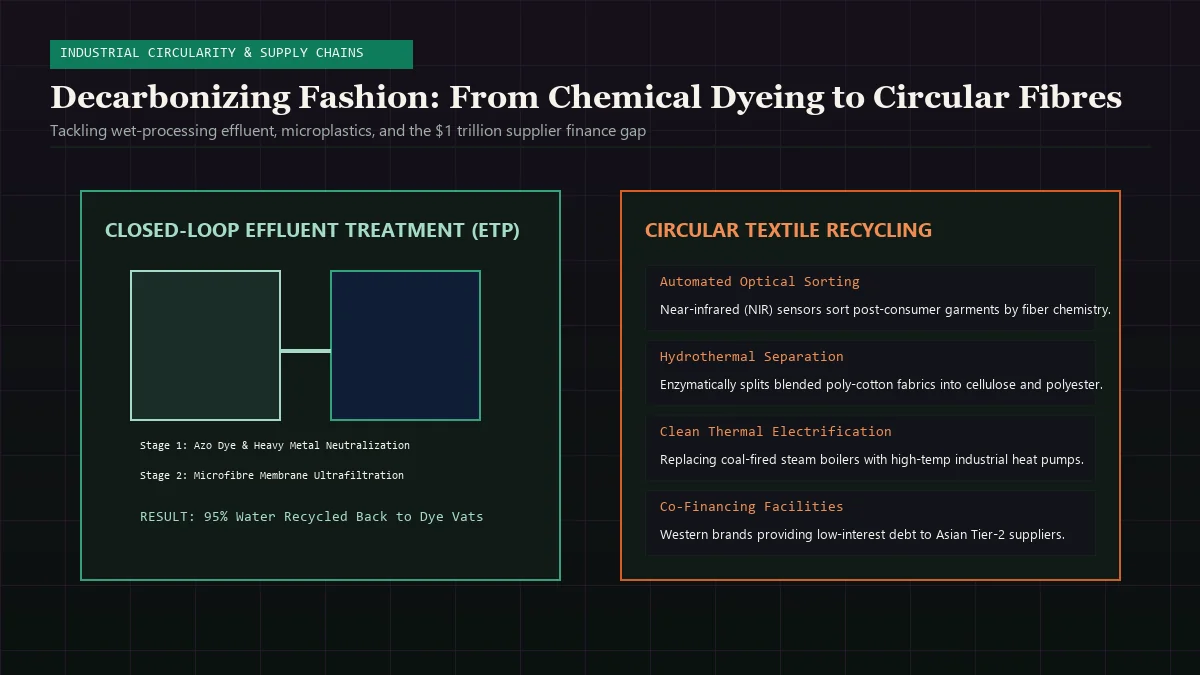
The global fashion and textile sector accounts for between two and eight percent of global greenhouse gas emissions, consumes over 215 trillion liters of fresh water annually, and contributes roughly nine percent of annual microplastic losses into global oceans, according to landmark reports by the Geneva Environment Network and the United Nations Environment Programme (UNEP). While global apparel brands celebrate high-profile "conscious" collections and retail marketing campaigns, over eighty percent of the industry's environmental footprint is concentrated in Tier 2 and Tier 3 wet-processing dye houses across the Global South. Decarbonizing this sector requires moving past superficial consumer recycling toward the structural co-financing of thermal boiler electrification.
The True Cost of the Global Wardrobe
Every second, the equivalent of one garbage truck full of textiles is landfilled or incinerated somewhere on earth. Over the past twenty-five years, the rise of the "fast fashion" business model—characterized by hyper-compressed design-to-retail cycles, extreme discounting, and deliberate product obsolescence—has driven global garment production to exceed 100 billion garments annually.
In a comprehensive inter-agency synthesis published by the Geneva Environment Network in collaboration with the United Nations Environment Programme (UNEP), researchers laid bare the full ecological invoice of this industrial acceleration. The fashion and footwear industry is responsible for:
- Approximately 2 to 8 percent of global greenhouse gas emissions—more than the carbon footprint of all international commercial flights and maritime shipping combined;
- Roughly 215 trillion liters of fresh water consumed annually, often extracted from severely water-stressed river basins;
- Approximately 20 percent of all global industrial wastewater pollution, saturated with toxic synthetic dyes and heavy metals;
- Over 9 percent of annual global microplastic discharges into the marine environment, shed during the domestic washing of synthetic polyester, nylon, and acrylic garments.
Yet, despite aggressive corporate marketing campaigns heralding "recycled polyester" capsule collections, the industry’s fundamental environmental footprint continues to expand. The reason is structural: the true engine of textile pollution does not sit on retail boutique racks in London, Paris, or New York. It is locked inside the coal-fired steam boilers, chemical sludge lagoons, and wet-processing dye houses of South and Southeast Asia.
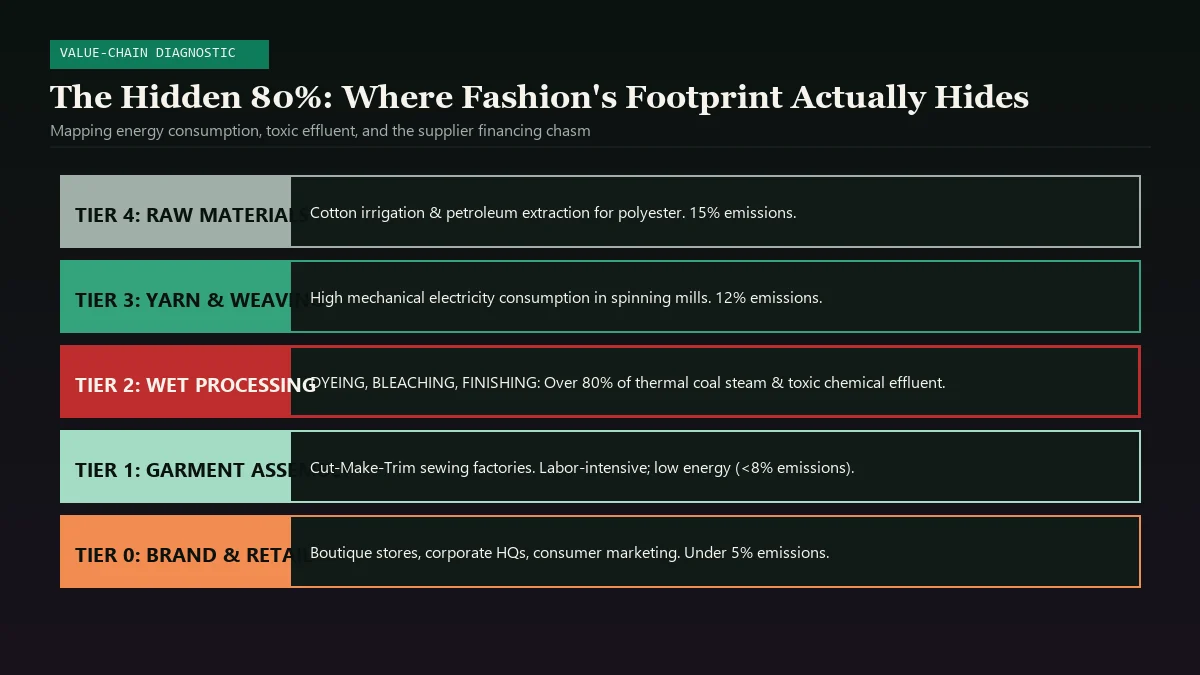
======================================================================================== THE FASHION VALUE-CHAIN BREAKDOWN ======================================================================================== [TIER 4: RAW MATERIALS] -> Fossil Extraction (Polyester) & Water-Intensive Cotton [TIER 3: PROCESSING] -> Yarn Spinning, Weaving & Knitting (High Mechanical Energy) [TIER 2: WET PROCESSING] -> DYEING, BLEACHING & FINISHING (80% of Energy & Toxic Effluent) [TIER 1: ASSEMBLY] -> Cut-Make-Trim Garment Factories (Low Energy / Labor Intensive) [TIER 0: RETAIL & BRAND] -> Marketing, Logistics, Stores (Scope 1 & 2 Emissions < 10%) ========================================================================================
The Chemical Scourge: Wet-Processing and Water Stress
To understand where fashion’s pollution concentrates, one must trace the anatomy of the supply chain. The industry operates across four primary tiers:
- Tier 4: Raw material production (cotton farming, synthetic polymer synthesis, sheep shearing).
- Tier 3: Yarn spinning and fabric formation (weaving, knitting).
- Tier 2: Wet-processing (scouring, bleaching, dyeing, printing, and chemical finishing).
- Tier 1: Final garment assembly (cutting and sewing).
While Tier 1 garment assembly factories capture the bulk of public and media attention regarding labor conditions, Tier 2 wet-processing facilities generate over 80 percent of the industry’s environmental damage.
Transforming raw, unbleached grey fabric into soft, vibrantly colored textiles requires massive thermal energy and an aggressive cocktail of chemical agents. To fix dyes into synthetic or natural fibers, dye houses immerse textiles in high-temperature chemical baths containing azo dyes, phthalates, formaldehyde, polyfluoroalkyl substances (PFAS "forever chemicals" used for water-repellency), and heavy metal mordants like chromium, lead, and cadmium.
In manufacturing clusters across Bangladesh, India, China, Vietnam, and Indonesia, millions of liters of untreated or poorly treated effluent are discharged directly into local river basins. In river deltas like the Buriganga in Dhaka or the Noyyal in Tamil Nadu, industrial effluents have depleted dissolved oxygen, eradicated freshwater biodiversity, and poisoned groundwater aquifers relied upon by local agrarian communities.
The Invisible Hazard: Synthetic Microfibres
While chemical effluent destroys freshwater systems at the manufacturing stage, another persistent crisis unfolds in domestic washing machines across the developed and developing world: synthetic microfibre shedding.
Today, over 65 percent of all global clothing is fabricated from synthetic petroleum-derived plastics—primarily polyester, polyamide (nylon), and acrylic. Every time a consumer launders a synthetic fleece jacket, yoga legging, or polyester dress, mechanical abrasion and turbulence dislodge an average of 700,000 microscopic plastic fibres (microfibres measuring less than 5 millimeters in length).
These microfibres are so fine that municipal wastewater treatment plants capture only a fraction of them. Trillions of synthetic fibres flow directly into rivers, lakes, and oceans. Once in the marine environment:
- Chemical Sponges: Microplastics act as hydrophobic chemical sponges, absorbing concentrated environmental toxins like PCBs, DDT, and dioxins from surrounding seawater.
- Bioaccumulation: Plankton, shellfish, and small fish consume these toxic microfibres, mistaking them for food. As larger marine predators consume smaller organisms, the toxins bioaccumulate through the marine trophic web, eventually reaching the plates of human consumers.
- Internal Translocation: Emerging medical research published in toxicological journals confirms that ingested and inhaled plastic microfibres cross the epithelial lining of the human gut and lungs, and have been detected in human blood, placental tissue, and deep lung tissues, triggering cellular toxicity and chronic inflammation.
The Supply-Chain Financing Chasm: The Tier-2 Decarbonization Trap
The central paradox of modern fashion sustainability is that international apparel brands have set ambitious Science Based Targets (SBTi) to achieve "Net-Zero by 2040 or 2050," yet have made virtually no direct capital investments into the factories that must actually deliver those emissions cuts.
Over 90 percent of a fashion brand's carbon footprint resides in Scope 3 emissions—specifically the electricity and thermal energy consumed by independent supplier factories in Tier 2 and Tier 3. To decarbonize a dye house, a factory owner cannot simply switch to a green retail electricity tariff. The facility requires enormous volumes of high-temperature industrial steam (120°C to 180°C) to boil dye vats and run stenter drying frames.
Currently, that steam is generated by burning low-grade thermal coal, petcoke, or unsustainably harvested firewood in cheap industrial boilers. Phasing out coal-fired steam requires massive capital expenditures:
- Replacing coal boilers with industrial high-temperature electric heat pumps, biomass gasifiers, or rooftop solar thermal collectors costs between $1.5 million and $4 million per facility.
- However, Tier-2 dye house operators operate on wafer-thin gross profit margins of 3 to 5 percent. Global fashion brands aggressively pit suppliers against one another, threatening to relocate orders to another vendor or country over price differences of a few cents per garment.
- Local commercial banks in South Asia charge interest rates of 12 to 18 percent for industrial upgrade loans, making it economically suicidal for a factory owner to absorb the debt required to decarbonize a brand's supply chain.
The result is a complete stalemate: Western brands publish glossy ESG reports pledging carbon neutrality, while refusing to increase order prices or co-invest in the capital equipment required to retire coal boilers in Asia.
``` ======================================================================================== THE FASHION SUPPLY CHAIN FINANCING CHASM ======================================================================================== GLOBAL BRANDS (Scope 3 Pledges) -> Demand 50% Carbon Cuts -> Provide Zero Direct Capex
[THE CHASM]
TIER-2 DYE HOUSES (Asia) -> Margin: 3-5% | Loan Rates: 15% -> Cannot Afford $3M Heat Pump
RESULT -> Coal Boilers Continue Burning; Greenwashing Persists ======================================================================================== ```
The Systemic Solution: Circularity and Co-Financed Transitions
To break this cycle, the Geneva Environment Network and UNEP outline a mandatory roadmap for industrial and regulatory transformation:
- Mandatory Brand Co-Investment and Blended Finance: Decarbonization must be co-funded. Leading multinational fashion groups must pool capital into dedicated Supply Chain Decarbonization Facilities, providing zero-interest or low-cost subordinated debt to their Tier-2 suppliers. Furthermore, brands must sign guaranteed, multi-year volume contracts with compliant factories, ensuring suppliers can amortize their clean-tech investments over a seven-to-ten-year horizon.
- Enforcing Extended Producer Responsibility (EPR): National governments in primary consumer markets—such as the European Union and North America—must enact strict EPR legislation. Fashion brands must be held legally and financially responsible for the post-consumer fate of their products, paying mandatory eco-fees based on garment recyclability and synthetic content, while funding domestic textile recycling infrastructure.
- Scaling Fibre-to-Fibre Recycling Technologies: Today, less than 1 percent of textile waste is recycled back into new clothing, with most "recycled polyester" made from diverted plastic beverage bottles (rPET), which merely delays bottle disposal by one consumer cycle without solving textile circularity. The industry must commercialize chemical hydrothermal recycling and enzymatic breakdown technologies capable of separating blended poly-cotton fabrics into virgin-equivalent cellulosic pulp and recycled polyester chips.
- Microfibre Washing Machine Standards: Mandate that all commercial and domestic washing machines manufactured after 2027 incorporate integrated microfibre filtration cartridges capable of capturing 90 percent of shed synthetic fibres before wastewater discharges into municipal sewers.
The era of treating clothing as a disposable single-use commodity must come to a definitive end. Real fashion sustainability cannot be achieved through clever advertising or eco-label tags. It will be achieved only when global fashion brands take direct financial responsibility for the physical chemistry, clean energy, and human dignity of the global supply chain that dresses the world.
---
Frequently Asked Questions
Why is textile wet-processing so environmentally destructive?
Wet-processing involves scouring, bleaching, dyeing, printing, and finishing fabrics. It consumes massive amounts of water and requires thousands of toxic industrial chemicals—including heavy metal mordants, synthetic azo dyes, and PFAS water-repellents. It also requires immense thermal energy to boil water and heat drying frames, which is predominantly generated by burning cheap thermal coal.
What are microfibres and how do they differ from general microplastics?
Microfibres are a specific sub-category of microplastics: ultra-fine synthetic threads (typically made of polyester, nylon, or acrylic) measuring less than 5 millimeters in length with a high aspect ratio. Unlike hard microplastic pellets, microfibres bend and twist, making them far more difficult for municipal wastewater filtration systems to trap, and easier for aquatic organisms to ingest.
What is the difference between Scope 1, 2, and 3 emissions in the fashion industry?
Scope 1 emissions are direct greenhouse gas emissions from brand-owned facilities (e.g., fuel burned in corporate vehicles or corporate offices). Scope 2 covers indirect emissions from purchased electricity in brand headquarters and retail stores. Scope 3 covers all other indirect emissions across the entire value chain—primarily the extraction of raw materials, spinning of yarn, and burning of coal in Tier 2 dye houses. Scope 3 represents 90 to 95 percent of a fashion brand's total carbon footprint.
Why is "recycled polyester from plastic bottles" not a true circular solution?
Beverage bottles made of polyethylene terephthalate (PET) can be mechanically recycled bottle-to-bottle up to ten times in a closed-loop food-grade cycle. When the fashion industry takes those bottles to make polyester yarn, it interrupts the closed-loop bottle recycling system. Once that polyester is spun into a garment and mixed with dyes and elastane, it cannot be recycled again and is almost always incinerated or landfilled after use, creating a "dead-end" linear pathway.