Air Pollution and Climate Change: The Trillion-Dollar Economic and Health Co-Benefits of Integrated Action
UNEP reveals how integrating air pollution and climate policies saves millions of lives and trillions in healthcare costs. The economics of clean air.
By WRXNEWS Research Team | Published | Updated
Executive Summary & Direct Answer
For decades, public health authorities and climate negotiators operated in isolated bureaucratic silos: air pollution was treated as a local, immediate municipal hazard, while greenhouse gas mitigation was framed as a distant, global intergenerational challenge. Groundbreaking scientific assessments released by the United Nations Environment Programme (UNEP) and the World Health Organization (WHO) demonstrate that this separation is economically and scientifically obsolete. By targeting Short-Lived Climate Pollutants (SLCPs)—including black carbon, methane, and tropospheric ozone—integrated policies deliver immediate domestic public-health dividends that outstrip clean-energy compliance costs by more than three to one.
The Artificial Boundary That Cost Millions of Lives
Across the world’s most polluted urban corridors—from the Indo-Gangetic Plain and the Pearl River Delta to the industrial heartlands of Eastern Europe and Central Mexico—air pollution and climate change are experienced not as distinct academic phenomena, but as a single, toxic atmospheric reality.
Yet for over thirty years, international governance has artificially bifurcated this crisis. Climate change was entrusted to high-level diplomats negotiating long-term greenhouse gas treaties under the UNFCCC, focusing on cumulative carbon dioxide (CO2) concentrations decades in the future. Air quality was relegated to municipal health departments and local environment boards, focusing on acute parts-per-million measurements of particulate matter (PM2.5), nitrogen dioxide (NO2), and sulfur dioxide (SO2).
In a landmark comprehensive synthesis report released by the United Nations Environment Programme (UNEP) in collaboration with the Climate and Clean Air Coalition (CCAC), scientists and health economists issue a definitive verdict: this bureaucratic separation has cost millions of lives and trillions of dollars in misallocated capital. Integrating air quality management directly into national climate strategies (Nationally Determined Contributions) represents the single most economically advantageous public investment a nation can make.
``` ======================================================================================== THE DUAL BURDEN: TWO CRISES, ONE SOURCE ======================================================================================== FOSSIL FUELS, INDUSTRIAL HEATING & OPEN BURNING
+-----------------------+-----------------------+
[CLIMATE CRISIS] [PUBLIC HEALTH CRISIS]
- Carbon Dioxide (CO2) - Fine Particulate Matter (PM2.5)
- Decadal Global Warming - 7 Million Premature Deaths Annually
- Melting Cryosphere & Sea-Level Rise - Pediatric Asthma, Stroke & Cardiovascular
+-----------------------+-----------------------+
[SHORT-LIVED CLIMATE POLLUTANTS]
======================================================================================== ```
- Methane (CH4) -> Ground-Level Ozone (O3)
- Black Carbon (Soot) -> High GWP & Lung Penetration
The Molecular Intersection: Short-Lived Climate Pollutants (SLCPs)
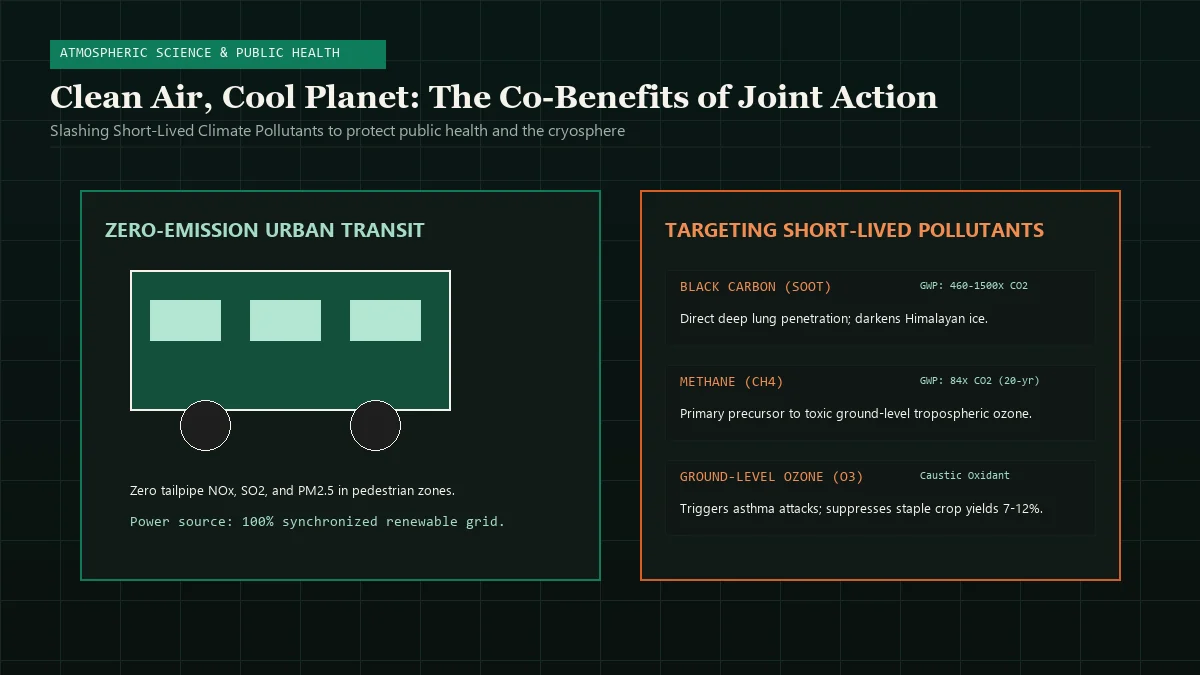
The physical bridge connecting climate change and human pathology resides in a specific class of atmospheric agents known as Short-Lived Climate Pollutants (SLCPs). Unlike carbon dioxide, which persists in the atmosphere for centuries, SLCPs remain airborne for periods ranging from several days to fifteen years. Because their atmospheric lifetimes are relatively brief, cutting SLCP emissions yields immediate reductions in both near-term warming and localized toxicity:
#### 1. Black Carbon (Soot) Black carbon is a primary component of PM2.5, produced by the incomplete combustion of fossil fuels, biomass, and agricultural stubble. Weight-for-weight, black carbon warms the atmosphere between 460 and 1,500 times more powerfully than CO2 by absorbing solar radiation directly. When it settles on Arctic ice sheets or Himalayan glaciers, it darkens the snow, drastically lowers the albedo (reflectivity), and accelerates glacial melt.
Simultaneously, black carbon particles are small enough to bypass the human body’s upper respiratory defenses. When inhaled, these microscopic carbon spheres penetrate deep into lung alveoli, translocate directly into the bloodstream, and trigger systemic chronic inflammation, causing ischemic heart disease, hemorrhagic strokes, lung cancer, and premature birth.
#### 2. Methane and Tropospheric (Ground-Level) Ozone Methane (CH4) is a greenhouse gas with a global warming potential more than 80 times greater than CO2 over a twenty-year timescale. Beyond its potent warming effect, methane serves as the primary chemical precursor for the formation of tropospheric ozone—a toxic, corrosive component of urban smog.
Unlike the protective ozone layer in the stratosphere, ground-level ozone is a powerful lung irritant that damages human pulmonary tissues, exacerbates severe pediatric asthma, and causes extensive cellular necrosis in agricultural crops. UNEP estimates that tropospheric ozone pollution suppresses global yields of wheat, rice, corn, and soybeans by 7 to 12 percent annually, undermining global food security at the exact moment climate disruption is drying croplands.
The Economic Equation: Health Savings Fund the Clean Transition
The most revolutionary dimension of UNEP's findings lies in the economic domain. For decades, opponents of climate action argued that decarbonizing power grids, retiring internal combustion engines, and scrubbing industrial smokestacks were ruinously expensive endeavors that dragged down gross domestic product (GDP).
Modern health economics inverts this paradigm completely. By deploying Integrated Assessment Modeling (IAM) that accounts for medical expenditures, hospital admissions, disability-adjusted life years (DALYs), and lost worker productivity, the economic return on clean air policies is staggering:
- Global Mortality Burden: Fine particulate matter and ground-level ozone currently kill over 7 million people prematurely every single year—more than the annual mortality of tuberculosis, malaria, and HIV/AIDS combined.
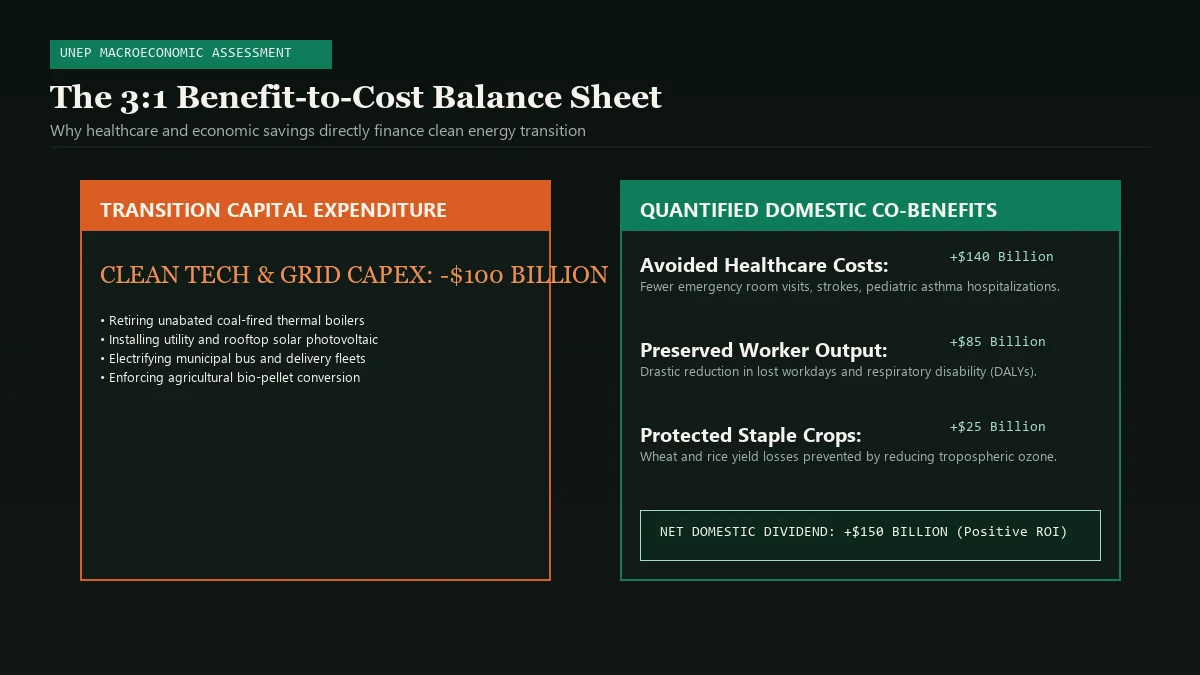
- The 3:1 Benefit-to-Cost Ratio: In developing and emerging economies, the monetized value of avoided premature deaths, reduced emergency room admissions, and preserved agricultural output exceeds the capital expenditure required to deploy solar, wind, and electric transit by a factor of 3 to 1.
- Immediate Local Dividend: When a national government invests $10 billion into phasing out unabated coal-fired power plants, the carbon reduction benefit is shared globally across 195 nations over the next century. However, the air quality benefit—eliminating tons of SO2, NO2, and PM2.5—is captured immediately and locally within the country’s domestic population. Within weeks of retiring an unscrubbed thermal power station, local pediatric asthma admissions plunge, delivering instant budgetary relief to domestic health ministries.
======================================================================================== THE MACROECONOMIC BALANCE SHEET: SILOED VS INTEGRATED ======================================================================================== TRADITIONAL VIEW: Clean Tech Capex = Heavy Cost Burden (-$100 Billion) ---------------------------------------------------------------------------------------- INTEGRATED REALITY: Clean Tech Capex = -$100 Billion Avoided Healthcare Costs = +$140 Billion Preserved Worker Output = +$85 Billion Protected Crop Yields = +$25 Billion -------------------------------------------- NET ECONOMIC DIVIDEND = +$150 Billion (Net Positive) ========================================================================================
The Catastrophic Danger of Policy Silos
History provides stark warnings of what occurs when policymakers optimize for climate without considering air pollution, or optimize for air pollution without considering climate:
- The European Diesel Trap (Carbon Blindness to Air Quality): In the late 1990s and 2000s, European regulators incentivized diesel vehicles over gasoline engines because diesel yielded marginally lower tailpipe CO2 emissions per kilometer. While this helped manufacturers meet fleet-average carbon targets, it flooded European urban centers with toxic nitrogen oxides (NOx) and diesel particulate matter, triggering an urban public-health emergency that ultimately culminated in the "Dieselgate" emissions scandal.
- The Biomass Burning Fallacy: In multiple regions, renewable energy mandates classified domestic residential wood-pellet burning as "carbon neutral" renewable biomass. While biogenic carbon cycles theoretically balance over multi-decade forest growth, the localized combustion of wood pellets caused catastrophic spikes in wintertime urban PM2.5 concentrations, choking valleys across Central and Northern Europe.
- The Aerosol Masking Dilemma: Conversely, purely aggressive air-pollution scrubbing can create unintended climate complications. Coal-fired power stations emit sulfur dioxide, which forms reflective sulfate aerosols in the upper atmosphere. These aerosols act as an artificial umbrella, temporarily reflecting sunlight and masking a portion of global greenhouse warming. Rapidly scrubbing sulfur without simultaneously slashing greenhouse gas emissions can unmask underlying warming, triggering regional temperature surges.
Only holistic, simultaneous planning can navigate these atmospheric trade-offs.

The Policy Blueprint: Integrated National Action Plans
To convert these scientific findings into governance, UNEP and the WHO recommend that governments abandon fragmented decision-making and adopt Integrated National Action Plans on Clean Air and Climate (INAP):
- Electrifying Public and Commercial Transport: Prioritize the immediate electrification of urban bus fleets, two-wheelers, and last-mile delivery vehicles. This eliminates localized tailpipe toxic emissions in dense pedestrian corridors while accelerating power-sector decarbonization.
- Agricultural Residue Management: Provide mechanized in-situ residue management machinery and establish commercial bio-pellet conversion hubs to incentivize farmers to convert crop stubble into industrial clean-burning solid biofuel rather than burning it in open fields.
- Mandatory Leak Detection and Repair (LDAR): Enforce strict satellite-monitored LDAR protocols across oil, gas, and coal mining infrastructure to eliminate fugitive methane emissions, generating instant cooling and reducing smog.
- Eliminating Household Energy Poverty: Subsidize clean electric cooking, induction stoves, and LPG access for the 2.3 billion people who still cook with charcoal, firewood, and animal dung, eliminating household air pollution that disproportionately kills women and infant children.
The conclusion of the latest research is irrefutable: breathing clean air and maintaining a livable climate are not competing objectives. They are identical scientific imperatives. Governments that merge these strategies will not only stabilize the global climate for future generations; they will save millions of lives and build wealthier, healthier societies today.
---
Frequently Asked Questions
Why is black carbon considered a short-lived climate pollutant?
Black carbon remains in the atmosphere for only a few days to a few weeks before being washed out by rain or settling on surfaces. In contrast, carbon dioxide lingers in the atmosphere for hundreds of years. Because black carbon clears quickly, eliminating its emission sources produces almost immediate reductions in regional atmospheric heating and air pollution.
How does reducing methane improve human health?
While humans do not breathe methane directly in toxic amounts under typical outdoor conditions, methane reacts chemically in sunlight with nitrogen oxides to form tropospheric (ground-level) ozone. Ground-level ozone is a caustic oxidant that causes severe airway inflammation, triggers asthma attacks, damages cardiovascular health, and damages agricultural crops. Cutting methane is the single most effective way to lower global ground-level ozone.
What are the main sources of fine particulate matter (PM2.5)?
PM2.5 originates from two primary pathways: primary PM2.5, which is emitted directly from combustion sources (vehicle exhaust, thermal power plants, industrial boilers, biomass cooking, and crop stubble burning); and secondary PM2.5, which forms in the atmosphere through complex chemical reactions between precursor gases such as sulfur dioxide, nitrogen oxides, ammonia, and volatile organic compounds (VOCs).
How do healthcare cost savings offset the expense of clean energy transition?
When a nation transitions from fossil fuels to clean energy, emissions of toxic particulate matter and acid gases plummet. This immediately lowers the incidence of chronic obstructive pulmonary disease (COPD), heart disease, pediatric respiratory infections, and missed working days. The billions of dollars saved in avoided medical bills, emergency room visits, and lost economic productivity provide a direct domestic economic return that exceeds the cost of installing renewable generation.