Children and Climate Risk: Inside UNICEF's 2026 Report on Multi-Hazard Exposure and Essential Service Resilience
UNICEF’s 2026 report reveals over 1 billion children face compounding climate risks. Discover the biological impacts, service disruptions, and adaptation gaps.
By WRXNEWS Climate Policy Unit | Published | Updated
Executive Summary & Direct Answer
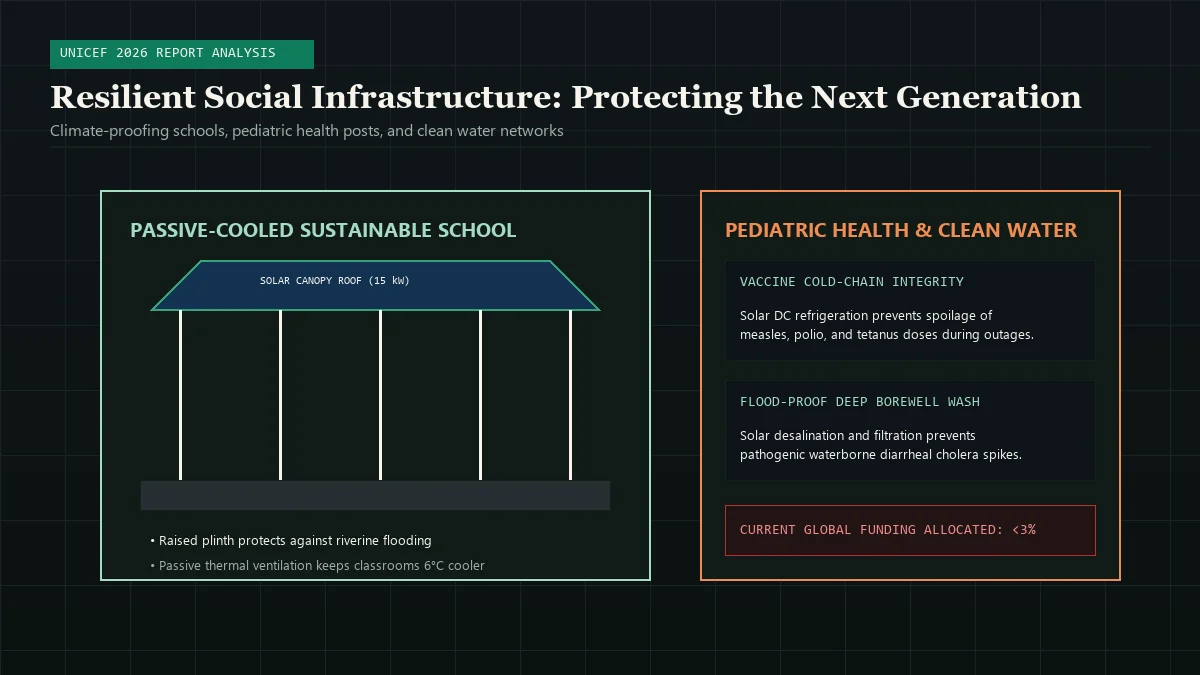
Over one billion children—nearly half of the global youth population—currently reside in nations classified as facing "extremely high risk" from overlapping climate shocks, according to the newly released [Children’s Climate Risk Index](https://www.unicef.org/environment-and-climate-change) (CCRI) 2026 Report by UNICEF. Combining unique biological vulnerabilities with the systemic disruption of essential pediatric healthcare, clean water networks, and schools, climate disruption is no longer a future forecast; it is a present-day developmental catastrophe. Yet despite facing the highest burden of disease and displacement, child-responsive infrastructure receives less than three percent of global adaptation finance.
The Unseen Victims of a Warming Atmosphere
When climate change is debated in parliamentary chambers and multilateral summit plenaries, the discourse is predominantly couched in technocratic abstractions: gigatons of carbon dioxide equivalent, parts per million, grid interconnection tariffs, and macroeconomic balance-sheet projections.
In late 2026, the United Nations Children’s Fund (UNICEF) released its comprehensive update to the Children’s Climate Risk Index (CCRI), forcing the international community to confront a far more intimate, human reality. The report establishes that more than 1 billion children—nearly half the world’s 2.2 billion young people—are living in thirty-four countries facing "extremely high risk" from compounding climate and environmental hazards.
The report delivers an uncompromising scientific verdict: children are not merely "small adults" who will endure the same impacts as the general population. Due to their distinct physiology, rapid anatomical development, and complete reliance on functioning societal systems, children bear a vastly disproportionate share of the global climate burden.
``` ======================================================================================== UNICEF CHILDREN'S CLIMATE RISK INDEX (CCRI) ======================================================================================== [PILLAR 1: CLIMATE HAZARD EXPOSURE] [PILLAR 2: CHILD VULNERABILITY & RESILIENCE]
\ / \ / [COMPOUNDING REAL-WORLD RISK] -> Stunting, Wasting, Educational Loss, Childhood Mortality & Early Displacement ======================================================================================== ```
- Extreme Thermal Heatwaves - Access to Pediatric Healthcare
- Severe Water Scarcity & Drought - Water, Sanitation & Hygiene (WASH) Quality
- Vector-Borne Diseases (Dengue/Malaria) - Educational Facility Continuity
- Riverine & Coastal Flooding - Social Protection Cash Safety Nets
The Biological Reality: Why Children Are Uniquely Vulnerable
The CCRI 2026 report draws upon extensive pediatric epidemiological research to document how thermal, atmospheric, and hydrological disruptions systematically attack developing bodies:
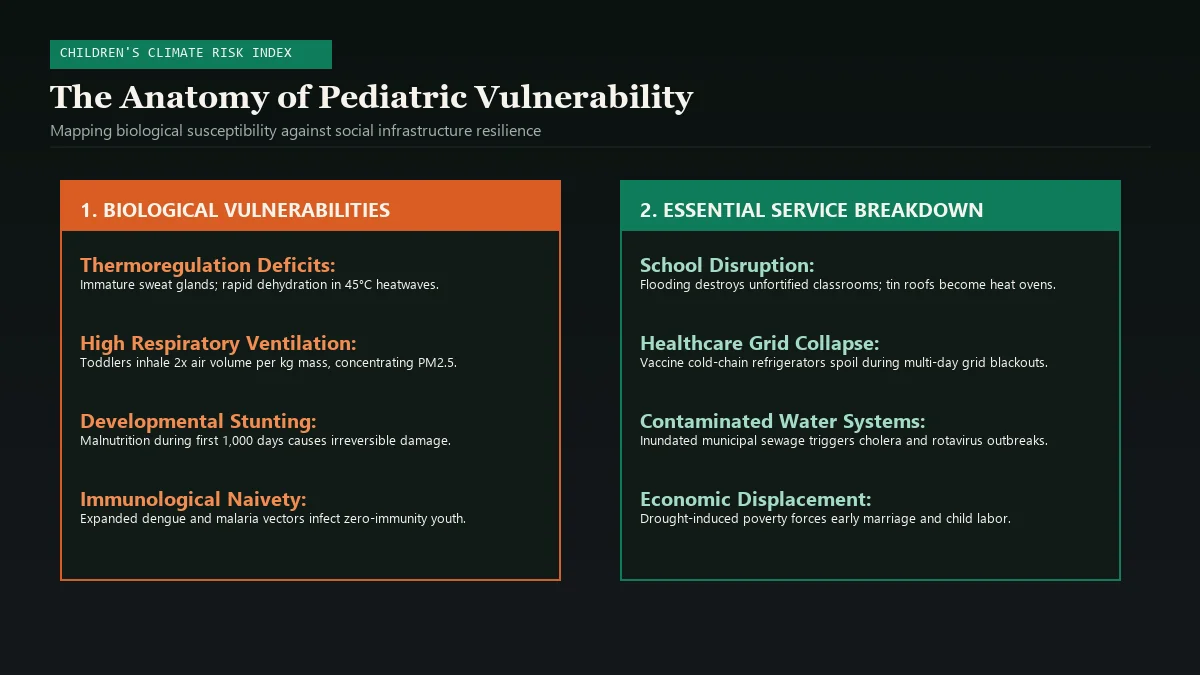
#### 1. Thermoregulation and Heat Exhaustion Infants and young children have a significantly higher body-surface-area-to-weight ratio than adults, meaning they absorb heat from their surroundings much faster. Furthermore, their sweat glands are not fully developed, severely limiting their physiological ability to cool down through evaporative perspiration. During prolonged summer heatwaves—where temperatures breach 45°C (113°F) across South Asia, the Middle East, and sub-Saharan Africa—infants face rapid, life-threatening dehydration, heatstroke, and acute electrolyte collapse.
#### 2. Pulmonary Vulnerability and Metabolic Rate Children breathe at twice the respiratory rate of adults per unit of body mass. In polluted metropolitan environments or fire-prone rural areas, a toddler inhales double the volume of airborne particulate matter (PM2.5), black carbon, and ground-level ozone relative to their lung surface area. Because their bronchial trees and alveoli are still undergoing cellular maturation through age eight, exposure to toxic smoke permanently stunts lung capacity, permanently escalating lifetime risks of asthma, chronic obstructive pulmonary disease, and neurodevelopmental delays.
#### 3. Nutritional Disruption and Chronic Stunting Climate-driven crop failures, droughts, and pest outbreaks directly trigger acute price shocks for staple foods. For a developing infant in the first 1,000 days of life, nutritional deprivation causes irreversible physiological and cognitive damage. Severe maternal and infant malnutrition manifests as stunting (low height for age) and wasting (low weight for height), permanently impairing neurological development and immune response.
The Multi-Hazard Web: When Shocks Collide
The hallmark of the 2026 UNICEF assessment is its mapping of multi-hazard exposure. In vulnerable geographies, climate risks do not strike in isolation; they arrive as overlapping, compounding waves:
- The Flood-Water-Disease Cycle: When severe monsoon inundations or supercharged cyclones strike coastal or riverine communities, municipal water networks are submerged and sewage systems overflow. Wells become contaminated with fecal pathogens, triggering rapid outbreaks of acute waterborne diarrheal diseases—including cholera and rotavirus. Diarrhea remains the second leading cause of infectious mortality in children under five globally.
- The Vector-Borne Expansion: Rising temperatures and erratic precipitation patterns have expanded the geographical and altitudinal range of disease vectors. Mosquitoes carrying dengue, malaria, and chikungunya now breed in highland plateaus and temperate zones where local populations have zero acquired immunological resistance, placing tens of millions of additional children at risk.
- Displacement and Toxic Stress: When drought destroys agrarian livelihoods, entire rural families are forced to migrate into crowded urban informal settlements. Children who experience climate displacement suffer severe psychological trauma, are pulled out of schools to perform manual labor, and face heightened risks of child labor and early marriage.
======================================================================================== THE MULTI-HAZARD ESCALATION IN THE GLOBAL SOUTH ======================================================================================== DROUGHT / HEATWAVE -> Crop Failures -> Malnutrition & Dehydration + CYCLONE / FLOODING -> Contaminated Water Systems -> Acute Cholera Outbreak + SERVICE COLLAPSE -> Primary Healthcare Center Destroyed -> Preventable Child Mortality ========================================================================================
The Infrastructure Gap: Defending Essential Services
UNICEF emphasizes that child vulnerability is not solely determined by the intensity of physical climate hazards; it is determined by the resilience of the basic social services that protect them:
- Climate-Resilient Healthcare Facilities: In rural clinics across the Global South, pediatric cold-chain refrigerators—vital for storing childhood vaccines against measles, polio, and tetanus—rely on fragile local power grids. A single multi-day blackout during an extreme weather event spoils thousands of doses, leaving entire cohorts of infants unprotected. Upgrading rural health clinics with off-grid solar photovoltaic systems and battery storage is an urgent matter of infant survival.
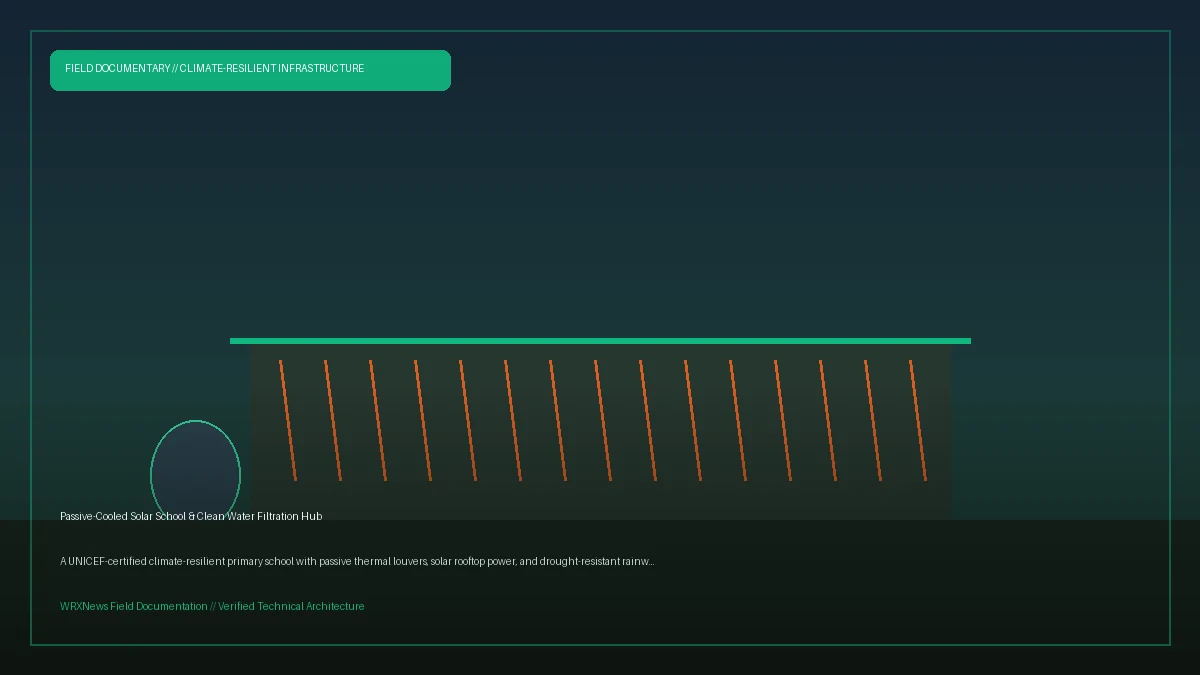
- Hardening Educational Infrastructure: When schools are constructed from uninsulated tin roofing and lack passive ventilation or air filtration, classrooms turn into dangerous heat ovens where cognitive function plummets. Furthermore, in many developing regions, schools are the first public buildings converted into temporary flood shelters during cyclones, halting formal education for months at a time.
- Resilient Water, Sanitation, and Hygiene (WASH): Building solar-powered deep-borewell pumps, elevated flood-proof latrines, and decentralized water-desalination skids prevents the contamination of municipal water sources during extreme hydrologic events.
The Adaptation Financing Inequity
Despite the overwhelming evidence that children suffer the most devastating physical and biological impacts of climate disruption, global climate finance remains blind to their existence.
An analysis conducted by UNICEF alongside the Climate Policy Initiative reveals an astonishing imbalance: less than 3 percent of all multilateral climate finance disbursed globally is targeted toward child-responsive social services.
The vast majority of multilateral and bilateral climate funding is channeled into large-scale mitigation infrastructure—such as high-voltage transmission lines, utility-scale wind farms, and industrial carbon capture facilities. While clean energy capital expenditure is necessary, failing to invest in social infrastructure leaves millions of children completely defenseless against present-day climatic shocks.
UNICEF is demanding a structural overhaul of international climate finance mechanisms:
- Child-Responsive Adaptation Funds: Multilateral institutions—including the Green Climate Fund (GCF) and the Adaptation Fund—must establish dedicated pediatric funding windows that fast-track capital for school climate-proofing, clean clinic power, and maternal-infant health interventions.
- Shock-Responsive Social Protection: Governments must expand automated digital cash transfers that trigger automatic cash payments to mothers and caregivers when satellite indices indicate that a region has crossed severe drought or heat thresholds, preventing families from resorting to negative coping mechanisms.
- Empowering Youth Leadership: Children and youth must be granted formal consultative seats within national delegations formulating updated Nationally Determined Contributions (NDCs) and National Adaptation Plans (NAPs).
A Test of Generational Justice
The children alive in 2026 did not build the industrial factories, burn the coal reserves, or design the hydrocarbon energy systems that brought the biosphere to the brink of collapse. Yet they are paying for that economic legacy with their physical health, their cognitive development, and their futures.
UNICEF’s 2026 report strips away any remaining complacency. The international community cannot claim to be building a sustainable green economy if it leaves the next generation vulnerable to preventable diseases, contaminated water, and scorched classrooms. Real climate leadership must be measured not only by gigawatts installed, but by whether the world's most vulnerable children can survive, grow, and thrive on a changing planet.
---
Frequently Asked Questions
What is the Children's Climate Risk Index (CCRI)?
The CCRI is a comprehensive analytical tool developed by UNICEF. It ranks countries based on children’s exposure to environmental and climate hazards (cyclones, heatwaves, flooding, water scarcity, vector-borne diseases) combined with children’s underlying vulnerability based on their access to healthcare, education, clean water, and social protection services.
Why do heatwaves affect infants and toddlers more severely than adults?
Infants and toddlers have a higher surface-area-to-body-mass ratio, meaning their bodies absorb ambient heat much faster than adults. Furthermore, their metabolic rates are higher, their physiological thermoregulation systems are immature, and they produce less sweat per sweat gland, rendering them highly vulnerable to sudden heatstroke, fever, and acute dehydration.
What is "child-responsive climate finance"?
Child-responsive climate finance refers to investments specifically earmarked to protect and build the resilience of essential social services that children depend upon. This includes climate-proofing pediatric clinics, installing solar power for vaccine refrigeration, ensuring clean water and sanitation in schools, and funding social safety net cash transfers for climate-affected families.
How does climate disruption lead to increased child labor and early marriage?
When extreme droughts or catastrophic floods wipe out agricultural crops and livestock, rural farming families lose their sole source of income. To survive severe economic distress, impoverished households often resort to negative coping mechanisms, pulling children out of school to perform manual agricultural or industrial labor, or marrying daughters off at an early age to reduce household expenses.