Climate Technology Transfer: UNEP's Renewed CTCN Mandate and the Harsh Reality of Global South Deployment
UNEP secured a renewed five-year mandate to host the CTCN at COP31. But can technical assistance bridge the massive clean tech divide in developing nations?
By WRXNEWS Energy & Clean Tech Desk | Published | Updated
Executive Summary & Direct Answer
In one of the few unanimous operational victories at COP31 in Antalya, the UNFCCC officially renewed the United Nations Environment Programme's (UNEP) hosting mandate for the Climate Technology Centre and Network (CTCN) through 2031. Operating as the operational arm of the UNFCCC Technology Mechanism, the CTCN has delivered hundreds of technical assistance interventions across developing nations. Yet as the climate crisis accelerates, a profound structural chasm remains between extending an institutional mandate in a plenary hall and delivering commercial-scale technology transfer to the frontlines of the Global South.
A Diplomatic Triumph in a Divided Summit
When the plenary in Antalya collapsed over political declarations and fossil-fuel rhetoric, one critical technical outcome had already been quietly approved without dissent: the extension of the United Nations Environment Programme’s (UNEP) mandate to host the Climate Technology Centre and Network (CTCN) for another five-year term, spanning 2027 through 2031.
Established under the 2010 Cancun Agreements as the operational arm of the UNFCCC Technology Mechanism—working in tandem with the policy-oriented Technology Executive Committee (TEC)—the CTCN is the primary multilateral vehicle tasked with facilitating the transfer of environmentally sound technologies to developing countries.
Securing another five-year hosting arrangement provides vital institutional continuity. It ensures that hundreds of ongoing technical assistance projects—ranging from industrial energy audits in Southeast Asia to agro-meteorological forecasting systems in West Africa—will not suffer administrative disruption. However, as ministers celebrated the consensus decision, experienced clean-technology practitioners in the corridors were quick to inject a note of sober realism. An intergovernmental mandate is not a transmission line; an institutional renewal does not fabricate a single solar wafer, drill a geothermal well, or manufacture a battery cell.
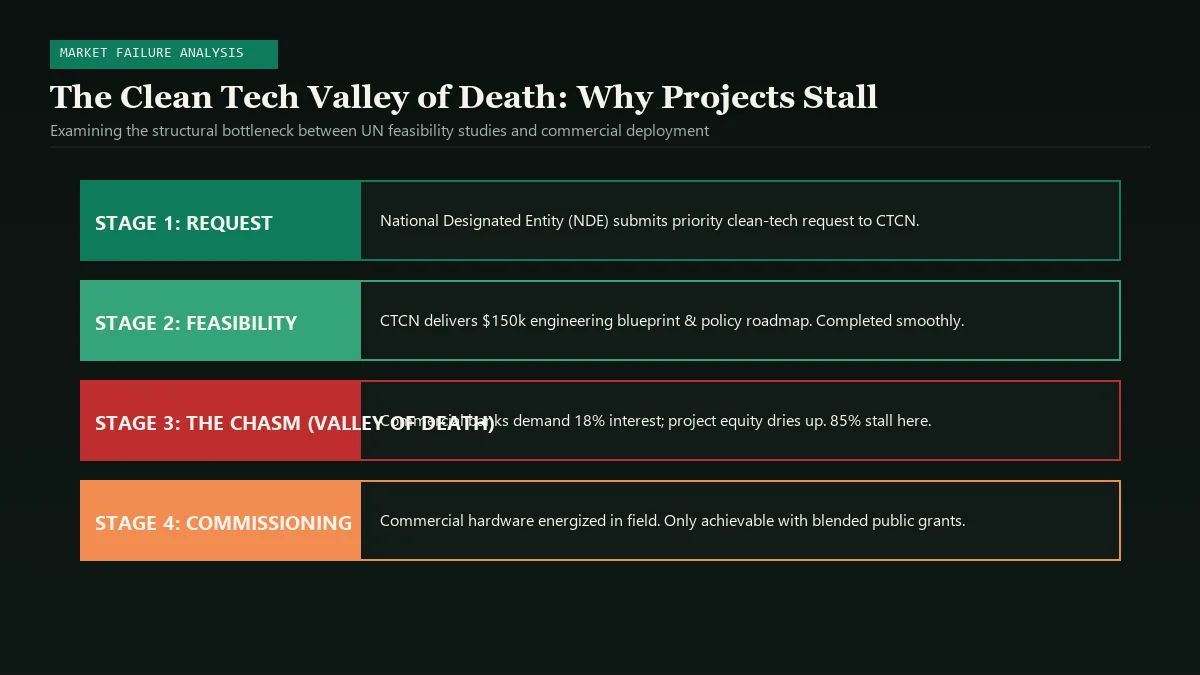
======================================================================================== THE CTCN TECHNOLOGY DELIVERY PIPELINE ======================================================================================== [STAGE 1: REQUEST] -> National Designated Entity (NDE) submits priority request [STAGE 2: ASSISTANCE] -> CTCN funds technical study, policy roadmap, or feasibility [STAGE 3: THE CHASM] -> "Valley of Death": Lack of commercial equity & capex loans [STAGE 4: DEPLOYMENT] -> Actual industrial hardware commissioned on the ground ========================================================================================
The Architecture: What the CTCN Actually Does
To understand the limitations of international technology transfer, one must first understand what the CTCN is designed to do—and what it was never equipped to execute.
The CTCN does not operate a multibillion-dollar sovereign investment fund. It does not purchase intellectual property licenses on the commercial market, nor does it ship containerloads of hardware across oceans. Instead, it functions as an elite technical matchmaking and capacity-building broker:
- The Request Mechanism: A developing nation identifies an acute technological bottleneck—such as modernizing an electrical grid to accept intermittent wind power or formulating energy-efficiency codes for commercial buildings. The country’s designated focal point, known as a National Designated Entity (NDE), submits a formal request.
- The Global Network: The CTCN taps into its global network of over 800 civil society, academic, and private-sector technology providers to deploy specialized engineering, policy, and financial consultants.
- The Deliverable: The CTCN funds and delivers tailored feasibility assessments, regulatory blueprints, technical specifications, and workforce training modules, typically valued between $50,000 and $250,000 per intervention.
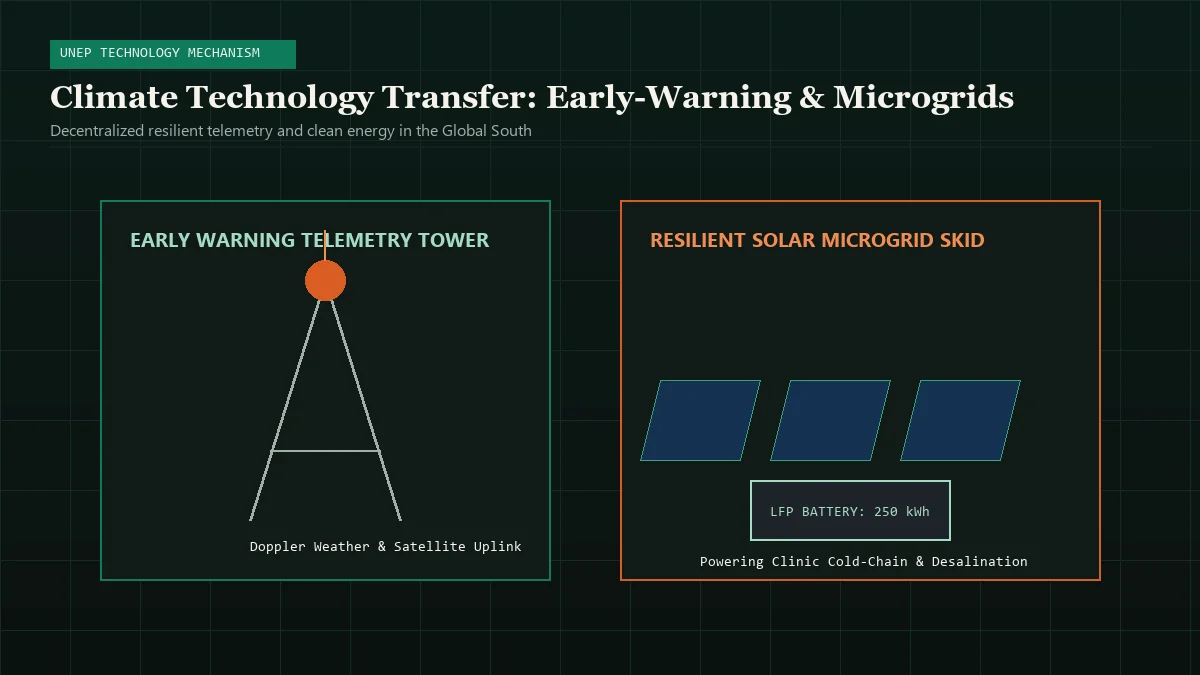
Over its initial operating cycles, the CTCN has completed more than 400 technical assistance projects across 110 developing nations. In East Africa, it helped design national e-mobility transition standards; in the Caribbean, it drafted engineering specifications for hurricane-resilient solar microgrids; and across the Pacific islands, it developed spatial modeling for sea-level defense barriers.
The Fundamental Flaw: The Financing "Valley of Death"
The core vulnerability of the UNFCCC technology architecture lies in the disconnect between Stage 2 (technical assistance) and Stage 4 (commercial deployment). This gap is widely referred to across clean-tech sectors as the financing valley of death.
The CTCN can deliver a brilliant, peer-reviewed engineering feasibility study demonstrating how a coastal municipality can convert organic municipal solid waste into biomethane fuel. But once that $150,000 technical document is stamped and handed over to local authorities, the CTCN’s mandate concludes. The municipality must then enter the cutthroat global capital markets to raise the $40 million to $60 million in project finance required to actually construct the anaerobic digester facility.
At this exact juncture, projects stall en masse. In the Global South, local infrastructure developers face borrowing costs of 12 to 22 percent—compared to 3 to 6 percent in Western Europe or North America. Commercial banks deem emerging-market clean technologies high-risk, while multilateral development banks move with glacial bureaucracy, requiring three to five years to review loan covenants. As a result, hundreds of meticulously prepared CTCN feasibility studies languish on ministerial shelves across the developing world, awaiting capital that never arrives.
The Intellectual Property Battlefield: Monopolies vs. Common Goods
Hovering above the financing dilemma is an intractable geopolitical dispute over Intellectual Property Rights (IPR) and patents.
Throughout the Antalya negotiations, developing nation coalitions argued that critical decarbonization technologies—such as proprietary perovskite solar coating formulations, advanced membrane chemistries for green hydrogen electrolysis, and solid-state battery electrolytes—are currently treated as corporate intellectual monopolies rather than global public goods. Under the World Trade Organization’s TRIPS agreement, developing countries face severe legal liabilities if they attempt to reverse-engineer or compulsory-license protected green innovations.
"We are told by the international community that we have an existential obligation to decarbonize rapidly, yet the essential technical instruments required to achieve that decarbonization are locked behind private patent walls in the Global North," observed Dr. Amina Diallo, a clean-energy policy researcher participating in the Antalya observer delegations. "True technology transfer cannot simply mean purchasing turn-key European or American hardware at full commercial markup; it must encompass the transfer of knowledge, manufacturing licenses, and domestic productive capacity."
Developed nations, led by the United States, Japan, and European members, steadfastly resist any relaxation of patent protections under the UNFCCC. They contend that robust intellectual property protections are the indispensable prerequisite that incentivizes billions of dollars in private research and development. In their view, watering down patent rights would undermine innovation and stifle future technological breakthroughs.
Funding Constraints: A Starved Agency
The scale of the CTCN's financial resources illustrates the mismatch between political rhetoric and operational reality.
While global climate summits routinely debate the mobilization of hundreds of billions of dollars under the NCQG, the CTCN’s annual operating budget relies entirely on voluntary, ad-hoc contributions from donor governments. Its historical operating budget hovers at an austere $10 million to $15 million per year. To put that figure into perspective, the entire annual budget of the UN’s primary clean technology deployment vehicle is less than the capital cost of constructing three modern wind turbines.
With such limited resources, the CTCN is forced to triage requests, approving only a fraction of the high-impact proposals submitted by developing country NDEs. Without a guaranteed, multi-year core replenishment mechanism derived from predictable UNFCCC budgetary assessments, UNEP's renewed mandate risks becoming an exercise in managing scarcity.
The Reform Path: What Must Happen by Addis Ababa
If UNEP's renewed hosting mandate is to transcend procedural symbolism and deliver transformative decarbonization across the Global South between 2027 and 2031, three structural reforms are urgent:
- Direct Linkage to the Green Climate Fund (GCF): The CTCN must establish an automatic, fast-track bridge to the GCF and the Global Environment Facility (GEF). When a CTCN technical assistance study reaches final approval, project-preparation financing and concessional equity loans should be pre-allocated automatically.
- Local Manufacturing & Knowledge Transfer: Shift emphasis from importing foreign turnkey hardware toward co-developing domestic manufacturing capacity, industrial toolmaking, and regional research consortia in Africa, Latin America, and South Asia.
- Patent Pools and Non-Exclusive Green Licensing: The UNFCCC and CTCN must pilot voluntary "green patent pools"—analogous to the Medicines Patent Pool that revolutionized HIV treatment in developing nations—enabling developing-world manufacturers to produce clean technologies under concessional licensing agreements.
UNEP has demonstrated commendable competence in stewarding the CTCN through complex geopolitical crosswinds. But the world does not have another five years to spend admiring technical blueprints. The renewed mandate will only be judged a success when the technologies documented in Antalya are actively turning wheels, charging batteries, and cooling communities across the Global South.
---
Frequently Asked Questions
What is the specific role of the National Designated Entity (NDE)?
An NDE is an officially appointed domestic focal point—typically housed within an environment, science, or energy ministry—that acts as the official liaison between a national government and the CTCN. The NDE evaluates domestic technological priorities, validates proposals from local institutions, and formally submits technical assistance requests to the CTCN secretariat.
Why doesn't the CTCN provide direct capital to build clean energy power plants?
The CTCN’s founding charter restricts its activities to technical assistance, advisory services, policy reform, and capacity building. Capital-intensive project financing is the legal purview of financial entities like the Green Climate Fund (GCF), the Global Environment Facility (GEF), and multilateral development banks. The CTCN prepares projects for financing, but does not disburse infrastructure equity or commercial loans.
What is a "green patent pool" and how could it help developing countries?
A green patent pool is an institutional mechanism where patent holders voluntarily license their intellectual property to a collective entity, which then issues non-exclusive, royalty-free or discounted licenses to manufacturers in developing nations. This allows local industries to produce clean technologies domestically at dramatically reduced costs while compensating patent holders fairly.
How does cost of capital hinder clean technology adoption in the Global South?
Renewable energy projects are front-loaded: they require high upfront capital expenditures for hardware and installation, but have zero fuel costs over their operating lifetime. When borrowing rates are high (e.g., 15 percent in emerging markets versus 4 percent in developed nations), the interest cost on the initial debt skyrockets, making clean electricity far more expensive per kilowatt-hour than continuing to burn cheap, highly polluting fossil fuels.