India's 300 GW Renewable Energy Milestone: Energy Security, Grid Physics, and the Storage Imperative
India crosses 300 GW of non-fossil power capacity. Discover how solar, wind, and storage are shielding the economy from fossil fuel imports and grid stress.
By WRXNEWS Energy & Clean Tech Desk | Published | Updated
Executive Summary & Direct Answer
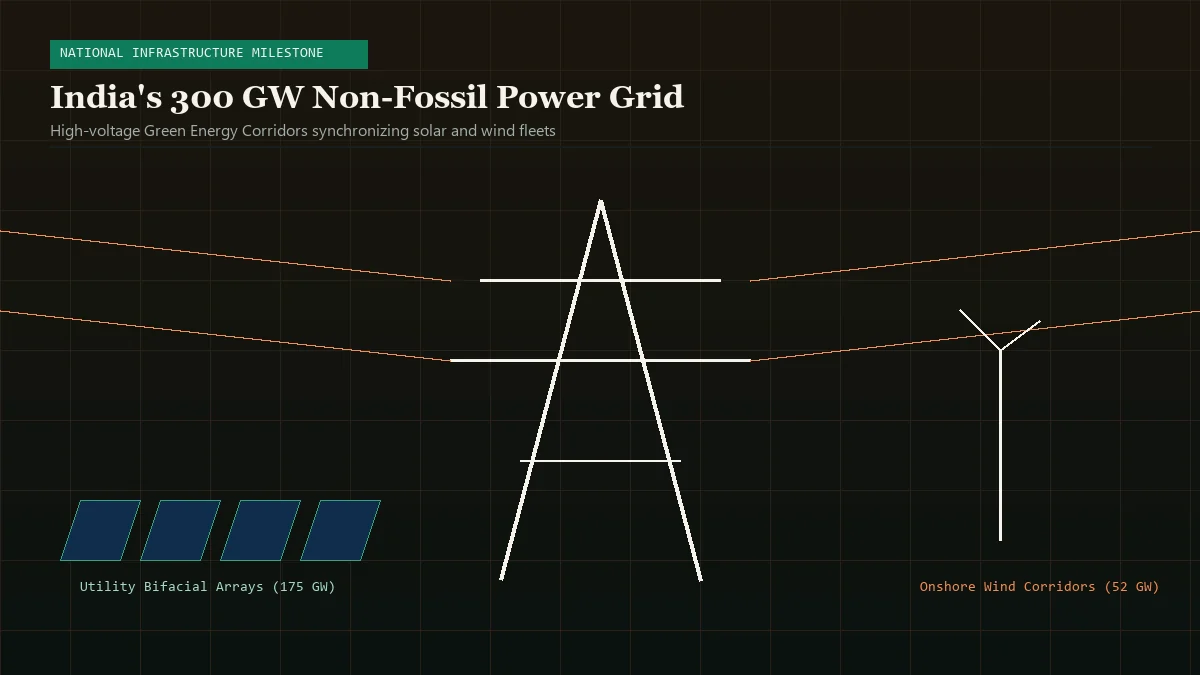
India has officially breached the landmark threshold of 300 gigawatts (GW) of installed non-fossil electricity capacity, cementing its position as one of the world’s fastest-growing clean energy giants. The milestone marks a major step toward New Delhi’s statutory commitment of reaching 500 GW of non-fossil capacity by 2030. Yet, as detailed in recent findings from the International Energy Agency (IEA) and the [Ministry of New and Renewable Energy](https://mnre.gov.in/) (MNRE), the transition is entering its most complex phase. Protecting macroeconomic stability against global hydrocarbon shocks now hinges on solving brutal grid physics: deploying multi-gigawatt-hour battery storage, executing pumped hydro storage corridors, and managing steep evening peak demands.
A Milestone of Global Proportion
In late 2026, the [Central Electricity Authority](https://cea.nic.in/) (CEA) and the Ministry of New and Renewable Energy (MNRE) confirmed a historic milestone in global energy history: India’s total installed non-fossil fuel electricity generation capacity officially surpassed 300 gigawatts (GW).
This achievement accounts for nearly 47 percent of the nation’s total electric power generation portfolio, placing India years ahead of its original Paris Agreement Nationally Determined Contribution (NDC) pledge—which aimed to achieve 40 percent non-fossil capacity by 2030. The achievement represents an astonishing expansion: in 2014, India’s total renewable capacity stood at just 35 GW. Today, the country ranks fourth globally in total installed renewable power, trailing only China, the United States, and Germany.
Yet this 300 GW milestone is far more than an impressive statistical bragging right for international summits. For a nation of 1.45 billion people experiencing surging industrialization, rapid urbanization, and escalating summer heatwaves, clean energy expansion has transformed from an environmental aspiration into the cornerstone of sovereign economic security.
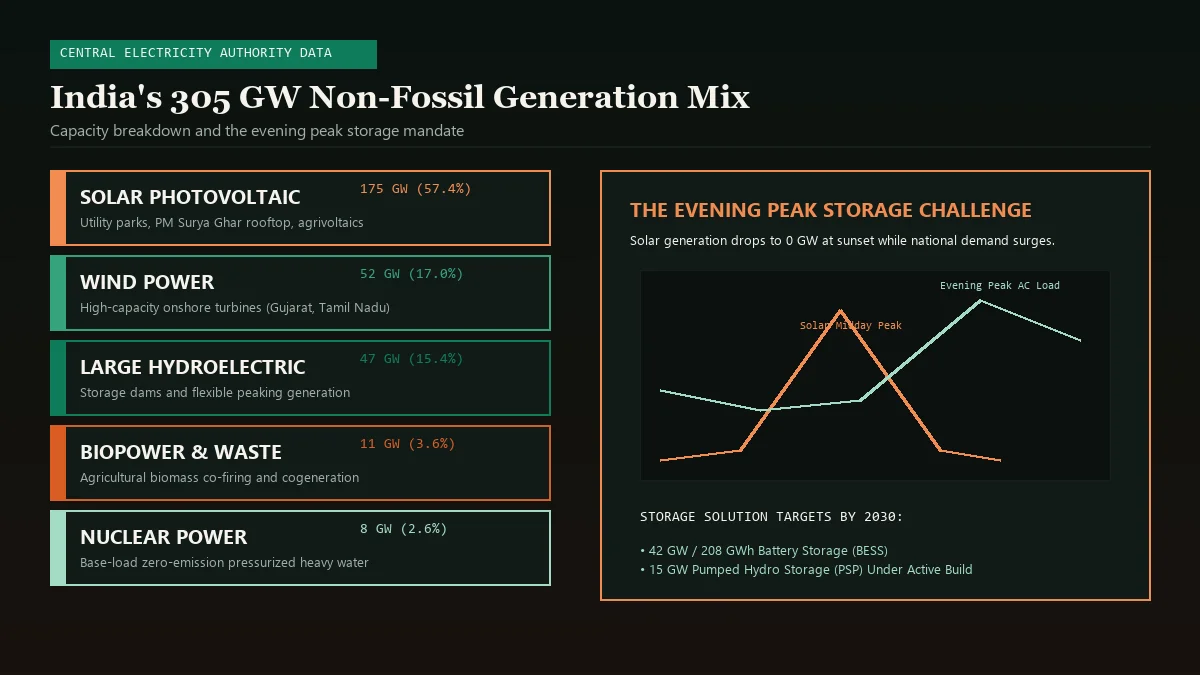
``` ======================================================================================== INDIA'S NON-FOSSIL POWER PORTFOLIO (~305 GW) ======================================================================================== [1. SOLAR PHOTOVOLTAIC] -> ~175 GW (Utility-scale parks, rooftop, agrivoltaics) [2. WIND POWER] -> ~52 GW (Onshore Gujarat, Tamil Nadu, Karnataka) [3. LARGE HYDROELECTRIC] -> ~47 GW (Himalayan basin storage and run-of-river) [4. BIOPOWER & WASTE-TO-ENERGY]-> ~11 GW (Biomass co-firing, bagasse cogeneration) [5. NUCLEAR POWER] -> ~8 GW (NPCIL pressurized heavy water & VVER reactors) ======================================================================================== ```
Economic Security: Decoupling Growth From Hydrocarbon Volatility
The geopolitical urgency underlying India’s clean energy acceleration is rooted in macroeconomic vulnerability. India remains one of the world’s largest importers of primary energy, importing over 87 percent of its crude oil requirements and nearly 50 percent of its natural gas consumption.
According to analytical data released in the International Energy Agency’s (IEA) India Energy Outlook, global hydrocarbon price spikes routinely threaten India’s fiscal deficit, drive domestic inflation, and deplete foreign exchange reserves. During global supply crunches, imported thermal coal prices have previously forced domestic power tariffs to escalate, stressing state electricity distribution companies (DISCOMs).
By adding 25 to 30 GW of domestic renewable generation capacity annually, India is effectively installing a structural domestic hedge against global geopolitical volatility:
- Foreign Exchange Savings: Every gigawatt-hour of solar and wind generation directly displaces imported liquefied natural gas (LNG) and high-calorific Indonesian or Australian coal. MNRE estimates that renewable generation currently saves the Indian treasury upwards of $12 billion annually in avoided fossil-fuel import bills.
- Tariff Deflation: While imported fossil generation costs fluctuate wildly between ₹6.50 and ₹11.00 per kilowatt-hour (kWh) during global commodity crunches, Indian utility solar tariffs have maintained long-term power purchase agreements (PPAs) between ₹2.40 and ₹2.75 per kWh, delivering long-term price certainty to energy-intensive manufacturing clusters.
The Domestic Manufacturing Pivot: From Assembling to Engineering
A critical shift that distinguishes this 300 GW milestone from previous phases is the aggressive domestication of the clean-tech supply chain. Historically, India’s solar boom was heavily dependent on imported photovoltaic modules and wafers, with over 80 percent of hardware originating from abroad.
Recognizing that replacing Middle Eastern oil dependency with East Asian clean-tech hardware dependency would merely substitute one vulnerability for another, the Indian government enacted powerful industrial policy levers:
- The Production Linked Incentive (PLI) Scheme: Backed by multibillion-dollar fiscal outlays, the national PLI scheme has accelerated integrated, gigawatt-scale manufacturing. Domestic solar module manufacturing capacity has surged past 60 GW annually, with domestic cell lines exceeding 25 GW and significant investments breaking ground for polysilicon and ingot production.
- The Approved List of Models and Manufacturers (ALMM): By strictly mandating that all government-backed tenders, open-access industrial projects, and subsidized rooftop initiatives utilize only ALMM-certified domestic equipment, the regulatory framework created guaranteed off-take markets for local manufacturers.
- Advanced Chemistry Cell (ACC) Battery PLI: To localize battery manufacturing for electric vehicles and grid storage, India has committed over $2 billion in incentives to establish 50 GWh of advanced cell fabrication plants across the subcontinent, reducing raw-material dependence on foreign supply chains.
The Grid Physics Dilemma: Confronting the "Duck Curve"
While generating daytime electrons from solar parks in the deserts of Rajasthan and Gujarat is a solved engineering problem, integrating those electrons into a synchronized national grid is where physical limits are encountered.
India’s power system faces an acute manifestation of the famous "duck curve." Peak solar generation floods the grid between 11:00 AM and 2:00 PM, creating massive midday surpluses. However, India’s peak electricity demand occurs between 7:00 PM and 10:30 PM, driven by domestic air-conditioning loads, municipal lighting, and evening commercial activity. At the exact hour the sun sets, renewable generation plummets, requiring the grid operator—the Grid Controller of India (Grid-India)—to scramble thousands of megawatts of flexible thermal generation or face catastrophic voltage collapse and frequency deviations.
Without massive energy storage, India risks curtailing clean energy during the day while continuing to burn low-efficiency coal at night.
``` ======================================================================================== THE EVENING PEAK STORAGE CHALLENGE ======================================================================================== MIDDAY SURPLUS (11 AM - 3 PM) -> 175 GW Solar Flood -> Storage Charging / Curtailment Risk SUNSET CLIFF (5 PM - 7 PM) -> Solar Output Drops to 0 GW in 90 Minutes EVENING PEAK (7 PM - 10 PM) -> Surging AC Demand -> Must be Met by BESS, PSP & Coal ======================================================================================== ```
The Storage Mandate: Battery Energy Storage and Pumped Hydro
To transcend this structural ceiling and march confidently toward the 500 GW target by 2030, India has pivoted its entire procurement strategy toward firm, dispatchable renewable energy (FDRE) and round-the-clock (RTC) power:
#### 1. Battery Energy Storage Systems (BESS) The Solar Energy Corporation of India (SECI) and state utilities have aggressively tendered standalone and co-located BESS projects. India’s national target mandates 42 GW / 208 GWh of storage by 2030. To overcome high initial capital costs, the Central Government introduced a Viability Gap Funding (VGF) scheme covering up to 40 percent of the capital expenditure for 13 GWh of battery storage projects, driving down standalone storage auction tariffs to unprecedented lows.
#### 2. The Pumped Storage Project (PSP) Renaissance While chemical batteries excel at fast-frequency response and short-duration discharge (1 to 4 hours), large-scale seasonal and long-duration storage belongs to pumped storage hydropower. India has identified over 119 GW of off-river closed-loop and on-river pumped hydro potential. The Ministry of Power has streamlined environmental clearances, exempted PSP projects from interstate transmission charges, and allocated dozens of sites across Maharashtra, Andhra Pradesh, Odisha, and Madhya Pradesh to public and private utilities. Over 15 GW of PSP capacity is currently under active construction.
Expanding the Supergrid: Green Energy Corridors
Generation assets are geographically concentrated: the high solar insolation of Rajasthan and Ladakh, and the offshore and coastal wind regimes of Gujarat and Tamil Nadu, are located thousands of kilometers away from the dense industrial and urban load centers of Uttar Pradesh, Maharashtra, and Delhi.
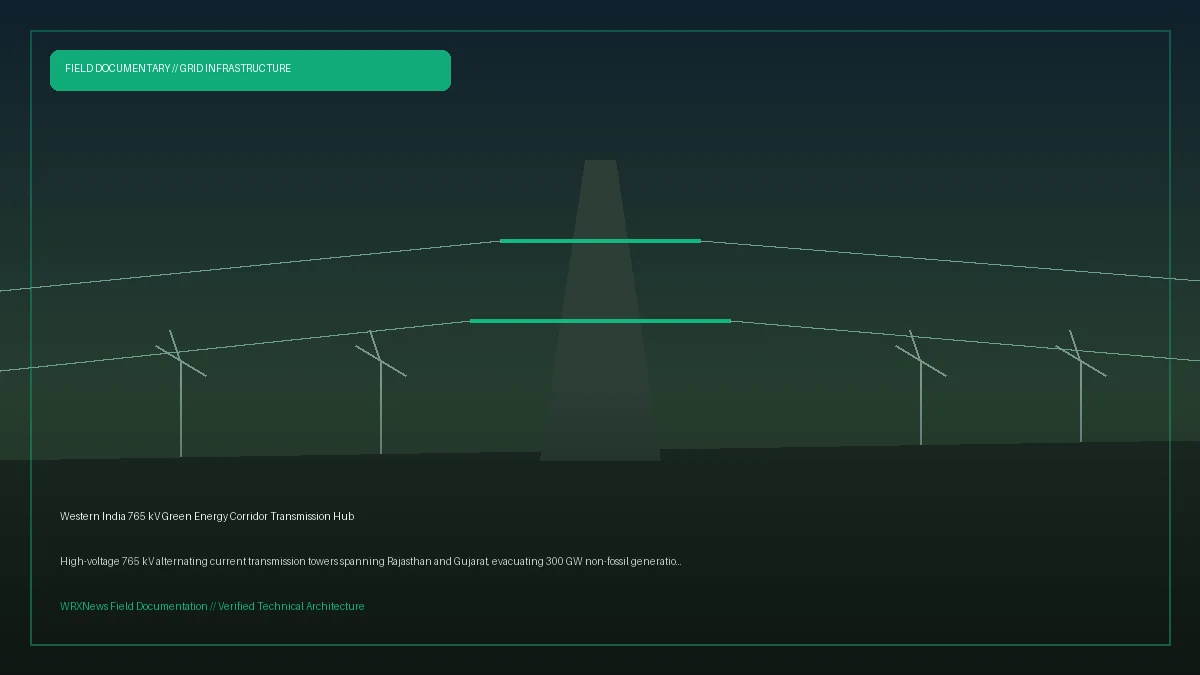
To resolve this geographical mismatch, India has executed one of the largest synchronized transmission buildouts on earth: the Green Energy Corridor (GEC) initiative. By constructing high-voltage direct current (HVDC) bipole lines—operating at up to 800 kV—and thousands of circuit kilometers of 765 kV alternating current lines, the Interstate Transmission System (ISTS) can evacuate dozens of gigawatts of clean power seamlessly across regional borders without overloading local distribution grids. Crucially, the Central Electricity Regulatory Commission (CERC) has maintained waivers on ISTS transmission charges for renewable projects commissioned through 2028, eliminating artificial geographic pricing distortions.
The Horizon Toward 500 GW
Crossing the 300 GW mark proves that India can build clean energy capacity at unprecedented speed. But the next 200 GW will be exponentially harder than the first. Reaching 500 GW by 2030 requires not just adding more solar panels, but fundamentally reimagining the electricity ecosystem: digitizing distribution utilities, deploying dynamic smart tariffs, enforcing renewable purchase obligations (RPOs), and expanding green hydrogen industrial off-take.
India has demonstrated to the global community that a rapidly developing economic powerhouse can decouple power generation from carbon intensity. The world will be watching closely as India now attempts to prove that a modern mega-grid can be balanced entirely on clean electrons and sovereign storage.
---
Frequently Asked Questions
What constitutes India’s non-fossil fuel capacity?
India’s non-fossil capacity includes all utility-scale and distributed solar photovoltaic systems, onshore and offshore wind energy, large and small hydroelectric power, biomass/bagasse cogeneration, waste-to-energy, and civil nuclear power plants.
What is the specific difference between renewable capacity and total non-fossil capacity?
Under international definitions and India's Central Electricity Authority categorization, nuclear power is classified as "non-fossil fuel" because it emits zero direct operational greenhouse gases, but it is not classified as "renewable" due to its dependence on mined uranium fuel. When nuclear (~8 GW) is subtracted, India’s purely renewable capacity stands at approximately 297 GW.
What is "Firm, Dispatchable Renewable Energy" (FDRE)?
FDRE refers to power supply contracts where renewable developers combine solar, wind, and storage technologies to guarantee a predictable, scheduled output profile to the grid operator, matching the load curve demanded by utilities rather than generating power only when the sun shines or the wind blows.
Why are interstate transmission system (ISTS) waivers so important?
Building long-distance high-voltage power lines involves substantial capital and operational charges. By waiving ISTS transmission charges for renewable projects, the central government allows solar and wind energy generated in high-resource western and southern states to be delivered to load centers in northern and eastern states without incurring punitive transmission fees, making clean energy cost-competitive nationwide.