India's Solar Expansion: The 175 GW Milestone, PM Surya Ghar Revolution, and the Industrialization of Rooftops
India reaches 175 GW of installed solar power. Explore the breakthrough of PM Surya Ghar rooftop solar, agricultural pumps, mega parks, and ALMM manufacturing.
By WRXNEWS Energy & Clean Tech Desk | Published | Updated
Executive Summary & Direct Answer
As of 31 October 2026, India's cumulative installed solar capacity reached an unprecedented 175 gigawatts (GW), establishing photovoltaic power as the primary engine of the subcontinent's clean energy transition. While massive ultra-mega solar parks in Rajasthan and Gujarat laid the groundwork, the current growth phase is defined by a decentralized democratization: the explosive uptake of the PM Surya Ghar Muft Bijli Yojana rooftop initiative, the rapid expansion of solar-powered agricultural pumps under PM-KUSUM, and the enforcement of the ALMM domestic manufacturing mandate.
The Photovoltaic Revolution Reaches Critical Mass
Official data compiled by the Ministry of New and Renewable Energy (MNRE) and the Central Electricity Authority (CEA) confirms that as of 31 October 2026, India’s cumulative installed solar photovoltaic capacity crossed 175 gigawatts (GW).
To comprehend the scale and velocity of this buildout, one must look back barely a decade. In 2014, India possessed less than 3 GW of grid-connected solar power. Reaching 175 GW represents nearly a sixty-fold expansion in twelve years. Solar energy now accounts for over 57 percent of India's total non-fossil capacity and generates approximately 20 percent of the country’s total midday electricity demand.
Yet the qualitative narrative behind this 175 GW milestone is undergoing a profound structural evolution. In its initial boom years, India’s solar expansion was almost exclusively characterized by gargantuan, centralized utility-scale installations located in remote desert corridors. Today, while ultra-mega solar parks remain vital baseload anchors, the growth vector has decisively decentralized—moving directly onto residential rooftops, rural agricultural feeders, factory sheds, and irrigation canals.
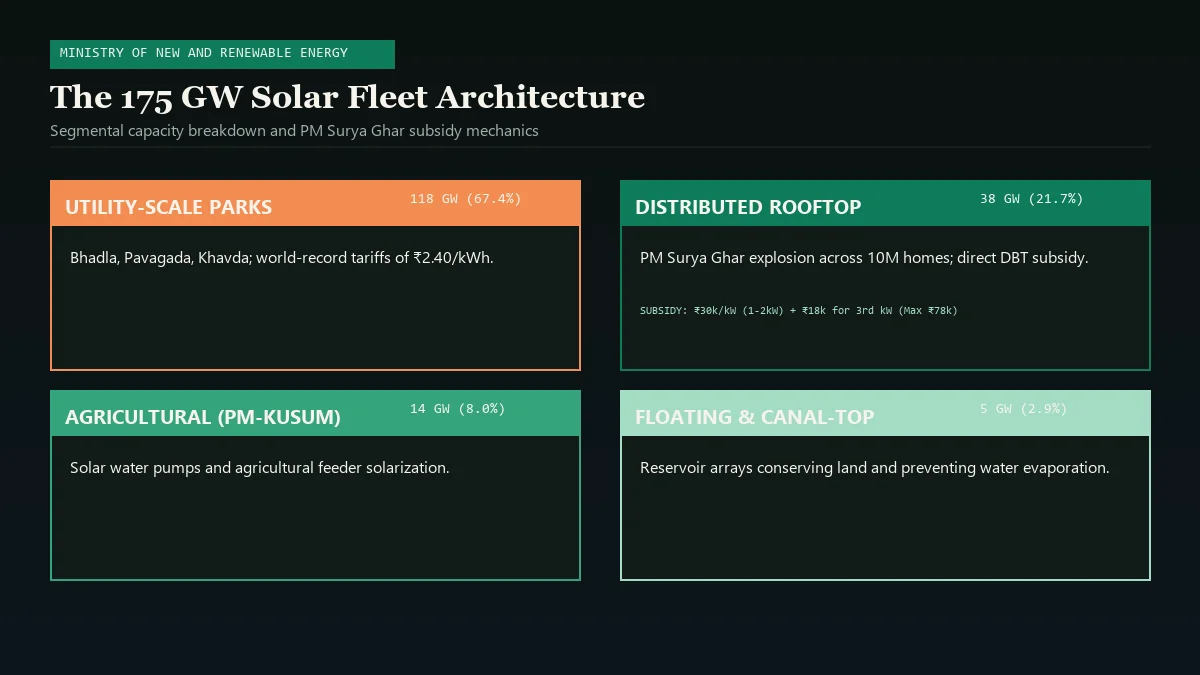
======================================================================================== INDIA'S 175 GW SOLAR FLEET ARCHITECTURE ======================================================================================== [1. UTILITY-SCALE SOLAR PARKS] -> ~118 GW (Bhadla, Pavagada, Khavda, Rewa) [2. RESIDENTIAL & C&I ROOFTOP] -> ~38 GW (Surging via PM Surya Ghar & commercial PPA) [3. AGRICULTURAL & OFF-GRID] -> ~14 GW (PM-KUSUM solar pumps & feeder solarization) [4. FLOATING & CANAL-TOP SOLAR] -> ~5 GW (Reservoirs, canals, water body co-location) ========================================================================================
The Decentralized Explosion: PM Surya Ghar Muft Bijli Yojana
For years, India’s solar achilles heel was residential rooftop adoption. While utility tenders regularly closed in days, residential homeowners hesitated, paralyzed by complex permitting, slow net-metering approvals from state electricity distribution companies (DISCOMs), and onerous upfront capital costs.
That dynamic shifted radically with the nationwide execution of the PM Surya Ghar: Muft Bijli Yojana (Free Electricity Scheme). Backed by a direct central budgetary allocation of ₹75,021 crore (over $9 billion USD), the program set an aggressive target: installing rooftop solar systems on 10 million Indian households.
By late 2026, the program’s systemic structural reforms had unlocked an exponential adoption curve:
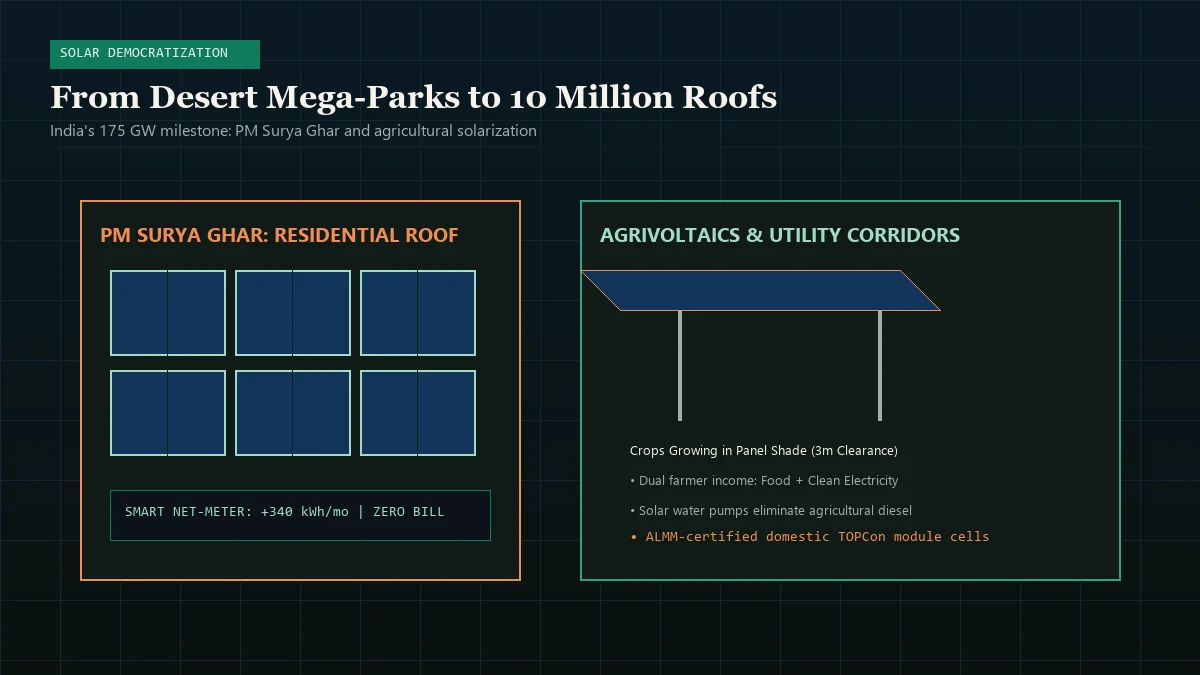
- Direct Benefit Transfer (DBT) Subsidies: The central government eliminated convoluted multi-month reimbursement channels. Homeowners installing up to 2 kW systems receive an immediate, non-discretionary capital subsidy of ₹60,000 directly into their bank accounts within thirty days of technical commissioning, with systems up to 3 kW receiving ₹78,000.
- National Single-Window Digital Portal: Homeowners can select certified local vendors, calculate diurnal generation profiles, apply for collateral-free bank loans at concessional interest rates (under 7 percent), and request net-meter installations through a unified digital interface.
- DISCOM Alignment and Incentivization: Historically, distribution utilities viewed rooftop solar as a threat to their highest-paying domestic consumer base. Under the revised framework, DISCOMs receive performance-linked financial incentives from the central government based on the cumulative rooftop capacity energized in their licensed areas.
As a result, residential rooftop capacity, which languished below 10 GW for years, has surged past 24 GW, with commercial and industrial (C&I) rooftop installations pushing total distributed rooftop solar beyond 38 GW. In cities across Gujarat, Maharashtra, Rajasthan, and Uttar Pradesh, residential rooftops have transformed from passive concrete slabs into income-generating micro-power stations.
Sun and Soil: Solarizing Agriculture Through PM-KUSUM
Nowhere is the intersection between climate action, energy access, and human well-being more apparent than in rural India. Under the Pradhan Mantri Kisan Urja Suraksha evam Utthaan Mahabhiyan (PM-KUSUM), solar energy is systematically dismantling one of the most toxic fiscal and environmental cycles in the Indian economy: agricultural diesel consumption and unmetered groundwater depletion.
For decades, millions of Indian farmers relied on polluting, expensive diesel pumps to irrigate crops, or depended on heavily subsidized, erratic nocturnal grid power that forced farmers to irrigate fields at midnight.
Under the three components of PM-KUSUM:
- Component A (Grid-Connected Solar Plants): Farmers, cooperatives, and panchayats have installed small-scale solar power plants (0.5 MW to 2 MW) on barren or fallow agricultural lands, selling power directly to local substations and earning steady rental yields.
- Component B (Standalone Solar Pumps): Over 1.5 million standalone off-grid solar water pumps have replaced diesel engines in remote areas, providing farmers with reliable, daytime pressurized irrigation without consuming a single drop of subsidized diesel.
- Component C (Feeder-Level Solarization): Agricultural electrical feeders are separated from domestic lines and energized directly by dedicated local solar arrays. Farmers receive free daytime irrigation power, while DISCOMs drastically reduce their agricultural subsidy burdens and avoid expensive rural transmission line losses.
Crucially, modern agrivoltaics—elevating solar arrays three meters above the ground to cultivate shade-tolerant horticulture like chilies, turmeric, and leafy greens beneath the panels—has emerged as a commercial reality. Farmers reap two crops simultaneously: agricultural harvests from the soil and clean electricity harvests from the sky.
The Industrial Bedrock: Ultra-Mega Solar Parks
While distributed solar captures public imagination, the backbone of India's 175 GW fleet remains its world-record utility-scale solar parks. Facilities such as the Bhadla Solar Park in Rajasthan (2,245 MW), the Pavagada Solar Park in Karnataka (2,050 MW), and the monumental Khavda Renewable Energy Park currently rising in the Rann of Kutch (slated for over 30 GW of hybrid solar and wind capacity) represent masterclasses in civil and electrical engineering.
By pooling land acquisition, constructing shared internal transmission lines, deploying automated water-free robotic cleaning systems, and securing long-term power purchase agreements with SECI, these parks drove Indian solar tariffs down to historic global lows of ₹2.00 to ₹2.50 per kWh.
However, utility-scale developers face mounting structural constraints:
- Land Acquisition and Ecological Sensitivities: Securing contiguous parcels of tens of thousands of acres has become legally and socially fraught, exemplified by litigation over the habitat corridors of the critically endangered Great Indian Bustard (GIB) in Rajasthan and Gujarat.
- Water Consumption in Arid Zones: Traditional panel washing in dusty desert climates previously consumed millions of liters of scarce groundwater. The rapid industry transition to waterless robotic crawling brushes has mitigated this footprint, saving over 85 percent of operational water use.
The Domestic Industrial Shield: ALMM and the PLI Framework
India’s solar expansion is fundamentally distinct from previous renewable transitions in that it is explicitly designed to foster domestic industrial sovereignty.
Under the Approved List of Models and Manufacturers (ALMM) enforced by the MNRE, developers participating in government tenders or availing open-access grid incentives cannot import cheap foreign photovoltaic modules. Only modules and cells manufactured in facilities physically inspected and certified by the National Institute of Solar Energy (NISE) are permitted.
Supported by the ₹24,000 crore Production Linked Incentive (PLI) Scheme for High-Efficiency Solar PV Modules, domestic manufacturing capacity has exploded:
- Domestic solar module assembly capacity has crossed 65 GW per annum.
- Domestic solar cell manufacturing capacity has surged to over 28 GW per annum.
- Advanced manufacturers are investing heavily in vertically integrated plants capable of processing polysilicon, casting ingots, slicing ultra-thin wafers, and fabricating high-efficiency TOPCon (Tunnel Oxide Passivated Contact) and heterojunction (HJT) cells.
By establishing a protective domestic ecosystem, India has insulated its clean energy rollout from global supply chain embargoes, shipping container shocks, and currency devaluations.

The Next Frontier: Floating Solar and Microgrids
As land constraints tighten, Indian public sector undertakings like NTPC and NHPC have pioneered **floating solar photovoltaic (FSPV)** systems. By mounting panels on floating platforms installed across hydroelectric reservoirs and industrial cooling ponds (such as the 100 MW floating array at Ramagundam, Telangana), developers bypass land acquisition altogether. Floating arrays offer significant co-benefits: the cooling effect of the water boosts panel electrical efficiency by 5 to 10 percent, while the physical panel shade prevents millions of cubic meters of water from evaporating into the arid atmosphere.
India’s 175 GW milestone is not a finish line; it is a springboard. With the technology matured, the domestic manufacturing supply chain established, and millions of domestic consumers transformed into clean energy producers, India has crafted a repeatable blueprint for how the developing world can build a solar-powered future on its own sovereign terms.
---
Frequently Asked Questions
What is the primary difference between utility-scale solar and rooftop solar?
Utility-scale solar refers to massive, ground-mounted photovoltaic power plants (ranging from 10 MW to several gigawatts) connected directly to high-voltage transmission networks, selling wholesale electricity to utilities. Rooftop solar involves smaller photovoltaic arrays (ranging from 1 kW on homes to several hundred kilowatts on industrial warehouses) installed directly on rooftops, serving on-site electricity needs and feeding surplus energy back into local distribution lines.
How much money does a household save with the PM Surya Ghar scheme?
A standard 3 kW residential rooftop solar system in India produces approximately 360 to 420 kWh of electricity per month. For a middle-class household paying ₹7 to ₹9 per unit, this saves between ₹2,500 and ₹3,500 monthly on electricity bills, effectively reducing the household’s net electric power bill to near-zero while paying back the homeowner’s subsidized capital investment within three to four years.
What is the Approved List of Models and Manufacturers (ALMM)?
The ALMM is a statutory registry maintained by the Ministry of New and Renewable Energy (MNRE). It lists solar module and cell manufacturing facilities and models that have undergone rigorous government audits for manufacturing quality, technical performance, and domestic origin. Only certified products on this list are eligible for use in government projects, government-subsidized schemes, and open-access industrial setups.
What are agrivoltaics and how do they benefit farmers?
Agrivoltaics is the simultaneous co-location of agriculture and solar electricity generation on the same land parcel. Solar panels are mounted on elevated stanchions (2.5 to 3.5 meters high) with wide spacing, allowing tractors and farm machinery to operate underneath. The partial shade creates a microclimate that reduces soil evaporation, protects delicate crops from intense midday solar scorching, and provides farmers with dual income streams from food and electricity.