Solar Energy Pocket Reference: Essential Terms, Formulas, Units and Sizing Calculations
A practical digital field reference for solar energy: essential physics formulas, electrical conversions, STC vs NOCT, temperature derating, and industry acronyms.
By M. Khalif | Published 2026-11-18 | Updated 2026-11-18
Whether you are an electrical engineer sizing a commercial rooftop array, a field technician commissioning an inverter, a student studying renewable energy, or a homeowner reviewing contractor proposals, having an authoritative, concise reference of fundamental constants, formulas, units, and industry terms is invaluable. Solar photovoltaics operates at the intersection of solid-state quantum physics, atmospheric optics, power electronics, and civil engineering.
This digital solar energy pocket reference compiles the mathematical equations, electrical conversion factors, standard testing thresholds, and acronyms used daily across the solar industry. Bookmark this guide as an ongoing field reference for evaluating system sizing, temperature losses, energy yields, and performance metrics.
Fundamental Solar Physical Constants and Standard Conditions
Accurate solar calculations require precise physical baseline definitions:
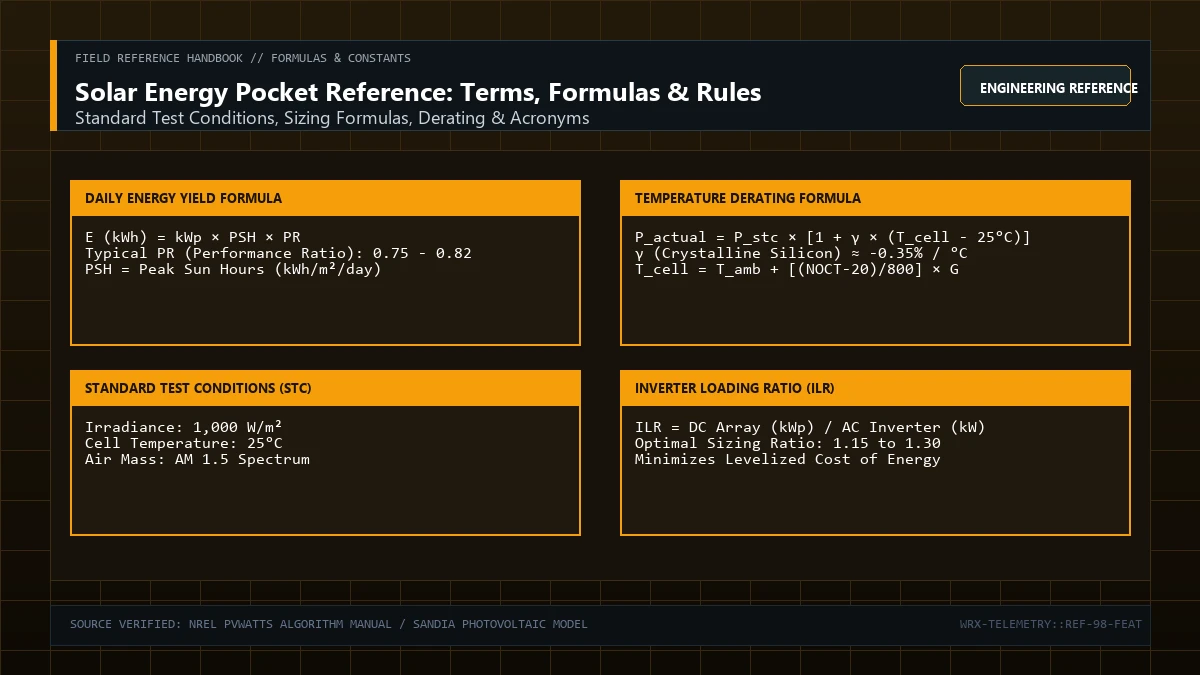
• The Solar Constant (G_sc): 1,361 W/m² (the average solar irradiance received on a surface perpendicular to the sun's rays outside Earth's atmosphere at mean orbital distance). • Standard Test Conditions (STC): The universal laboratory benchmark used by manufacturers to rate solar panel wattage on nameplate datasheets: - Irradiance: Exactly 1,000 W/m² - Cell Temperature: 25°C (77°F) - Solar Spectrum: Air Mass 1.5 Global (AM1.5G, representing the path length sunlight travels through the atmosphere when the sun is at a zenith angle of 48.2°) • Nominal Module Operating Temperature (NMOT / NOCT): A more realistic indicator of field performance than STC: - Irradiance: 800 W/m² - Ambient Air Temperature: 20°C (68°F) - Wind Speed: 1.0 m/s - Module: Open back-mounting • Peak Sun Hours (PSH): The equivalent number of hours per day during which solar irradiance averages 1,000 W/m². For example, if a roof receives 5.2 kWh/m² of total solar radiation throughout the day, that location provides 5.2 Peak Sun Hours.
Core Engineering Formulas and Sizing Equations
1. Daily Energy Yield Estimation (kWh): $\text{Daily Yield (kWh)} = \text{System Capacity (kWp)} \times \text{PSH (Hours)} \times \text{PR}$ Where PR is the Performance Ratio (typically 0.75 to 0.82) accounting for thermal derating, inverter efficiency, wire resistance, dirt, and clipping.
2. Real-World Temperature Derating of Power: $P_{\text{actual}} = P_{\text{STC}} \times \left[1 + \gamma_{\text{Pmax}} \times (T_{\text{cell}} - 25^\circ\text{C})\right]$ Where $\gamma_{\text{Pmax}}$ is the module's temperature coefficient of maximum power (typically -0.30% to -0.38% per °C for monocrystalline silicon; N-type TOPCon and HJT cells achieve better performance at -0.26% to -0.30%/°C).
3. Estimating Cell Temperature from Ambient Weather: $T_{\text{cell}} = T_{\text{ambient}} + \left(\frac{\text{NOCT} - 20}{800}\right) \times G$ Where G is the incident solar irradiance in W/m².
4. Inverter Loading Ratio (ILR, or DC-to-AC Ratio): $\text{ILR} = \frac{\text{DC Array Nameplate Capacity (kWp)}}{\text{AC Inverter Rated Output (kW)}}$ Optimal commercial sizing typically targets an ILR of 1.15 to 1.30. Sizing the DC array slightly larger than the AC inverter ensures the inverter operates closer to peak efficiency during early morning, late afternoon, and overcast conditions, with minimal economic loss from midday clipping.
5. Array Surface Area Requirement: $\text{Required Area (m}^2) = \frac{\text{Target System Capacity (kWp)} \times 1000}{\text{Module Power (W)}} \times \text{Module Area (m}^2)$ Rule of thumb: Modern 400W–430W residential modules average 1.95 to 2.1 square meters. A typical 10 kWp residential array requires roughly 48 to 55 square meters (520 to 590 square feet) of unshaded roof space.
The Essential Photovoltaic Acronym Glossary
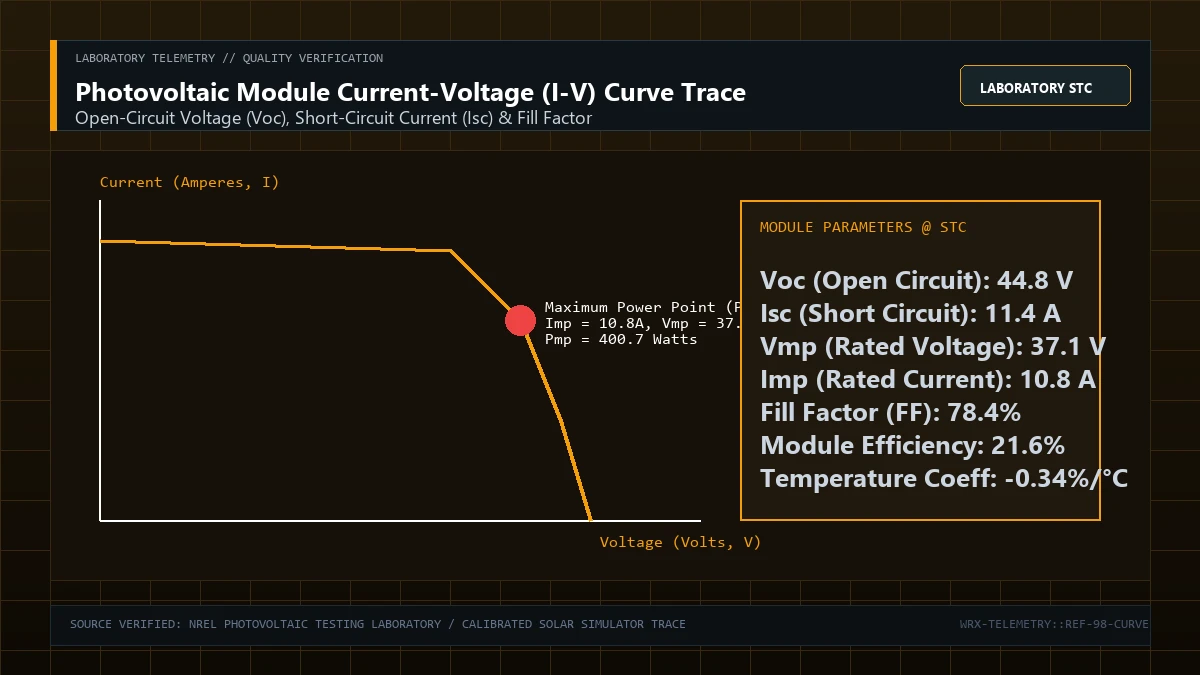
• MPPT (Maximum Power Point Tracking): An advanced electronic algorithm in solar inverters that dynamically adjusts electrical impedance along the panel's Current-Voltage (I-V) curve to extract the maximum possible wattage under varying sunlight. • BOS (Balance of System): All hardware components in a photovoltaic system other than the solar panels themselves—including inverters, racking, combiner boxes, conduit, wiring, disconnect switches, and meters. • GHI (Global Horizontal Irradiance): The total solar radiation received on a horizontal surface, comprising Direct Normal Irradiance (DNI) and Diffuse Horizontal Irradiance (DHI): $\text{GHI} = \text{DNI} \times \cos(\theta) + \text{DHI}$. • LCOE (Levelized Cost of Electricity): The net present cost of electricity generation over the full system lifespan, dividing total lifetime capital and operating costs by total lifetime kilowatt-hours generated. • Voc (Open-Circuit Voltage): The maximum voltage produced across a panel when no external circuit is connected and zero current flows. • Isc (Short-Circuit Current): The maximum current produced when the positive and negative terminals are directly connected together at zero resistance. • Vmp & Imp: Voltage and Current at the Maximum Power Point ($P_{\text{mp}} = V_{\text{mp}} \times I_{\text{mp}}$). • PID (Potential-Induced Degradation): Performance loss caused by stray electrical leakage currents between semiconductor cells and the grounded metal frame. • LID (Light-Induced Degradation): Initial efficiency drop (typically 1–2%) occurring during the first few days of sun exposure in P-type boron-doped silicon; eliminated in modern N-type cells.
Silicon Cell Technologies: Comparison Snapshot
• Monocrystalline PERC (Passivated Emitter and Rear Cell): Standard legacy technology (2018–2023). Commercial efficiency: 20.5%–21.5%. P-type silicon wafer. Temperature coefficient: ~-0.35%/°C. • N-Type TOPCon (Tunnel Oxide Passivated Contact): Current commercial mainstream (2024–2026). Commercial efficiency: 22.0%–23.2%. N-type silicon eliminates boron-oxygen LID defects. Temperature coefficient: ~-0.30%/°C. Superior bifaciality (up to 80%). • HJT (Heterojunction Technology): Crystalline silicon wafer sandwiched between ultra-thin amorphous silicon layers. Commercial efficiency: 22.5%–23.8%. Outstanding temperature coefficient (-0.26%/°C) and bifaciality (85–90%), but higher initial manufacturing cost. • Perovskite-Silicon Tandem Cells: Next-generation laboratory and pilot technology stacking high-bandgap perovskite layers on silicon base cells. Laboratory efficiencies exceed 33.9%, breaking single-junction theoretical limits.
Field Rules of Thumb and Common Pitfalls to Avoid
• True South vs Magnetic South: Always align fixed arrays to True South in the Northern Hemisphere (True North in Southern Hemisphere). In regions with large magnetic declination (e.g., Maine at -15° or Oregon at +14°), compass readings must be adjusted, or use GPS solar noon. • Tilt Angle Optimization: For year-round maximum generation, tilt angle should approximate the site's latitude. To favor winter generation, tilt at latitude + 15°; to favor summer generation, tilt at latitude - 15°. • Don't Ignore Voltage Temperature Rise: Open-circuit voltage (Voc) rises as temperature drops. When designing inverter string lengths in cold climates, calculate Voc at the record minimum winter temperature to ensure the string never exceeds the inverter's maximum input voltage rating (typically 600V for residential US, 1000V for EU/commercial, or 1500V for utility), which destroys inverter input capacitors. • Shading Impact: Because cells within a module are connected in series, shading even 10% of a panel can collapse the entire string's output if bypass diodes fail to engage properly.
Frequently Asked Questions
What is the difference between solar irradiance and solar insolation?
Solar irradiance is the instantaneous power density received from the sun, measured in Watts per square meter (W/m²). Solar insolation is the total solar energy accumulated over a period of time, measured in kilowatt-hours per square meter per day (kWh/m²/day) or Peak Sun Hours.
Why do solar panels produce less power on very hot days?
As semiconductor temperatures rise above 25°C, thermal vibrations in the silicon lattice increase electron-hole recombination and decrease open-circuit voltage. For crystalline silicon, power output drops by approximately 0.30% to 0.38% per degree Celsius rise in cell temperature.
What is the Inverter Loading Ratio (ILR) and why is it important?
The Inverter Loading Ratio (ILR, or DC-to-AC ratio) is the total DC capacity of the solar panels divided by the maximum AC power output of the inverter. Sizing this ratio between 1.15 and 1.30 ensures the inverter operates near maximum efficiency during early morning, late afternoon, and cloudy conditions.
What is the Performance Ratio (PR) of a solar PV system?
Performance Ratio (PR) is the ratio between actual usable AC electricity delivered by the system and the theoretical maximum electricity it would produce under ideal Standard Test Conditions without losses. Modern well-engineered solar systems typically achieve a PR between 75% and 82%.