What Is Solar Energy? Sources, Conversion Technologies and Global Applications Explained
What is solar energy? Explore how solar radiation is generated by nuclear fusion, atmospheric transmission, photovoltaic and thermal conversion, and its limits.
By WRXNEWS Editorial Team | Published 2026-11-18 | Updated 2026-11-18
Solar energy is electromagnetic radiant energy produced by thermonuclear fusion in the core of the Sun, transmitted across 150 million kilometers (93 million miles) of space, and intercepted by Earth. It is the primary energy engine of our planet: solar radiation drives atmospheric circulation (wind), powers the hydrological cycle (rainfall and hydropower), warms the oceans, and enables photosynthesis, which sustains biological life and created all fossil fuel reserves over geological epochs.
From a modern technological perspective, solar energy refers to human methods for capturing this continuous radiant flux and converting it into regulated, usable forms of power—principally electricity and thermal heat. In sheer physical abundance, the solar resource dwarfs all other energy reserves combined: more solar energy strikes Earth's surface in 90 minutes (approximately 430 quintillion Joules) than all human civilization consumes in an entire year. Understanding the physical origin of solar radiation, its atmospheric behavior, and the engineering pathways used to harness it is the foundation of the clean energy transition.
The Physical Source: Thermonuclear Fusion in the Solar Core
The ultimate origin of solar energy is nuclear fusion taking place in the Sun's core, where extreme temperatures (approximately 15 million Kelvin) and immense gravitational pressures fuse four hydrogen nuclei (protons) into a single helium-4 nucleus through the proton-proton chain reaction:
$4\,^1\text{H} \rightarrow \,^4\text{He} + 2e^+ + 2\nu_e + 26.73\text{ MeV}$
Every second, the Sun fuses roughly 600 million metric tonnes of hydrogen into helium, converting approximately 4 million tonnes of mass into pure electromagnetic energy according to Einstein's mass-energy equivalence ($E = mc^2$). This energy radiates outward through the Sun's radiative and convective zones over hundreds of thousands of years before escaping the photosphere as radiant photons.
The resulting electromagnetic radiation spans three primary spectral bands: • Ultraviolet (UV, wavelengths < 400 nm): Accounts for approximately 8% of solar irradiance. • Visible Light (400 nm to 700 nm): Accounts for approximately 47% of solar irradiance; the human eye is attuned to this peak spectral intensity. • Infrared (IR, wavelengths > 700 nm): Accounts for approximately 45% of solar irradiance, felt as radiant thermal heat.
Atmospheric Transmission: Direct, Diffuse and Global Irradiance
Outside Earth's atmosphere, solar irradiance averages 1,361 Watts per square meter (the Solar Constant, G_sc). As sunlight penetrates Earth's atmosphere, gases (ozone, carbon dioxide, oxygen), water vapor, and suspended aerosols absorb and scatter roughly 30% of that incoming energy.
At sea level under a clear noon sky, peak irradiance perpendicular to the sun vector reaches approximately 1,000 W/m². Terrestrial solar radiation divides into two distinct components:
1. Direct Normal Irradiance (DNI): Sunlight that travels directly from the solar disc in a straight line without being scattered by atmospheric molecules. DNI casts sharp shadows and can be concentrated by optical lenses and curved mirrors in Concentrating Solar Power (CSP) systems. 2. Diffuse Horizontal Irradiance (DHI): Sunlight scattered by atmospheric dust, nitrogen molecules (Rayleigh scattering), and clouds. Diffuse light arrives from all directions across the sky dome and cannot be optically concentrated, but can be absorbed by flat photovoltaic panels. 3. Global Horizontal Irradiance (GHI): The geometric sum of direct beam and diffuse radiation striking a horizontal surface: $\text{GHI} = \text{DNI} \times \cos(\theta_z) + \text{DHI}$, where $\theta_z$ is the solar zenith angle.
The Two Primary Conversion Technologies: Photovoltaic vs Solar Thermal
Humanity harnesses solar radiation primarily through two distinct technological pathways:
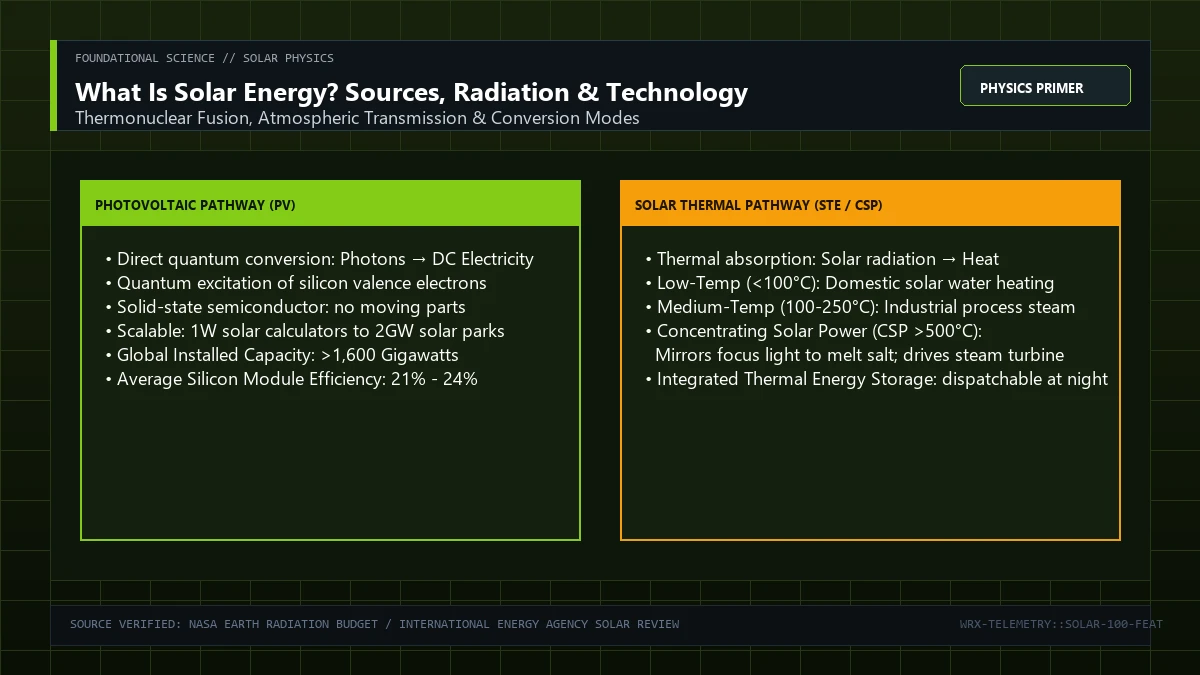
1. Solar Photovoltaic (PV) Technology: Photovoltaic technology converts photon energy directly into direct-current (DC) electricity at the atomic level via the photoelectric effect in solid-state semiconductors (principally crystalline silicon). When photons with energy greater than the semiconductor bandgap strike the silicon wafer, they excite electrons from the valence band to the conduction band. An internal electric field formed by a P-N junction directs these mobile electrons into external metallic contacts, producing an electrical current. Solar PV has no moving parts, requires zero water during operation, operates silently, and scales modularly from a 1-Watt solar wristwatch to 2,000+ Megawatt utility solar parks.
2. Solar Thermal Energy (STE) Technology: Solar thermal systems absorb solar radiation as thermal heat. They divide into three temperature classes: • Low-Temperature (<100°C): Flat-plate or evacuated tube collectors circulate water or glycol through dark absorber plates to provide domestic hot water and residential space heating. • Medium-Temperature (100°C to 250°C): Parabolic trough collectors focus sunlight onto linear absorber tubes to generate pressurized steam for industrial processes, food drying, and district heating. • High-Temperature Concentrating Solar Power (CSP, >500°C): Expansive fields of computer-controlled mirrors (heliostats) track the sun and reflect concentrated sunlight onto a central receiver atop a tall tower. The intense heat melts nitrate salts (heated to 565°C), which are stored in insulated tanks and pumped through a heat exchanger to boil water into high-pressure steam, driving a conventional steam turbine generator. A primary advantage of CSP is integrated thermal energy storage, allowing electricity generation to continue dispatching for 10 to 15 hours after sunset.
Global Applications: Beyond Rooftop Electricity
While residential and commercial rooftop solar receives significant public attention, solar energy powers a vast array of modern applications:
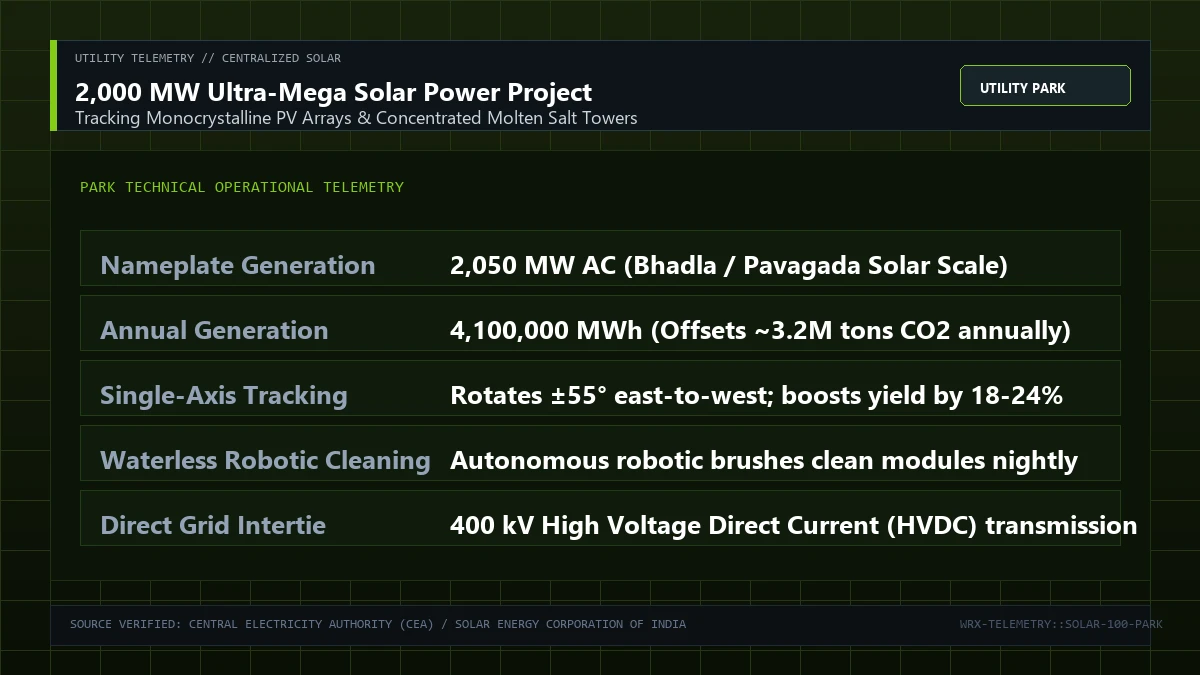
• Centralized Utility Grids: Multi-gigawatt solar parks—such as the Bhadla Solar Park in Rajasthan (2,245 MW) or Golmud Solar Park in Qinghai (2,800 MW)—feed clean power into regional transmission supergrids at levelized costs below $0.03 to $0.04 per kilowatt-hour, outcompeting new coal and gas power plants. • Agriculture and Rural Water Security: Agrivoltaics co-locates elevated solar panels above agricultural crops, providing partial shade that reduces soil moisture evaporation while generating clean power. Solar-powered agricultural water pumps have replaced millions of polluting diesel pumps across India and sub-Saharan Africa. • Industrial Decarbonization and Green Hydrogen: High-temperature solar thermal energy provides process heat for chemical and cement manufacturing, while utility-scale solar PV powers PEM and alkaline water electrolysers to produce green hydrogen and green ammonia for zero-carbon fertilizers. • Water Desalination: In arid coastal nations, solar-powered reverse osmosis plants convert ocean seawater into clean drinking water without burning fossil fuel reserves.
Environmental Strengths and Inherent Physical Limitations
Evaluating solar energy objectively requires examining both its unique strengths and physical constraints:
Strengths: • Inexhaustible Resource: The Sun will deliver reliable radiation for an estimated 5 billion years. • Zero Operational Carbon Emissions: Generating electricity from solar PV emits zero greenhouse gases, toxic sulfur dioxide, nitrogen oxides, or mercury. • Ultra-Low Lifecycle Carbon: Lifecycle emissions average 40–50 g CO2e/kWh, 95% lower than coal and 90% lower than natural gas. • Extremely Rapid Construction: Utility solar parks can be planned, permitted, and constructed in 12 to 18 months, compared to 5 to 10 years for conventional thermal or nuclear plants.
Physical Limitations and Challenges: • Intermittency: Solar generation is diurnal (zero output at night) and weather-dependent (cloud cover reduces output by 60% to 80%), necessitating battery storage, grid interties, or flexible backup. • Low Spatial Energy Density: Sunlight is diffuse, requiring relatively large land or rooftop footprints (approximately 2 to 3 hectares per megawatt of capacity) compared to energy-dense nuclear or gas power plants. • Mineral Supply Chains: Crystalline silicon PV manufacturing requires high-purity polysilicon, silver (used in screen-printed contact fingers), copper, and aluminum, requiring robust circular recycling supply chains as early installations reach end-of-life.
Frequently Asked Questions
What is the simplest definition of solar energy?
Solar energy is light and heat radiated from the Sun that is captured and converted by human technology into electricity (using solar panels) or heat (using solar thermal collectors).
What is the difference between solar PV and solar thermal?
Solar photovoltaic (PV) systems use semiconductor cells to convert sunlight directly into electricity with zero moving parts. Solar thermal systems capture sunlight as heat, which is used for hot water, industrial processing, or to boil water into steam to spin a turbine.
Do solar panels work on cloudy or rainy days?
Yes. Solar panels do not require direct cloudless sunshine to operate; they absorb diffuse sunlight that penetrates through clouds. However, output on heavily overcast or rainy days drops to between 15% and 35% of peak rated capacity.
How long will solar energy be available on Earth?
The Sun is approximately halfway through its main-sequence lifespan and has enough hydrogen fuel in its core to continue thermonuclear fusion for roughly another 5 billion years, making solar energy truly inexhaustible on human timescales.