From Antalya to Addis Ababa: Five Critical Questions COP32 Must Answer in Ethiopia
Following the Antalya stalemate, COP32 in Ethiopia faces five existential tests: fossil fuels, public finance, adaptation, loss and damage, and accountability.
By WRXNEWS Climate Policy Unit | Published | Updated
Executive Summary & Direct Answer
The breakdown of political consensus at COP31 in Antalya has thrust extraordinary historical responsibility onto COP32, scheduled to convene in Addis Ababa, Ethiopia, in late 2027. Returning to African soil at a moment of acute economic turbulence and compounding climate disasters, the multilateral climate process cannot survive another stalemate. The summit's success will depend entirely on resolving five existential questions: enforcing fossil-fuel phase-out timelines in next-generation NDCs, delivering unconditional public grant finance, operationalizing adaptation metrics, capitalizing the [Loss and Damage Fund](/climate-loss-and-damage-finance-cop-funds/), and holding sovereign governments accountable through the Enhanced Transparency Framework.
The Heavy Baton Passes to Africa
When the gavel fell on the unresolved plenary floor in Antalya, Türkiye, in November 2026, the diplomatic failure did not terminate the international climate agenda. Instead, it magnified the stakes for the next host. In late 2027, the United Nations Climate Change Conference (COP32) will convene in Addis Ababa, Ethiopia—the diplomatic capital of Africa and the headquarters of the African Union.
The return of the COP to the African continent occurs at an inflection point. Across the Sahel, the Horn of Africa, and the Small Island Developing States, the consequences of a rapidly heating planet are no longer speculative future risks; they are daily humanitarian crises. Yet the multilateral negotiations designed to mitigate these impacts have stalled over geopolitical fractures, sovereign debt crises, and entrenched industrial interests.
Addis Ababa cannot afford to be another procedural summit characterized by creative ambiguity and non-binding side pledges. If the Paris Agreement's integrity is to be preserved, COP32 must directly confront the five unresolved structural questions left lingering in Antalya's Mediterranean wake.
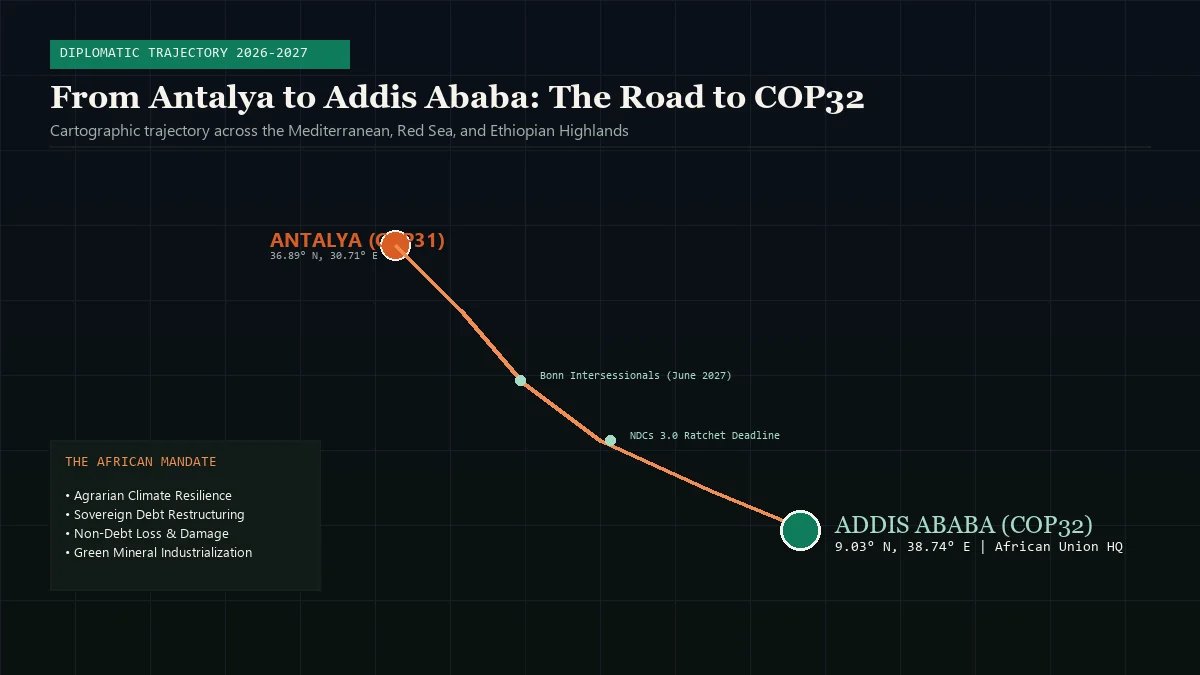
======================================================================================== THE ROAD FROM ANTALYA TO ADDIS ABABA ======================================================================================== [COP31 ANTALYA] [INTERIM DIPLOMACY] [COP32 ETHIOPIA] Cover Text Fails -> Bonn Intersessionals (June 2027) -> Fossil Fuel Timelines NCQG Grants Deadlock -> G20 & IMF/WB Spring Assemblies -> Public Finance Delivery Technical Rules Passed -> Submission of NDCs 3.0 (2027) -> Transparency & Loss Fund ========================================================================================
Question 1: How Will Sovereign NDCs Operationalize the Fossil Fuel Transition?
The central casualty of COP31 was the refusal of major hydrocarbon-producing states and energy-dependent economies to convert the high-level language of the UAE Consensus—transitioning away from fossil fuels in energy systems—into concrete, time-bound phase-down milestones.
COP32 will take place directly following the formal submission deadline for "NDCs 3.0"—the third generation of national climate pledges required under the Paris Agreement. These national plans must outline sovereign decarbonization commitments through 2035. The fundamental test for the Addis Ababa presidency will be whether national pledges reflect real-world energy transitions:
- Will major emitting economies include explicit, sector-specific phase-out targets for unabated coal power, or will they hide behind undefined carbon capture offsets?
- How will the summit address the geopolitical tension between mature developed economies, which have exhausted their historical carbon budget, and African nations seeking to utilize transitional gas resources to provide basic energy access to 600 million people who currently live without electricity?
The African Group of Negotiators (AGN) has repeatedly stated that transition cannot be decoupled from equity. If COP32 is to establish real fossil-fuel accountability, developed nations must demonstrate accelerated retirement of domestic hydrocarbon production while providing direct capital transfers to enable developing nations to leapfrog straight to renewable infrastructure.
Question 2: Can Public Climate Finance Escape the Trap of Commercial Debt?
Antalya demonstrated that without financial confidence, mitigation diplomacy collapses. The New Collective Quantified Goal (NCQG) remains an empty container until parties agree on the precise ratio between public grants and mobilized private capital.
At COP32, African leadership will place sovereign debt restructuring at the center of climate finance negotiations. Currently, developing economies spend more than double the amount of capital servicing foreign-denominated debt than they receive in bilateral and multilateral climate assistance. When climate finance is delivered as commercial loans, it deepens the insolvency cycle:
- The Public Grant Mandate: Developing nations in Addis Ababa will demand that at least $300 billion annually be guaranteed as non-debt-creating public grants, specifically earmarked for adaptation and catastrophic loss recovery.
- Reforming Multilateral Development Banks (MDBs): The summit will force a reckoning on whether institutions like the World Bank and regional development banks can expand concessional lending windows, provide currency-exchange risk guarantees, and pause debt repayments automatically when climate disasters strike.
- The Contributor Base Dispute: Western nations will continue pushing high-income emerging economies (including Gulf petrostates and upper-tier industrial nations) to formally contribute to the multilateral fund. Resolving this diplomatic standoff will determine whether the NCQG is capitalized or remains a hollow accounting exercise.
Question 3: How Will the Global Goal on Adaptation Be Financed and Measured?
While COP31 adopted fifty-seven technical indicators for the Global Goal on Adaptation (GGA), technical metrics do not protect crops from drought or coastlines from storm surges without capital. The United Nations Environment Programme's Adaptation Gap Report indicates that developing nations face an adaptation finance deficit exceeding $250 billion per year.
In Addis Ababa, the diplomatic challenge shifts from what to measure to how to deliver:
- Developing countries will demand a formal timeline to verify the doubling of adaptation finance promised at Glasgow, requiring developed nations to submit transparent, audited bilateral disbursements.
- The GGA indicators must be integrated into national adaptation plans (NAPs) without creating onerous bureaucratic hurdles that prevent vulnerable municipal governments from accessing funding.
- With Ethiopia being an agrarian nation deeply exposed to shifting rainfall patterns, the host country will push to make climate-resilient agriculture, water security, and rural electrification the premier themes of the adaptation track.
Question 4: Will the Loss and Damage Fund Reach Commercial Scale?
The formal operationalization of the Fund for responding to Loss and Damage was hailed as a breakthrough at COP27 and COP28, but its initial capitalization of less than $1 billion represents a fractional drop in an ocean of need. The economic costs of extreme weather events in developing nations routinely exceed $400 billion annually.
COP32 in Addis Ababa will be the ultimate test of whether the Loss and Damage Fund can mature from a symbolic fund into a robust, permanently replenished humanitarian financing vehicle:
- Replenishment Cycles: Developing states will insist on regular, predictable multi-year replenishment rounds, mirroring the International Development Association (IDA) model, rather than relying on sporadic, voluntary charity.
- Direct Access for Communities: The fund’s board must finalize fast-track disbursement modalities that deliver funds within forty-eight hours of a verified catastrophic climate disaster, bypassing central treasury delays.
- Innovative International Levies: Civil society and progressive negotiating blocs will revive proposals for international solidarity levies—including taxes on international maritime bunker fuel, aviation business-class tickets, and fossil fuel windfall profits—to provide independent, non-budgetary revenues for loss and damage.
Question 5: Can the Enhanced Transparency Framework Enforce Real Accountability?
COP32 will be the first UN climate conference where a complete cycle of Biennial Transparency Reports (BTRs) under the Enhanced Transparency Framework (ETF) is publicly available for examination. This transition marks the end of self-declared, unverifiable climate progress.
For the first time, independent technical expert review teams will analyze whether nations are actually cutting greenhouse gas emissions in line with their statutory pledges, or whether reported reductions are illusory products of creative carbon accounting.
- Exposing the Implementation Gap: Transparent emissions inventories will reveal which major economies are expanding oil and gas infrastructure in direct contradiction to their Paris targets.
- Building Global South Capacity: To maintain equity, developed nations must fulfill their obligations under Article 13 of the Paris Agreement by funding technical monitoring systems, remote sensing data networks, and national reporting agencies across Least Developed Countries.
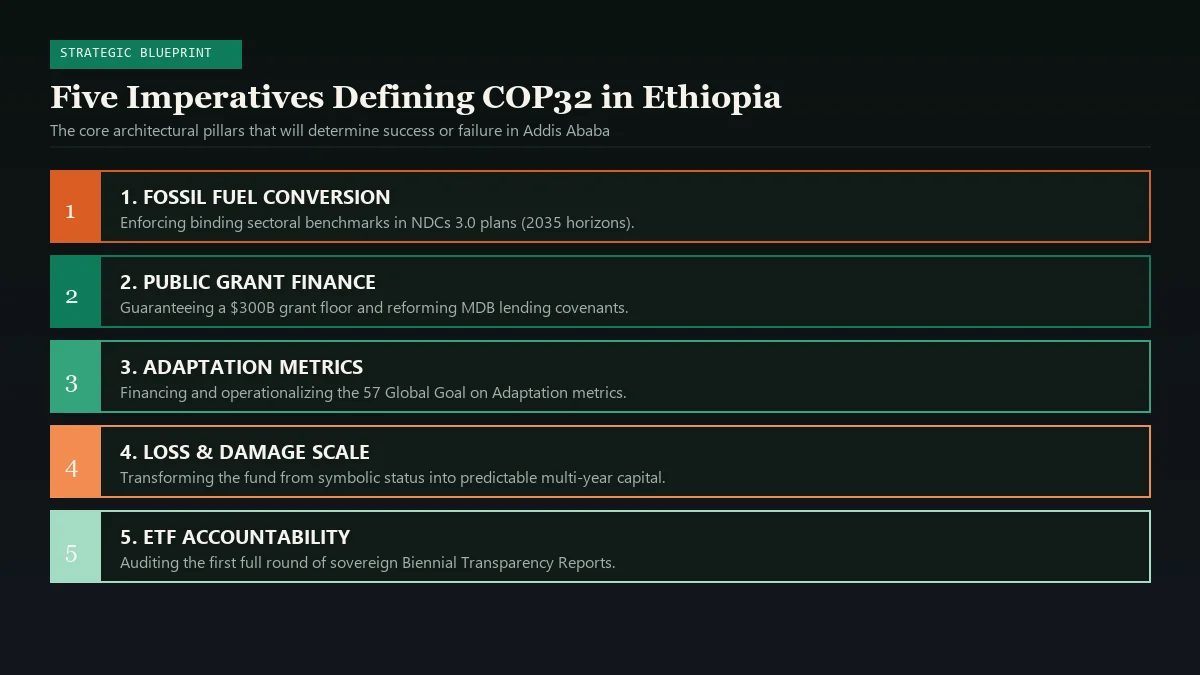
======================================================================================== THE FIVE PILLARS OF THE COP32 TEST ======================================================================================== [1. FOSSIL FUEL CONVERSION] -> Binding sectoral benchmarks in NDCs 3.0 (2035 plans) [2. PUBLIC GRANT FINANCE] -> Minimum $300B grant floor; debt-relief integration [3. ADAPTATION DELIVERY] -> Operationalizing 57 GGA metrics with dedicated capital [4. LOSS & DAMAGE SCALE] -> Predictable multi-year replenishment & rapid payouts [5. ETF ACCOUNTABILITY] -> Strict audit of first Biennial Transparency Reports ========================================================================================

The Imperative of Addis Ababa
The failure in Antalya stripped international climate diplomacy of its rhetorical cushions. When delegates reconvene in Addis Ababa, the luxury of deferred action will have expired. A planet repeatedly crossing dangerous thermal thresholds cannot wait for another cycle of procedural evasions.
For the African COP Presidency and the global climate community, the mission is absolute: transform the technical foundations codified in Antalya into an unshakeable, financed, and just program of global implementation.
---
Frequently Asked Questions
Why is COP32 being referred to as an "African COP"?
Under the UNFCCC system, the hosting of annual COP conferences rotates among the five recognized UN regional groups: Africa, Asia-Pacific, Eastern Europe, Latin America and the Caribbean, and Western Europe and Others. With Ethiopia serving as host in late 2027, the agenda will naturally emphasize African development priorities, including agricultural adaptation, sovereign debt relief, green mineral industrialization, and energy access.
What are "NDCs 3.0" and why are they so crucial to COP32?
Under the five-year ratchet mechanism of the Paris Agreement, every signatory must submit updated, progressively more ambitious Nationally Determined Contributions (NDCs) by 2025–2027. NDCs 3.0 will set emissions reduction targets for the period up to 2035. They represent the last realistic window for national policy targets to keep the 1.5°C temperature target technically viable.
How does the Enhanced Transparency Framework (ETF) change climate diplomacy?
Previously, developing and developed countries reported under separate, often fragmented reporting guidelines. Under the Paris Agreement's ETF, all nations must submit standardized Biennial Transparency Reports (BTRs) detailing national emissions inventories, progress toward NDC targets, and financial support provided or received. This enables independent peer review and closes transparency loopholes.
What is the relationship between sovereign debt and climate action in Africa?
Many developing and African nations currently pay more in debt service to foreign creditors than they spend on healthcare, education, and climate resilience combined. High credit risk ratings and crippling interest rates make it virtually impossible for these countries to borrow capital for clean energy infrastructure, creating a vicious cycle where climate vulnerability worsens sovereign creditworthiness.