What COP31 Actually Achieved: Disentangling Formal Decisions, Carbon Rules, and Technical Progress from Political Deadlock
Despite the lack of an overarching political pact, COP31 adopted key decisions on Article 6 carbon markets, adaptation metrics, and technology transfer.
By WRXNEWS Climate Policy Unit | Published | Updated
Executive Summary & Direct Answer
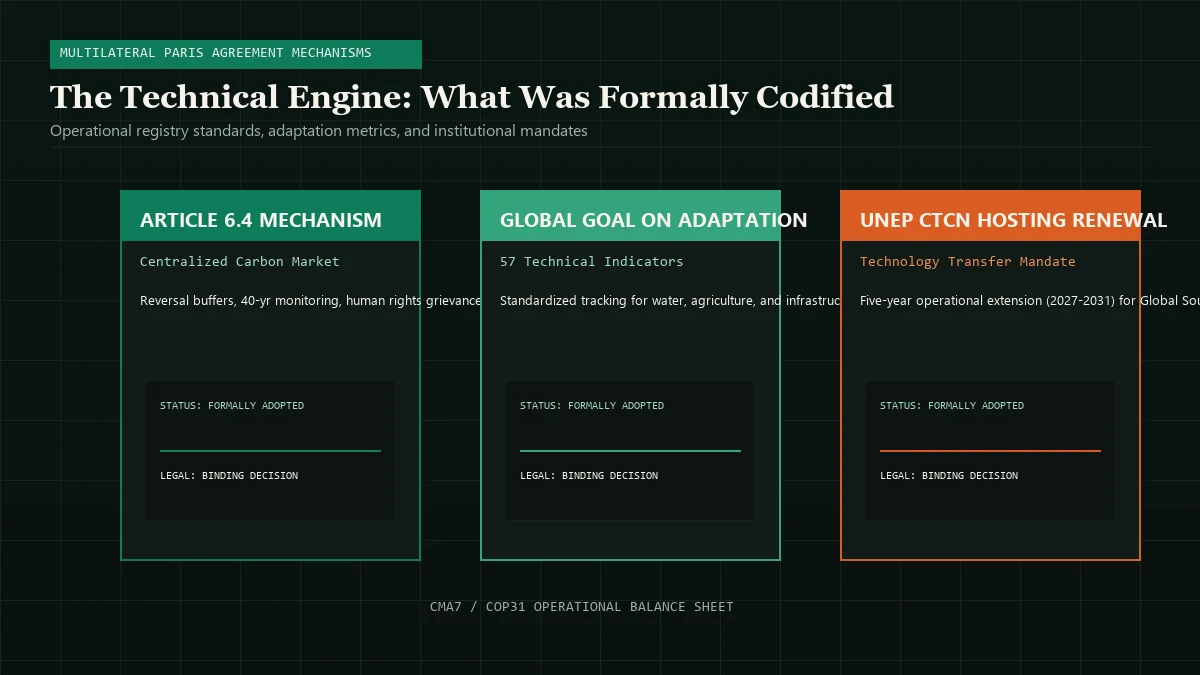
While the headline collapse of the Antalya political cover declaration dominated global media cycles, declaring COP31 an absolute failure misrepresents the mechanics of international climate governance. Operating beneath the ministerial stalemate, technical working groups in Türkiye adopted over forty substantive decisions. Negotiators finalized operational rules for Article 6.4 global carbon markets, agreed on the first cohort of technical indicators for the Global Goal on Adaptation, renewed UNEP’s hosting mandate for the Climate Technology Centre and Network, and advanced the Just Transition Work Programme. Here is the rigorous, category-by-category balance sheet of what was codified, what was launched, and what remains unresolved.
The Danger of a Binary Verdict
In the immediate aftermath of a contentious UN Climate Conference, public discourse almost inevitably collapses into binary hyperbole: either a summit saved the planet or it was an unmitigated catastrophe. The conclusion of COP31 in Antalya—ending without an agreed ministerial cover declaration—has fueled widespread claims that two weeks of diplomatic negotiation produced nothing of value.
Such an assessment reflects a fundamental misunderstanding of the UNFCCC treaty architecture. The absence of a high-level political declaration is an undeniable setback for global momentum and climate diplomacy. However, the international climate regime does not function exclusively through rhetorical ministerial communiqués. It functions through a vast, highly codified apparatus of technical decisions, work programmes, registry standards, and supervisory bodies established under the Paris Agreement.
When the final gavel descended in Antalya, delegates had formally adopted dozens of binding procedural, technical, and operational decisions across the COP, CMP, and CMA agendas. Disentangling these adopted mechanisms from non-binding announcements and unresolved disputes is essential for understanding where international climate policy actually stands heading into 2027.
``` ======================================================================================== COP31 OUTCOME ARCHITECTURE ======================================================================================== [1. FORMAL BINDING DECISIONS] -> Adopted under CMA7/COP31 (Article 6, GGA, CTCN, BTR) [2. WORK PROGRAMME OUTCOMES] -> Procedural progress (Just Transition, Mitigation) [3. NON-PARTY ACTION AGENDA] -> Voluntary pledges, private coalitions, sub-national [4. UNRESOLVED MATTERS] -> Deferred to Bonn/COP32 (Cover text, NCQG public floors) ======================================================================================== ```
1. Formal Decisions Adopted Under the Paris Agreement (CMA7)
The most consequential operational breakthroughs at COP31 occurred within the technical architecture of Article 6, the treaty mechanism governing international carbon trading and cooperations:
#### A. Finalization of the Article 6.4 Centralized Mechanism Delegates in Antalya formally endorsed the operational standards recommended by the Article 6.4 Supervisory Body. This landmark decision completes the transition from the legacy Kyoto Protocol Clean Development Mechanism (CDM) to a centralized, UN-supervised crediting mechanism:
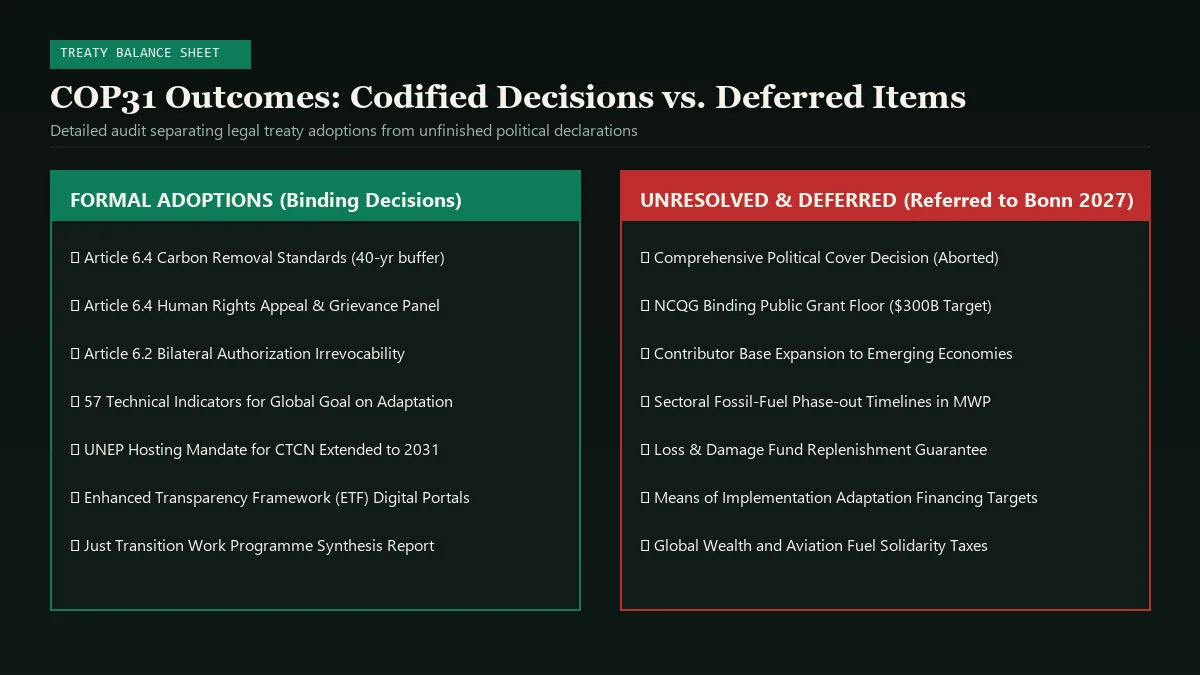
- Carbon Removal Standards: Parties established rigorous accounting methodologies for both nature-based removals (mangrove restoration, afforestation, soil carbon) and technological engineered removals (direct air capture and mineralization). The standards mandate reversal-risk buffers, insurance mechanisms, and minimum monitoring periods of forty years.
- Human Rights & Free, Prior, and Informed Consent (FPIC): For the first time, Article 6.4 projects must embed independent environmental and social grievance mechanisms that allow Indigenous Peoples and local communities to appeal project approvals directly to an independent panel.
- Interoperable International Registry: Negotiators finalized data exchange protocols connecting national carbon registries with the international Article 6.4 mechanism registry, closing loopholes that previously allowed double-counting of emissions reductions.
#### B. Article 6.2 Bilateral Authorization Consistency Under Article 6.2, which allows sovereign nations to trade Internationally Transferred Mitigation Outcomes (ITMOs), parties resolved long-standing ambiguities over "authorization revocation." The adopted decision establishes that once a host country issues a formal authorization for an ITMO to be used toward another nation’s NDC or for international aviation compliance (CORSIA), that authorization cannot be unilaterally revoked, providing long-sought certainty to commercial project developers.
#### C. The Global Goal on Adaptation (GGA) Indicator Suite Following intense technical deliberations under the UAE-Belém work programme, parties adopted an initial set of fifty-seven quantifiable indicators designed to track national and regional progress toward the UAE Framework for Global Climate Resilience. These metrics span water stress reduction, climate-resilient agricultural infrastructure, ecosystem health, and healthcare system adaptive capacity. While developing countries expressed frustration that financial means of implementation indicators were diluted, the adoption of baseline metrics provides the world with its first standardized rubric for measuring climate adaptation.
#### D. UNEP’s Technology Mechanism Mandate Renewal Parties unanimously passed a formal decision extending the United Nations Environment Programme's (UNEP) mandate as host of the Climate Technology Centre and Network (CTCN) for another five-year cycle (2027–2031). This ensures uninterrupted institutional continuity for technical assistance programmes across developing countries.
2. Work Programme Outcomes: Codifying Transition Pathways
Beyond standalone legal texts, COP31 processed significant interim deliverables across established UNFCCC bodies:
- The Just Transition Work Programme (JTWP): Delegates agreed to a joint implementation synthesis detailing social protection frameworks, workforce reskilling metrics, and community-led economic diversification strategies. The Antalya text formally integrates labor organization recommendations into the preparation of next-generation Nationally Determined Contributions (NDCs).
- The Sharm el-Sheikh Mitigation Work Programme (MWP): While LMDC and Arab Group negotiators blocked efforts to insert top-down sector targets into the MWP summary, the formal procedural conclusion was adopted, ensuring that technical dialogues on power-sector storage, grid modernization, and industrial electrification will continue through 2027 without interruption.
- Enhanced Transparency Framework (ETF) Readiness: Negotiators reviewed early submissions of Biennial Transparency Reports (BTRs). The secretariat confirmed that training programmes, digital reporting platforms, and technical expert reviews had achieved full operational deployment, marking the formal arrival of Paris Agreement accountability.
3. The Non-Party Action Agenda: Sub-National and Industrial Coalitions
In accordance with modern COP dynamics, a substantial volume of climate activity in Antalya took place outside the negotiating rooms under the Climate Champions' High-Level Action Agenda:
- Industrial Methane Abatement Coalition: Thirty-four national oil and gas entities signed an operational charter committing to continuous satellite-verified methane monitoring and third-party verification, aiming for near-zero upstream flaring by 2030.
- Global Port Electrification Initiative: A coalition of sixty-two maritime port authorities across Europe, Asia, and North America announced unified technical standards for shore-to-ship high-voltage electrical connections, designed to eliminate auxiliary diesel engine emissions at berth.
- Sub-National Resilient Cities Facility: Regional governors and mayors unveiled an initial $2.8 billion blended-finance facility dedicated to urban stormwater infrastructure, urban forestry, and heat-island mitigation across secondary cities in the Global South.
Crucial Distinction: While these announcements demonstrate real-world momentum, they are voluntary pledges rather than intergovernmental treaties. They lack binding dispute-settlement mechanisms and must not be conflated with formal CMA decisions.
4. What Remains Unresolved: The Deferred Ledger
To accurately evaluate COP31, one must place its real technical achievements alongside its glaring omissions:
| Policy Area | Status at Antalya Close | Next Formal Forum |
|---|---|---|
| **High-Level Cover Decision** | Aborted without consensus due to fossil fuel transition language | Deferred under Rule 16 to Bonn Intersessional (June 2027) |
| **NCQG Public Grant Target** | Deadlocked over $300B public floor vs private mobilized capital | High-Level Ministerial Dialogue; COP32 Addis Ababa |
| **Contributor Base Expansion** | No agreement on requiring high-income emerging nations to pay | Informal Consultations / Bonn Intersessional 2027 |
| **Fossil Fuel Phase-Out Timetable** | Blocked from inclusion in formal mitigation work programme texts | National NDC updates (due 2027) / COP32 Plenary |
| **Loss & Damage Capitalization** | Modest voluntary pledges; no permanent predictable replenishment mechanism | Fund Board Meeting (Q1 2027) / COP32 |

The Realistic Sum of Antalya
COP31 was neither a triumph of visionary political leadership nor a collapse of the international system. It was an exhibition of a divided world whose political leaders could not paper over deep economic fractures, but whose technical diplomats refused to let the operational apparatus grind to a halt.
By establishing robust carbon removal standards, codifying adaptation indicators, and ensuring institutional stability for technology transfer, COP31 delivered the technical plumbing necessary to implement climate policy. But plumbing cannot substitute for political will. The failure to adopt a cover text leaves the hard questions of power, cash, and carbon to be fought again on the road to Addis Ababa.
---
Frequently Asked Questions
What is the practical difference between Article 6.2 and Article 6.4?
Article 6.2 governs bilateral agreements where two sovereign governments directly negotiate the transfer of mitigation outcomes (ITMOs), using customized accounting frameworks subject to UNFCCC review. Article 6.4 is a centralized, multilateral crediting mechanism overseen by an independent UN Supervisory Body, open to both public and private entities, replacing the older Clean Development Mechanism (CDM).
Why are adaptation indicators so difficult to agree upon internationally?
Adaptation is intrinsically local, making universal metrics difficult to define. A flood barrier in Vietnam, a drought-resistant crop in Kenya, and heat-resilient housing in Spain require entirely different measurements. Furthermore, developing countries insist that adaptation metrics must measure whether developed nations have provided adequate financial resources, while donor countries prefer measuring only physical resilience outcomes.
Do Action Agenda voluntary pledges count toward Nationally Determined Contributions (NDCs)?
No. Non-party pledges made by corporations, cities, or coalitions do not automatically count toward a nation’s formal NDC commitments unless that national government formally incorporates those specific emissions reductions into its official sovereign inventory and reports them under the Enhanced Transparency Framework.
How does the Article 6.4 human rights grievance mechanism protect local communities?
Under the new Antalya guidelines, any individual or community that can demonstrate direct adverse environmental or social impacts resulting from an approved Article 6.4 carbon project has the legal right to submit an appeal to an independent grievance panel. If the panel finds violations of Free, Prior, and Informed Consent (FPIC) or environmental damage, project credits can be suspended or revoked.