COP31 Antalya Ends Without a Climate Pact: Inside the Breakdown Over Fossil Fuels and Finance
COP31 in Antalya concluded without a formal cover decision as talks deadlocked over fossil fuel timelines and climate finance. Inside the summit collapse.
By WRXNEWS Climate Policy Unit | Published | Updated
Executive Summary & Direct Answer
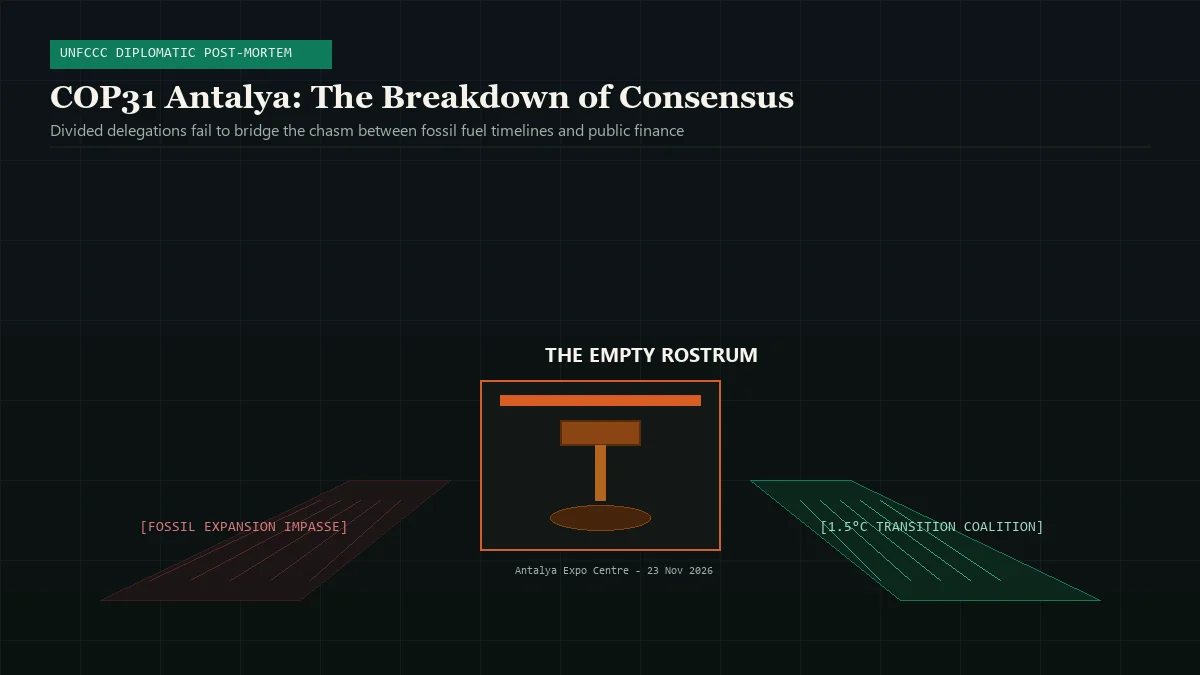
Following forty-eight hours of bitter overtime negotiations along the Mediterranean coast, the [UN Climate Change Conference (COP31/CMA7)](/cop31/) in Antalya concluded without adopting a unified political cover decision. Deep, irreconcilable fissures between vulnerable island nations demanding explicit fossil-fuel phase-out milestones and energy-exporting coalitions resisting binding transition timelines—coupled with deadlocked negotiations over public grant delivery under the New Collective Quantified Goal (NCQG)—prevented consensus. While dozens of technical decisions survived, the absence of an overarching political pact leaves global climate governance facing unprecedented friction heading into 2027.
The Final Gavel Falls in Silence
In the early hours of 23 November 2026, within the cavernous plenary hall of the Antalya Expo Centre, the Turkish COP31 Presidency brought the UN Climate Change Conference to an abrupt and sober close. Unlike previous summits marked by dramatic eleventh-hour compromises or fragile consensus declarations hammered out past dawn, COP31 concluded without the adoption of an overarching political cover decision.
For the first time since the contentious Madrid talks of COP25 in 2019, delegates dispersed into the Mediterranean drizzle without a shared ministerial declaration to define global ambition for the coming year. The failure to adopt both the draft COP31 decision and the CMA7 (Conference of the Parties serving as the meeting of the Parties to the Paris Agreement) overarching text represents a profound fracture in the multilateral climate regime. While technical work programmes across carbon markets, adaptation metrics, and technology transfer were formally passed, the political core of the summit collapsed under the weight of unresolved geopolitical tensions, energy realpolitik, and sovereign balance-sheet anxieties.
The Core Fault Lines: Fossil Fuels and 1.5°C Ambition
At the heart of the Antalya impasse was an escalating dispute over how to operationalize the commitment made two years earlier in Dubai: transitioning away from fossil fuels in energy systems in a just, orderly, and equitable manner.
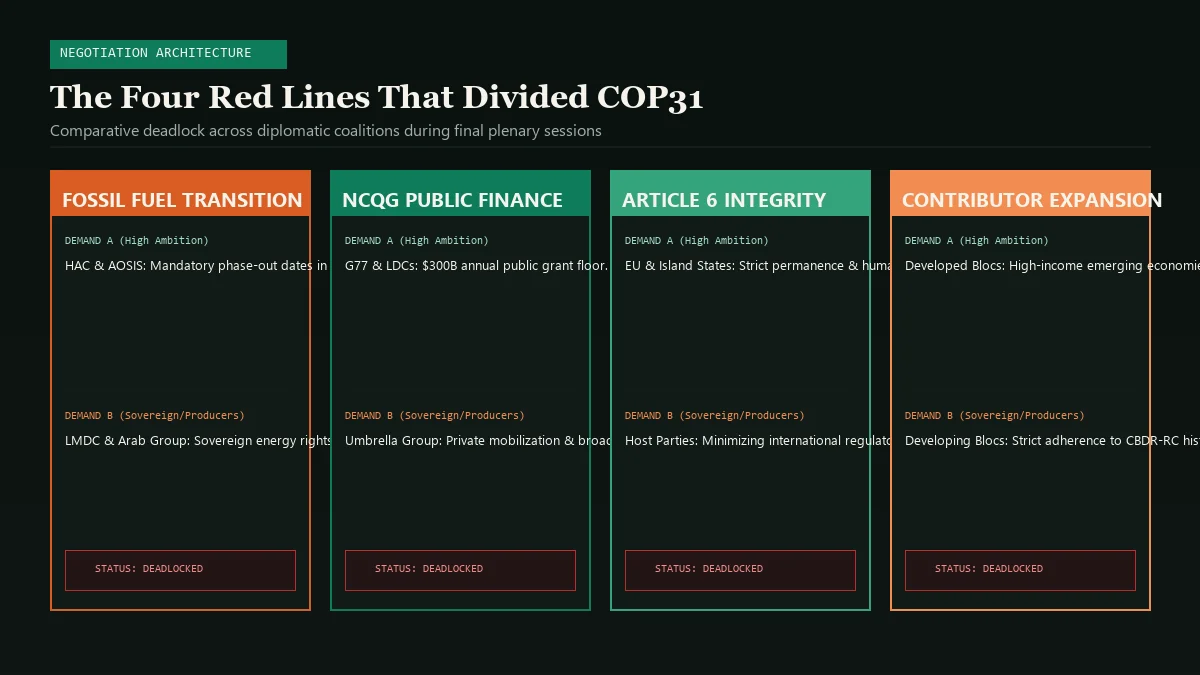
From the opening days of the summit, the High Ambition Coalition (HAC)—aligned closely with the [Alliance of Small Island States (AOSIS)](https://www.aosis.org/) and the European Union—insisted that the Antalya cover text must convert the qualitative pledge of the UAE Consensus into concrete, sector-specific timelines. Developing vulnerable states argued that with atmospheric concentrations of carbon dioxide reaching historic highs and global temperatures repeatedly breaching the 1.5°C threshold across multi-month spans, anything less than explicit interim benchmarks for halting unabated coal permitting and winding down hydrocarbon expansion would render the Paris Agreement obsolete.
"For our communities in the Pacific, language that merely acknowledges transition without binding accountability is not diplomacy—it is a surrender," declared Cedric Schuster, speaking on behalf of AOSIS during the frantic final night. "We did not travel to Antalya to sign off on a retreat from Dubai."
Conversely, the Like-Minded Developing Countries (LMDC) group, alongside powerful delegations within the Arab Group, firmly rejected what they termed "prescriptive mitigation mandates." Led by major energy producers and emerging industrial powers, this bloc contended that top-down phase-out targets directly infringed upon national sovereign development rights and violated the foundational principle of Common But Differentiated Responsibilities and Respective Capabilities (CBDR-RC). They argued that developed countries, having consumed the vast majority of the historical carbon budget, were attempting to impose structural economic constraints on the Global South without delivering the mandatory financial and technological enablers.
When the Presidency circulated its third draft text on Saturday afternoon, attempts to soften the language—replacing "accelerating transition pathways" with generic references to "national energy diversifications"—provoked a mutual veto. The HAC and AOSIS refused to endorse an empty formulation, while fossil-fuel-producing states refused any text that singled out oil and gas extraction. Faced with an unbridgeable chasm, the Presidency was forced to table the draft without a gavel.
The Finance Impasse: NCQG Implementation and Public Grants
While energy transition rhetoric captured the headlines, the summit's true structural anchor—and its ultimate undoing—was climate finance. Delegates in Antalya were tasked with operationalizing the New Collective Quantified Goal (NCQG) on Climate Finance, establishing the precise accounting, delivery mechanisms, and thematic sub-targets for global capital flows through 2035.
Negotiations ground to a halt over the critical distinction between public grant-equivalent finance and broader mobilized private capital. Negotiators representing the African Group of Negotiators (AGN), the Least Developed Countries (LDCs), and G77+China maintained that the NCQG must feature a legally binding floor of at least $300 billion annually in public, non-debt-creating grants dedicated specifically to adaptation and loss and damage. Developing countries cited soaring debt distress, pointing out that over 60 percent of existing climate flows arrive in the form of commercial loans, effectively forcing climate-vulnerable populations to pay interest on disasters they did not cause.
On the other side of the negotiating table, developed country contributors—including the United States, the European Union, Japan, and other members of the Umbrella Group—categorically refused to accept standalone public grant quotas. Confronted by domestic fiscal pressures, electoral shifts, and legislative spending constraints, donor nations pushed to broaden the contributor base to include high-income emerging economies and emphasized private capital mobilization, de-risking instruments, and multilateral development bank (MDB) leverage.
When compromise language attempted to blend grant targets into broad, undefined "multi-layered investment targets," developing country finance coordinators walked out of informal informals. Without agreement on how finance would be tracked, verified, and distributed, developing blocs withheld their assent on the mitigation work programme and the broader political declaration.
An Anatomy of Plenary Gridlock: Blocs and Red Lines
The collapse in Antalya exposed how multipolar and fragmented multilateral diplomacy has become:
- Alliance of Small Island States (AOSIS): Held the line on 1.5°C ecological integrity, demanding explicit milestones for fossil fuel phase-out and dedicated, easily accessible grant funding for loss and damage.
- Least Developed Countries (LDCs): Demanded debt-free adaptation finance and categorical safeguards against loan-dominated climate financing packages.
- High Ambition Coalition (HAC) & European Union: Pushed for robust Biennial Transparency Report (BTR) accountability, strict Article 6 integrity, and binding renewable capacity deployment schedules, but resisted unconditional public grant floors.
- Like-Minded Developing Countries (LMDC): Championed CBDR-RC, insisting that developed economies achieve net-negative emissions before forcing transition benchmarks on developing economies.
- The Arab Group: Consistently opposed language targeting specific fuel types or supply-side extraction limits, emphasizing carbon capture, utilization, and storage (CCUS) and circular carbon economy concepts.
- Umbrella Group: Resisted binding multilateral finance quotas and pressed for an expanded contributor base that would require emerging economies with high gross domestic products to contribute to the global fund.
What Survives: Disentangling Technical Delivery from Political Deadlock
It is vital to distinguish between the collapse of the political cover text and the operational machinery of the UNFCCC. The absence of an Antalya Pact does not mean COP31 produced nothing. Through rigorous technical committee work, parties adopted over forty discrete technical decisions:
- Article 6 Carbon Crediting: Parties finalized operational guidelines for the Article 6.4 Supervisory Body's centralized crediting mechanism, establishing registry interoperability standards and baseline methodologies for carbon removal activities.
- Global Goal on Adaptation (GGA): Delegates agreed upon an initial suite of technical indicators to measure progress under the UAE Framework for Global Climate Resilience, laying the groundwork for systematic adaptation assessments.
- Technology Mechanism Mandate:** The COP approved a renewed five-year hosting mandate for UNEP to continue operating the Climate Technology Centre and Network (CTCN), ensuring institutional continuity for technical assistance across the Global South.
However, the failure to bind these elements into a unified political declaration leaves them operating in a strategic vacuum. Without political consensus on finance scale and overall transition speed, individual work programmes face severe implementation bottlenecks.
The Diplomatic Road Ahead: Bonn to Addis Ababa
The breakdown in Antalya shifts extraordinary responsibility onto the UNFCCC subsidiary bodies and interim diplomatic engagements. With the cover text abandoned, the formal agenda items revert to the intersessional meetings scheduled for June 2027 at the World Conference Center in Bonn, Germany.
Diplomatic focus is already turning toward Africa, where Ethiopia will host [COP32 in Addis Ababa](/from-antalya-to-addis-ababa-five-questions-for-cop32/) in late 2027. African leaders have already signaled that COP32 must be an "Implementation and Justice Summit," centering agrarian adaptation, green industrialization, and global sovereign debt restructuring.
The collapse in Antalya proves that the era of vague diplomatic consensus is over. Global climate negotiations have arrived at an acute juncture where physical climate realities collide directly with national fiscal limits and global energy dependencies. As delegates pack their files and depart Türkiye, the lesson of COP31 is unmistakable: future summits cannot bridge policy chasms with diplomatic ambiguity. Real climate governance requires facing the economics of transition head-on.
---
Frequently Asked Questions
What is a COP "cover decision" and why does its failure matter?
A cover decision is the collective, consensus-driven political declaration adopted at the conclusion of a UN Climate Conference. It sets the overarching political tone, reaffirms collective commitments (such as maintaining the 1.5°C temperature threshold), and provides strategic guidance across mitigation, adaptation, and finance. While not legally binding in isolation, its failure signals severe diplomatic fracture and slows global momentum for coordinated policy action.
Does the lack of an Antalya cover pact cancel the Paris Agreement?
No. The Paris Agreement is a permanent, legally binding international treaty. Individual country Nationally Determined Contributions (NDCs), reporting mechanisms, and legal obligations remain fully active. The failure to adopt a cover decision at COP31 means that parties were unable to agree on new joint political language, but existing treaties and baseline decisions remain entirely valid.
What was the specific dispute over the New Collective Quantified Goal (NCQG)?
The central conflict centered on the quality and source of climate finance. Developing countries demanded a legally binding public grant floor (at least $300 billion annually) for adaptation and loss and damage to prevent deepening sovereign debt. Developed countries pushed for a broader contributor base (including wealthy emerging economies) and emphasized private investment leverage, guarantees, and loans rather than direct treasury grants.
What happens to the negotiation texts that were not agreed upon in Antalya?
Under UNFCCC Rule 16 of the draft rules of procedure, agenda items on which no consensus is reached are automatically deferred to the next formal negotiating session—the Bonn climate change intersessionals in June 2027, followed by the COP32 summit in Addis Ababa, Ethiopia.